Audi switches to 48V
Audi is to upgrade part of its vehicle electrical system from 12 to 48V. The move represents another technical building block for facilitating the integration of advanced systems without jeopardising corresponding increases in engine performance and efficiency.
“We are using the full bandwidth of electrification in our drive principles strategy,” said Ulrich Hackenberg, member of the board of management for technical development at Audi. “Running part of the vehicle electrical system at 48V plays a central role in this. It enables us to make more energy available. That paves the way for new technologies with which we can make our cars more sporty, more efficient and more convenient to use.”
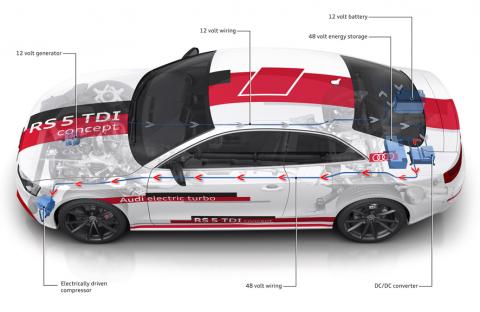
Audi recently showcased the scope of the 48V electrical system in the Audi A6 TDI concept and RS 5 TDI concept technology demonstrators. Both models are fitted with an electrically powered compressor. This operates independently of the engine load and therefore improves the accelerative performance. The 48V technology is also suitable for realising convenience systems for dynamic chassis control. Audi says it will shortly be unveiling applications in this field.
The current state of the art technology has taken 12V electrical systems to their very limits. Especially at low temperatures, all the various static-load consumers can account for the entire power generated by the alternator, which can deliver up to 3kW. The battery power is no longer capable of meeting the demands of new, dynamic-load consumers such as high-performance electric compressors.
The answer, says Audi, is a second subsidiary electrical system running at 48V, to complement the 12V power supply. The higher voltage means smaller cable cross-sections are needed; this translates into lighter cable harnesses with lower power dissipation.
The 48V electrical system has different storage technologies and delivers more power than the 12V system with lead batteries. That makes it an important element of the Audi strategy of electrifying various stages of the drivetrain. The group’s developers have already come up with a scalable platform concept, including a version that incorporates the electrically powered compressor.
In the current highest development version, a compact lithium-ion battery supplies 48V as the energy source during engine-off phases; a DC-DC converter integrates the 12V electrical system. The lithium-ion battery operates with an efficiency optimised alternator that qualifies the drivetrain as a mild hybrid. Within this concept there are diverse ways of starting, controlling and deactivating the combustion engine as needed.
The alternator achieves an energy recovery output of 10kW, far more than is possible at present. That adds up to a saving of up to 10g of CO2 per kilometre, equivalent to around 0.4-litre of fuel per 100km.
