Connectivity: The game is bond
Jan-Bart Picavet from Amada Miyachi Europe discusses why using anisotropic conductive film bonding for automotive applications suits advanced safety and driver assistance systems
Anisotropic conductive film (ACF) bonding has been used for years for creating electrical conductive adhesive bonds between flexible and rigid circuit boards, glass panel displays, and flex foils. The process essentially means heating and cooling an adhesive containing conductive particles under pressure.
ACF bonding is one of the best methods for bonding fine pitch connections, and is now being used for a growing number of new automotive safety and driver assistance systems. The advent of autonomous driving and increasing use of displays and cameras will only increase this trend, since it will require even more communications and sensor applications.
ACF connections require less space, and offer a cost effective and reliable alternative to other connection methods, including zero insertion force (ZIF) connectors, board-to-board (BTB) connectors or soldering.
Basics
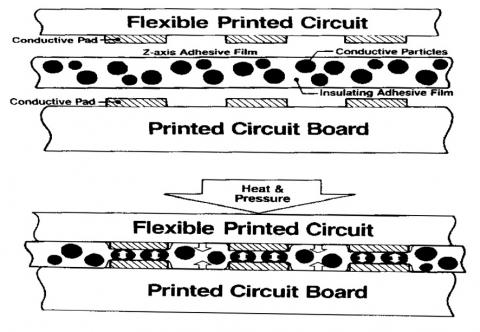
ACF bonding is the process of creating electrical conductive adhesive bonds, with anisotropic conductive adhesive or film, between flexible and rigid circuit boards, glass panel displays, and flex foils. This interconnection technique is mostly used for connecting to PCBs, as shown in the diagram.
The ACF material comes in reels and has three functions – electrical connection, insulation of the adjacent terminal and adhesion.
Anisotropic conductive adhesives contain small, spherical particles that, when compressed and heated, form an electrical connection between parts. The conductive material in the adhesive can be foil, flex or paste. The conductive particles are distributed homogeneously, maintaining consistent particle density and thickness.
Before bonding, the particles are separated by an isolating matrix of adhesive. The parts to be joined are first brought together with the adhesive in between and tacked, in a step called ACF laminating.
A heating element (thermode) then presses the top and bottom circuit board together with the adhesive in between, causing the adhesive to flow and trapping the conductive particles, resulting in an electrical connection. The particles that are trapped between the conductors form a conductive interface between the pads on the two mating surfaces and conduct only in the Z axis.
The joint is stabilised by subsequent cooling and full curing of the adhesive while still in the compressed condition. Because of the low filler content, there is no short-circuiting between adjoining tracks.
A scanning electron microscope image can show one hollow conductive particle squeezed between two conductive tracks. The actual particle size is about 5µm. Normally there are between 100 to 1000 particles involved in one connection.
The adhesive usually consists of a mixture of thermoplastic and thermohardening (also called thermoset or duroplast) glues, to get the best of both substances’ properties.
The conductive particles can be either massive conductive particles, massive plastic particles coated with conductive material, or hollow plastic particles coated with conductive material. They are most frequently made of graphite, gold or gold-plated plastic, each of which has specific advantages and disadvantages.
Graphite particles are sharp, which can be a benefit if one of the materials being connected has a thin isolating oxide layer. One disadvantage is that that the particles are not elastic, causing higher resistance. Graphite particles are also hygroscopic in that they absorb moisture from the air, which can influence the glue matrix and cause corrosion between the contacts.
Gold is not hygroscopic, and contact resistance is lower than graphite particles. However, gold can be more expensive than carbon.
Gold-plated plastic particles are compressible, so contact resistance is lower, because there can be more surface contact between the upper and lower track. The gold-plated particle also works as a spring: a small relaxation of stress in the glue is compensated by an extension of the particle, resulting in an extra safe connection.
ACF bonding is the most cost effective option for a growing list of automotive applications. ACF has been used for a long time for vehicle navigation systems, sensor input devices and car keys. Recently, the bonding method has been used in newer organic light-emitting diode (OLED) rear car lighting systems, as well as for advanced driver assistance systems, such as lane departure warning, frontal collision warning, intelligent parking assist and driver monitoring.
These systems typically use cameras with fine pitch connections, usually defined as those with centre-to-centre spacing between the leads of a component of between 50 and 500µm. Safe and durable connections are critical, since the cars may go into an emergency stop if there is a problem with a connection, an unacceptable outcome.
ACF bonding is a good option for these new systems compared with other available options, which include ZIF connectors, BTB connectors or soldering. The main reason for selecting ACF bonding is cost-down – the price of these other connectors is high compared with ACF.
In addition, ZIF or BTB connectors require a good deal of space and they must be positioned more to the centre of the board, whereas ACF uses less space and can be placed on the edge. Locating connectors on the outside of the board allows users to include more components in the centre of the board. The other option, soldering, is difficult to be done at the fine pitches required. There is also the risk of shorts if there are problems guaranteeing the amount of pre-tinning.
Smaller pitch
The general trend is towards finer pitches and more connections, as automotive dashboards use more and more complex displays. These systems feature high definition cameras requiring more connections in the same amount of space to process and display data.
Larger pitches are generally considered to be between 500 and 1000µm and fine pitches between 50 and 500µm.
With ACF, the problems limiting very fine pitches, in the 50-100µm range, do not occur from the glue or the equipment, but from thermal expansion. The newest ACF interconnects allow a fine pitch – a minimum of 150 to 200µm pitch for film on board (FOB).
ACF is by far the best option for making connections to glass and flexible displays. With the huge increase in general automotive communications and connectivity to the outside world, the technique is being called on for touchscreen displays and connecting antennas for near-field communications (NFC) applications.
Flux free
Not only is there an increase in vehicle communications systems, there is also an increasing number of sensors being placed inside cars for monitoring. When making a connection to a sensor, it is critical to avoid any contamination.
ACF is flux free, eliminating the contamination risk of flux used in soldering connections. In addition, no cleaning is required after the process, unlike soldering, which requires flux application, reflow and then part cleaning.
When using ACF for very fine pitches, first clean the parts, and then perform the ACF bonding steps; no further cleaning is required, which results in time and money savings.
Reliability
ACF bonding produces a very durable and reliable connection. For example, heat and humidity tests show that conductive resistance remains low and stable. Adhesive strength is typically 10N/cm right after bonding. ACF interconnections also withstand drop tests, while mechanical connectors have higher failure rates.
A shift is taking place towards the ACF bonding interconnection technique, supported by the market demand for higher input and output counts, further interconnection miniaturisation and weight, and the explosive increase of cameras, displays and antennas in automotive applications.
New developments in production equipment – for example, vision-supported automatic alignment, full automatic ACF laminating module and full process monitoring – have recently opened up the path for widespread usage of the ACF technique by significantly lowering interconnection costs.
For example, ACF bonding suitable for OLEDs was used by BMW on an OLED rear light for its M4 Coupé. Other similar projects are under development.
Jan-Bart Picavet is product engineer for hot bar technology at Amada Miyachi Europe
