Continental calls for legal framework for autonomous driving
Continental has called for a market-based adaptation of the legal framework for automated driving.
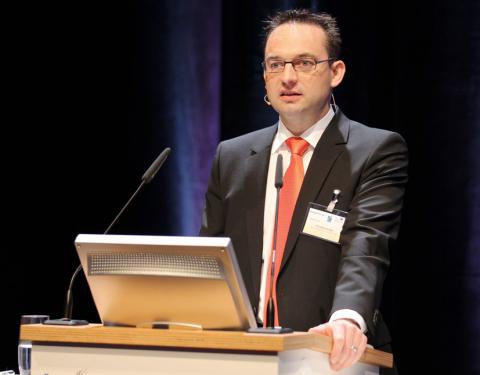
"The Continental Mobility Study 2013 has shown that motorists worldwide want automated driving on the freeway,” said head of research Christian Senger, during today’s (7 July 2014) Zulieferer Innovativ congress at BMW Welt in Munich.
He said that motorists’ needs matched up perfectly with the development possibilities in the upcoming years.
“However, the necessary adjustments to the traffic regulatory framework must not fail to take into account the connection with these market dynamics," he said. "Initial success in this regard was seen with the recent modification of the Vienna Convention, which established the legal foundations for partially automated driving. But we are still a long way away from highly automated driving from a traffic regulatory perspective."
According to Senger, legislators should address the basic policy decisions now so motorists will be able to make use of highly automated driving functions post 2020.
"Legislation should continue to play a role in the timing, paving the way towards fewer accidents, enhanced energy efficiency and greater driving comfort,” he said. “This would bring it in line with the needs of motorists worldwide."
Article eight of the Vienna Convention on road traffic specifies that the driver must maintain permanent control of the vehicle. This limitation was amended, however, in March 2014 in response to the increasing automation of vehicle systems. Automated systems are now permitted as long as they can be overridden or deactivated by the driver. This has established the legal foundation for partially automated driving since control of the vehicle may now essentially be assumed by systems as well.
A critical hurdle along the path to highly automated driving is laid down in a UN/ECE regulation (UN-R 79: "Uniform Provisions Concerning the Approval of Vehicles with regard to Steering Equipment"). According to this regulation, automated steering is currently only permitted up to a speed of 10km/h. So to make highly automated driving functions such as traffic jam assist or emergency steer assist a reality, this speed limitation needs to be lifted.
The Vienna Convention came about as a result of the 1968 UN Conference in Vienna. It aims to facilitate international road traffic and increase road safety. The basis for this is formed by the acceptance of uniform traffic regulations and their incorporation into national road traffic laws. The convention therefore functions as superordinate legislation for nation states.
Not all countries have ratified the 1968 Vienna Convention. In addition to Germany and most EU member states, the other principal signatories include Russia, Brazil, South Africa, Switzerland and Turkey. By contrast, countries that have not yet ratified the convention include the UK, Spain, the USA, Canada, Mexico, China, Japan, Korea, India, Australia and Singapore.
