Continental digitalises production process
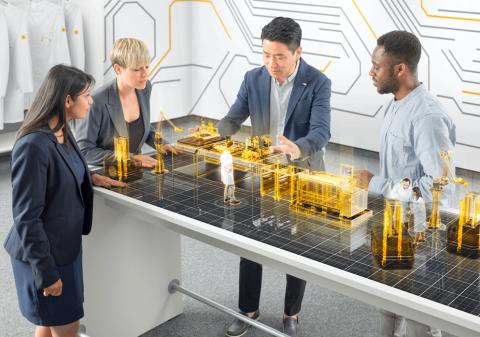
Continental is digitalising its entire production process for automotive components, and has formed a partner consortium with eight IT and process optimisation companies, universities and specialist start-ups.
Continental’s user experience business area is responsible for project management. The three-year project is called Diazi, and is funded by the German government.
The aim of the Diazi project is to transfer production plants into the digital world. In the future, new production lines will be planned, simulated and operated digitally, increasing the efficiency, flexibility and cost-effectiveness of modern automotive plants and allowing them to keep pace with faster development cycles, complex supply chains and changing customer requirements.
The results of the Diazi project should make the industrialisation of the automotive industry more effective, and thus contribute to sustainable mobility as a whole.
“Diazi is a major step towards the digitalisation of the automotive industry,” said Thomas Ebenhöch, head of operations for Continental’s user experience business. “As the lead company in the Diazi project, Continental is driving a new approach to effective and sustainable production processes in the automotive and supplier industries. We’re already a leader in the development of digital components such as intelligent displays. Now, through digital simulation, artificial intelligence and data management in the cloud, we’re bringing innovations to market faster, more efficiently, more sustainably and more cost-effectively across the manufacturing industry. Early results show we’re on the right track. Our vision of the digital factory is clearly taking shape.”
The infrastructure of the German automotive and supplier industries should benefit from a digital update. In view of the increasing competition in key technologies, a holistic, digitally driven approach to optimising industrialisation processes is increasingly important. This is to adapt to increasing customer requirements and faster development cycles.
The Diazi project promotes the digital factory: a fully digitalised production environment in which new production lines are digitally planned and production processes are simulated. In this way, new production plants can first be started up virtually before commissioning.
Driven by artificial intelligence, this step makes it possible to optimise processes continuously, make accurate productivity predictions and reduce downtime thanks to in-depth data analysis of all machines. Various production plants of a company, as well as production sites of suppliers, can thus be connected to ensure fast, scalable and high-quality production.
The project, which is funded by the German government and financed by the European Reconstruction & Resilience Facility, started this year and is designed to run for around three years.
“The dynamic transformation of the automotive sector into a highly digitalised industry offers enormous potential,” said Ernst Stöckl-Pukall, head of digitalisation at the German Federal Ministry for Economic Affairs & Climate Action. “Cooperation across company boundaries, as practiced in the Diazi project, represent a key component for the entire industry. The findings and demonstrators from the project have the potential to be adapted to numerous companies and production lines and serve as an impulse generator for fully digitalised and AI-supported production processes.”
The first phase of the project, which has now been completed, aimed to define specific demonstration models within various fields of digitalisation to include the entire virtual line planning and commissioning process, from data-based process optimisation to application operation.
Experts from Landshut University of Applied Sciences, Technical University of Braunschweig, software start-up IFox Systems, IT management company Suse, intralogistics expert Naise, process and production optimiser Dualis, and Plus10, a provider of analysis software for automated production plants, were involved in the process.
The first successes of the Diazi project show potential. For example, the consortium partners in the data-based process optimisation work package were able to display the complete data stream from several production lines in a newly created cloud environment and prepare it for effective data analysis.
These data helped the Diazi team in the virtual line planning and commissioning work package simulate production lines and optimise existing production processes.
Continental’s customers are already benefiting from this, for example in the accelerated production of new displays.
