Displays: Colour guide
Theju Bernard from Intersil discusses colour brightness matching in automobile LCD panels
Today, more and more vehicle models include displays in the instrument cluster, centre console, rear-view mirror, and in the rear seats to keep the kids entertained. Manufacturers go to great lengths to create styling and branding for each model and the styling extends from the exterior vehicle body to the interior passenger cabin.
Increasingly, it is important that each display has the desired look and matches the other adjacent or nearby displays.
And as displays become critical in relaying important safety information to the driver, such as the backup camera image, ensuring the displays are highly reliable and present this information accurately is a must.
The need for gamma correction originated with the invention of CRT TV displays. The CRT uses an electron beam raster to illuminate the phosphor coating behind the display front panel. The applied grid control voltage proportionately controls the luminous intensity and it follows the power law:
- Luminous intensity = Control voltage to the power gamma
This is inherently non-linear. The nominal gamma for the CRT is about 2.5. The human eye on the other hand has an inverse response and is relatively sensitive to changes in the darker portion of the greyscale. Therefore, to make the final image display the greyscale true-depth variation to the human eye, gamma correction must be implemented on the red, green and blue signals prior to transmission. This is done at the system where the video originates, such as a TV broadcast camera.
Gamma correction, also known as gamma calibration, can ensure consistent brightness and colour matching of TFT-LCD panels used in automobiles.
Cameras are designed to output a voltage that is proportional to luminous intensity raised to power 1/2.5 or luminous intensity raised to power 0.4. Since a gamma slightly greater than 1.0 is preferred, the broadcast standard typically uses a gamma of 0.5, which leads to a system gamma of 1.25. The camera’s built-in gamma response is the inverse of the CRT response and therefore no additional system gamma correction is required. However, the TFT-LCD’s signal must be adjusted to compensate for the camera’s gamma adjustment, which was originally set for the CRT display.
Gamma calibrating
TFT-LCD panels are increasingly used in an automobile’s instrument cluster, infotainment and navigation head unit, and advanced driver assistance system (adas) smart mirrors. They do not have an electron gun and phosphors to generate luminous intensity, but instead apply a voltage to a liquid crystal pixel, which controls the transmittance of “backlight” through the pixel. A cold cathode fluorescent lamp or LED array is used to provide the backlight. The voltage applied to a liquid crystal pixel controls the amount of backlight allowed to pass to the front to recreate the transmitted image and this defines the transmission curve for the TFT-LCD.
The gamma of the TFT-LCD differs from the CRT; however, it does have a slight gamma response. Legacy broadcast systems have gamma correction built into the transmission to compensate for CRT gamma response, and this combines with the inverse response as perceived by the human eye. Therefore, gamma correction must be done to the signal before applying it to the TFT-LCD pixels.
It is necessary that TFT-LCD gamma correction follows that of a CRT display. The incoming video signals are digital and the gamma correction code is applied to the digital-to-analogue converter (DAC), which generates the voltage that is then applied to the pixels.
These gamma correction codes help panel display manufacturers determine applicable codes that enable the required visual performance. Often the system can store multiple gamma correction settings for varying ambient light conditions.
Digital video data, typically low-voltage differential signalling (LVDS), must be converted using a DAC to generate an analogue voltage for the pixel. Gamma is corrected – intentionally made non-linear – by the use of piecewise non-linear DACs in the panel’s source and column drivers. The source driver DACs determine how many different voltage steps can be applied to the pixels. For example, an 8bit DAC yields 28 or 256 steps of possible greyscale. The perception of changes in greyscale intensity caused by each voltage step is relative to the panel’s gamma response – voltage-transmission or V-T curve – and the response of the eye.
The non-linear nature of gamma correction results in compressed image data that reside at the low luminance level, with little or no compression at the high luminance level. The low-level compression makes the image data in the dark to not so dark region stand out and be more discerning to the human eye. This improves the image depth.
And as an added bonus, the compression and non-linearity results in a lower number of bits used for luminance coding, for example 8bit for non-linear versus 12 or 14bit if it were linear. The compression also helps reduce video signal noise, if any exists.
Programmable gamma buffer
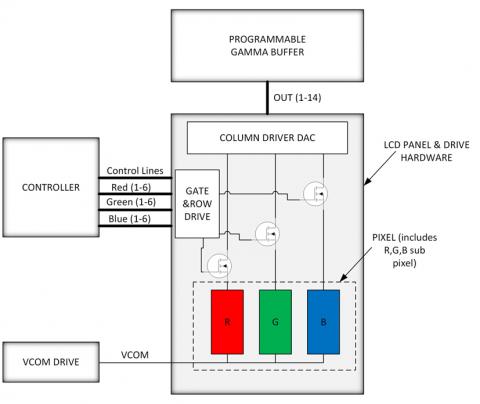
To change the LCD panel’s gamma response to a desired V-T transfer function, the panel’s source (column) driver DACs may use various reference voltages applied at multiple tap points. These voltages force each DAC to have a certain desired non-linear operation. The reference voltages are often supplied by gamma buffer ICs, which are generally buffer amplifiers that drive the analogue voltages to the DAC taps. The gamma buffer ICs can be static or programmable.
The diagram shows a simplified system block diagram of a TFT-LCD panel.
With the capability to control the DAC taps, automotive LCD panel makers can fine-tune the voltages to adjust or calibrate further the panel’s non-linear gamma response, also called gamma calibration. It allows an automotive LCD panel maker to ensure that all of their LCD panels of a certain model exhibit the same gamma response from panel to panel.
This means any potential visual performance variations, caused by things such as variances in LCD fabrication and manufacturing, are reduced and thus the automotive LCD panel maker has a more consistent and visually appealing product. Consumers can be assured that the vehicle they purchase will include displays that visually perform like the ones they saw during their test drive at the dealership.
Panel makers ultimately decide how they want to calibrate the gamma response – for example Ɣ = 2.2, 2.0, 1.8, or a combination of gammas based on the intended brightness – so their display has a certain look. It’s noteworthy that gamma characteristics tend to shift with wide viewing angles and different ambient lighting conditions. When shopping for a car at the dealership, it would be a good idea to compare the display under bright light and low light conditions to determine whether the image presented is visually appealing.
Display settings
Automotive LCD panels have black-to-white endpoint levels that are fixed by the capability of the source driver. However, digital adjustments can be made to the signal during video data processing. Brightness can also vary by simply adjusting the LCD panel’s backlight intensity, which adds another dimension to system performance. Often the display controls can be adjusted for brightness and contrast, and for day and night settings.
The programmable gamma buffer simplifies the task of evaluating and setting the display transfer function by moving it into the manufacturing cycle of the auto display maker. These gamma settings are programmed into the eeprom and are transferred to the DAC on power up.
Some have multiple banks to hold more than one display profile for various ambient light conditions, and a custom setting that could be user programmable with the facility to save and store it.
The manufacturer set gamma profile is generally adequate for most automotive applications. This programming is done during the initial setup, after which the profile is never changed, unless fine-tuning is required to improve the display’s visual performance.
Conclusion
Automotive LCD panel manufacturers strive to make their display panels visually desirable to car makers and consumers. Doing so requires a stable gamma buffer reference that ensures the video colour images displayed on their LCD panels are matched with the exact same contrast, brightness and colour across all displays. This can be accomplished by using a high accuracy programmable gamma buffer.
Theju Bernard is a principal applications engineer at Intersil
