Driver assistance: Project zero
Volvo hopes its proving ground in Sweden will help achieve its vision of zero road deaths
Just outside of Gothenburg in Sweden is a two million square meter area on which Volvo is pinning its hopes of reaching the vision that by 2020 no one should be killed or seriously injured in a new Volvo car. This is Astazero, the world’s first full-scale proving ground for future traffic safety systems.
An important measure towards achieving this goal will be the development of active safety systems, which will help prevent accidents. These active safety systems will be the primary focus at Astazero, located close to the Volvo Cars headquarters in western Sweden.
One of the facility’s greatest assets is its flexibility, with a design that permits the construction of unique, customised environments.
“You can simulate all types of real-world traffic scenarios,” said Pether Wallin, CEO of Astazero. “At most proving grounds, the options are more limited.”
The centre can accommodate a wide range of test conditions, such as those found on busy city roads, highways, multi-lane motorways and crossroads. These conditions are crucial for studying the way cars interact with moving obstacles such as other cars, pedestrians, cycles, mopeds, motorcycles, lorries, buses and even animals that suddenly appear. In certain studies, such as those involving complex traffic situations and high speeds, robots will operate the test vehicles.
“Safety testing under realistic circumstances is a pre-requisite for developing our active safety systems,” said Anders Axelson from Volvo Cars’ safety centre. “The facility will play several important roles: not only will it help us meet our safety vision, developing cars that don’t crash, it will also help us further develop safety functions that will address non-motorists, such as pedestrians and cyclists.”
Research and development
One of Astazero’s main functions will be as a platform for the research and development of next-generation safety technologies. Here, in collaboration with universities and industry partners, Volvo will undertake a range of initiatives, from strategic vehicle research and innovation projects to targeted research projects.
The work will also include the development and testing of autonomous driving technology, an intelligent driver support system designed to reduce accidents while improving the driving experience. Advanced systems are also under progress to help prevent, for example, inattentiveness and driver fatigue.
Although meeting its target date of 2020 may be an ambitious goal, Volvo has every reason to be optimistic. Indeed, as its innovative safety methods have already shown, the future may not be that far off.
“The Swedish automotive industry is at the leading edge of active safety,” said a confident Axelson. “Thanks to Astazero, we have great prospects for keeping our leading position. We’re the only car manufacturing company in the world to have set a goal of zero traffic fatalities for a specific date, and we’re the only country in the world whose government supports a zero traffic fatalities vision.”
Proving ground
The SEK500m proving ground will serve as an open, international platform for all interested stakeholders such as vehicle manufacturers, suppliers, legislators, road agents, universities and technical institutes from around the world. Industry partners consist of Volvo, Scania, Autoliv and Test Site Sweden. The name Asta (active safety test area) relates to the facility’s connection to a vision of zero traffic fatalities.
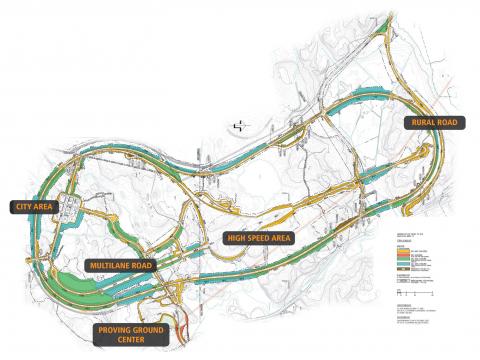
The total surface area amounts to about two million square metres with a paved surface of 250,000 square metres. The facility is encircled by a 5.7km highway connected to a city environment with four blocks, 40 by 25m. There is also a high-speed area consisting of a circle, 240m in diameter, with drop add-ons joined to a 700m long multilane road.
The rural road contains ten different points, both open and concealed, where objects will appear in front of the vehicles. The area is specially designed for different tests of driver behaviour and is well suited for the use of hidden or suddenly appearing obstacles. At the road, there will be two T-junctions and a crossroads with signage in the specified language and changeable to suit user requirements. The rural road will also have bus stops and lay-bys at two locations.
The city area will primarily be used to test the vehicle’s capacity to interact with the surrounding environment to avoid hitting buses, cyclists, pedestrians or other road users. The area therefore covers a number of different sub-areas, such as a town centre with varying street widths and lanes, bus stops, pavements, bike lanes, street lighting and building backdrops. The city area also has a road system with different kinds of test environments such as roundabouts, T-junction, return-loop and laboratory area.
The multilane road consists of four lanes. These are connected to the high-speed area, with an acceleration road that is approximately 300m long, 7m wide and with a turning loop for long vehicles. Several scenarios can be tested on the multilane road, such as lane changes, different collision scenarios and crossing scenarios.
Located in the centre of the facility, the high-speed area consists of two acceleration roads. Acceleration road one is about 1km long. It is also possible to use the multilane road for acceleration, which means vehicles can enter the high-speed area from three directions. In this area, focus will primarily be on vehicle dynamics such as avoidance manoeuvres at very high speeds.
Environment
Respect for the environment has permeated all work at the test site. Careful planning has made it possible to keep a mass balance in the area, meaning no external material apart from asphalt were brought in for the construction.
When construction began, Astazero took compensatory measures for the four protected animals residing in the area; moor frog, red-throated diver, ortolan bunting and whopper swan. For example, the company built a rampart, several transportation tunnels and two new ponds where the moor frogs’ need for spawning and feeding sites are met.
The company also realised the importance of carrying out the various construction stages in a way that did not interfere with the biological cycle. All work that could disturb the water in the Nolån river was completed in August 2012, so as not to endanger the reproduction of the freshwater pearl mussels and trout, which live here in symbiosis.
Environmental aspects also play a part in current activities, not least since the development of advanced safety systems is related to significant environmental benefits, and vice versa.
An increased awareness of environmental issues and the need to reduce the use of finite resources has put pressure on governments and industries to act, such as by reducing traffic emissions. Due to technical reasons, for example battery technology, future climate-smart vehicles will weigh significantly less than today’s cars. This size reduction makes the development of new and technically advanced safety systems especially important, since the lighter vehicles will be running on the same roads as large trucks and buses.
Parallel to the development of more energy-efficient transport, on-going initiatives can change the entire road network as well as current traffic systems, such as the development of electrified roads and environmental road trains. One current example of this is Sartre, (safe road trains for the environment) a project funded by the European Commission that aims to develop strategies and technologies to allow vehicle platoons to operate on normal public highways.
Since Astazero’s test site was built to provide unique environments with a focus on research, development and certification of road safety systems, the environmental aspect is embedded in the nature of the company´s business.
Conclusion
Astazero is the world’s first full-scale test environment for future road safety. What is unique about the facility is that the different traffic environments make it possible to test advanced safety systems and their functions for all kinds of traffic and traffic situations. This enables research, development and certification of future road safety systems, and functions as an international arena open for vehicle manufacturers, suppliers, legislators, universities and colleges from throughout the world.
