Driver Assistance: Stopping accidents
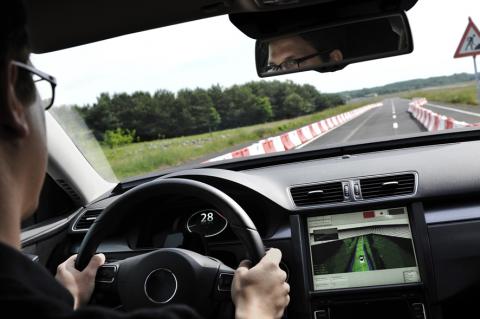
The latest Proreta driver assistance project published its findings last month
In 2011, the third interdisciplinary research project between Continental and the Technische Universität (TU) Darmstadt – one of Germany’s leading technical universities – was started to look at ways vehicle accidents could be avoided. Called Proreta 3, it lasted for three and half years and explored a comprehensive driver assistance and automated manoeuvre concept.
The first Proreta project (2002 to 2006) focussed on an assistance concept for emergency braking and avoiding obstacles such as stationary vehicles or vehicles driving ahead. The second project (2006 to 2009) introduced a passing assistant that can prevent accidents with oncoming traffic. The TU Darmstadt (formerly Technische Hochschule) and Continental have been cooperating on research projects since the 1980s. TU Darmstadt’s involvement in the latest project included automotive engineering, ergonomics, control methods and robotics as well as control engineering and mechatronics.
The third project aimed to evolve a system that kept the vehicle in a safe driving corridor; cooperative automation makes automated driving manoeuvres possible. An innovative human machine interface (HMI) allowed intuitive understanding of the system state and the distribution of tasks between driver and vehicle.
“So far, assistance systems such as lane keeping assist or forward collision warning have been working as independent, individual systems in vehicles,” said Hermann Winner, chair of the Institute of Automotive Engineering at TU Darmstadt and the Proreta 3 project manager. “In Proreta 3, we have integrated the driver assistance systems in such a way that the functions have been enhanced and functioning synergies have been achieved.”
Peter Rieth, head of systems and technology in Continental’s chassis and safety division, added: “Integration allows optimum exploitation of the existing sensor infrastructure in the vehicle. The driver in the research vehicle is supported by a complete system for driving safety and assistance – with the ultimate objective of avoiding accidents.”
The chassis and safety division develops and produces electronic and hydraulic brake and chassis control systems, sensors, driver assistance systems, air bag electronics and sensors, washer systems, and electronic air suspension systems.
In addition, research was carried out on an information and warning concept that takes the pressure off drivers and helps them cope with the driving situation. The research results and the research vehicle were presented in September at the Euler Airfield in Griesheim near Darmstadt in Germany.
Corridor
While driving, the vehicle is kept permanently in a safe driving corridor in conformity with traffic regulations – the so-called safety corridor. This happens, as long as possible, without any intervention. If critical situations arise, the system intervenes with warnings or even corrective manoeuvres if necessary – for example, when cornering at excessive speeds, when obstacles suddenly appear, at intersections and construction sites, as well as during turning manoeuvres, wrong-way driving or non-compliance with a red light.
For this safety corridor, the Proreta 3 concept determines the free space available for the vehicle. The model takes into account the predicted positions of other vehicles, road boundaries and obstacles as well as road lane markings. These are all used to calculate the vehicle’s trajectory. The regulation of this trajectory and the information displayed to the driver in the HMI constitute a consistent driver assistance concept that helps the driver and protects against potential hazards.
Manoeuvres
In addition to the permanent safety function, Proreta 3 provides the driver a cooperative automation option, which is a manoeuvre-based and partly automated way of driving. On driver command, the research vehicle takes over longitudinal and lateral movement for whole manoeuvres. These include both lane changes and turning manoeuvres at intersections. To delegate turning, for example, it suffices if the driver activates the turn signal at a certain distance before an intersection – this initiates automated execution of the manoeuvre.
“Proreta 3 is the first time such a concept of automation on a manoeuvring level has been able to be implemented in a research vehicle,” said Winner.
Interface
Research was done on an innovative information and warning concept for the research vehicle: the Proreta instrument cluster, a 360˚ light strip with coordinated audible warning signals as well as the accelerator force feedback pedal (AFFP) inform the driver in an intuitive way about the current assistance mode and relevant hazard situations. A camera inside the vehicle continually analyses the driver’s viewing behaviour.
Depending on the viewing direction, a light draws the driver’s attention specifically to critical traffic situations.
“The transparent way that these innovative instruments work allows drivers to familiarise themselves quickly and easily with the new function,” said Ralf Lenniger, head of interior electronics at Continental’s interior division.
TU Darmstadt
TU Darmstadt has around 300 professors, 4250 scientific and administrative employees, and 25,100 students who devote their talents and efforts to the future research fields such as energy, mobility, communications and information technologies, housing and living conditions. Most disciplines represented are focussed on technology, as viewed from the vantage point of engineering, the natural sciences, the humanities and the social sciences, and cover the full range of academic endeavour, from the origination of basic concepts to practical, everyday applications.
It is Germany’s first autonomous university and had a state- funded budget of €271m in 2013, including building funds. Its capacity for innovation is evidenced by the high level of annual funding received from outside sources. The €160.3m in 2013 contributed by industry, the Deutsche Forschungsgemeinschaft and the European Union makes it one of Germany’s leading academic recipients of outside funding.
