Head-up display developed for smaller vehicles
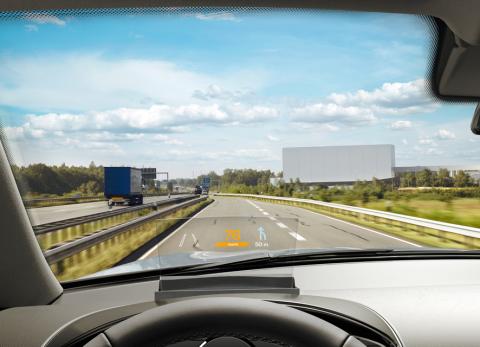
Continental has developed a compact example of its head-up display (HUD) product for smaller vehicles. Called combiner HUD, it is closely related to the existing windshield HUD, but requires less installation space.
In the combiner HUD, a small, transparent plastic disc called the "combiner" is used as a mirror for the information shown, instead of the windshield itself.
"It is important to us that the ergonomic advantages of HUD technology can have the broadest possible use within the vehicle,” said Helmut Matschi, a member of the executive board at Continental. “With the combiner HUD, we are offering a system that can be easily integrated into whole vehicle families, as well as in particularly sporty cars with limited space in the cockpit.”
Compared with the windshield HUD, which Continental has produced as a colour system since 2003, the combiner HUD requires only slightly more than half the installation space, depending on the application. This is possible because the windshield does not need to be integrated in the optical path. Instead, this path is positioned in the combiner, which is optimised for its visual properties.
Under favourable conditions, a combiner HUD can be just one single mirror in the interior. This allows the technology not only to be compact but also extremely flat, which makes it easier to integrate in smaller or sporty vehicles.
As the little brother of the windshield HUD, it provides almost the same ergonomic advantages.
"The combiner head-up display rounds off our HUD portfolio perfectly,” said Eelco Spoelder, head of the Continental instrumentation and driver HMI business unit. “While reading select information, drivers can constantly keep their eyes on the traffic. They no longer have to look back and forth between the road and their display instrument. Vehicle manufacturers can equip different vehicle models with a single technical basis."
Even in the combiner HUD, the full-colour instrument display projects over the end of the engine bonnet, just below the driver's viewing angle. The optical path is marginally shorter than the windshield application, so the driver's eyes have to adjust slightly more to the shorter distance – but this is more than offset by the increase in safety.
"The more vehicles are equipped with a HUD, the less drivers have to look away from the road," said Spoelder. “The combiner HUD is an equally important member of our product family. Each HUD can reduce potentially dangerous periods of flying blind when a driver looks down to their instruments or operating elements."
Since the combiner HUD is suitable for compact vehicle models, it is helping to bring this technology to a wider range of drivers. While the windshield HUD can now be found as an equipment option in the upper mid-size class vehicles, the combiner HUD is also available for smaller volume models.
"The design and production experience from two generations of windshield HUD was invaluable for the combiner HUD, with its high level of functional integration, compact design and its few components," said Pablo Richter, a HUD technology expert in Continental’s interior division. Continental is planning the first production run of the combiner HUD for 2015.
