Helping design safer vehicles
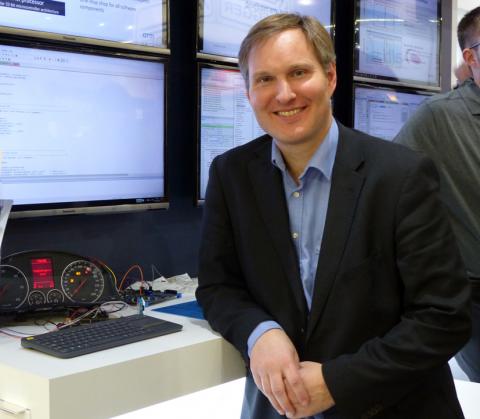
Steve Rogerson talks with Arm’s John Ronco about the company’s automotive plans
Arm is finding itself engaging with car makers more than it is ever done so, according to John Ronco, who is general manager of the company’s embedded and automotive line.
“We are doing more and more talking with car manufacturers and tier ones,” he said. “We have to do that to see what they need in four years’ time. We did that in the mobile market and now we do it for cars.”
The company is involved at many levels in automotive, and that excites Ronco.
“Automotive is fascinating,” he said. “Once this was an uninteresting space but now there is a surge of interest in electronics in the car. There is a lot of talk about adas and autonomous vehicles, but it is really the whole spectrum.”
A key area is functional safety, and Arm has been increasing its investment in this area.
“There is no one right answer,” said Ronco. “The customer has to design a vehicle that is safe, but there are lots of ways to do that, so we seek to provide a lot of different capabilities so they can build a safe system.”
The ISO 26262 functional safety standard has had a big impact on that.
“ISO 26262 is built into the way we work,” he said. “At first, it was about providing extra documentation for customers but now it part of the whole design flow. This is a really important part of what we do.”
One of the company’s investments has been in software test libraries (STLs). Being able to verify that a processor is working safely and correctly in a running system is an important element of functional safety. An STL consists of functions that can be run within the programme code to check that the different areas of the processor logic are working as they should.
An STL can be run at start up and during programme operation, maintaining coverage of a running system. The first STL is for the Cortex-R52, a real-time processor for use in functional safety applications.
The company has also been investing in machine learning. In February, it announced Project Trillium, a suite of Arm IP including new highly scalable processors that will deliver enhanced machine learning (ML) and neural network functionality. The current technologies are focused on the mobile market and will enable ML-equipped devices with advanced compute capabilities, including object detection.
“We are looking at a processor designed around object recognition,” said Ronco. “We can have one that, say, looks for people.”
Finally, he said Softbank’s takeover of the company had been “really positive” and that the new owners were looking for long-term value.
“They didn’t want to change the business model,” he said, “but they have given us the freedom to invest more for long-term growth, and in automotive we have to think really long term. You need patience in automotive.”
