How Analog Devices sees the future following last year’s Linear Technology takeover
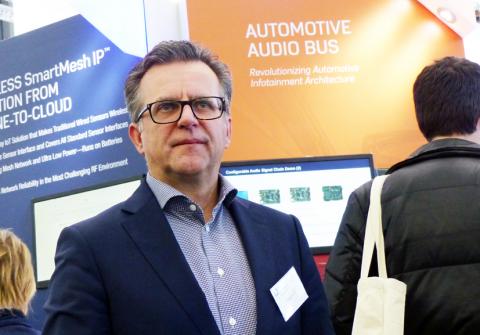
Steve Rogerson talks with Stefan Steyerl from Analog Devices
Over a year has passed since Analog Devices took over Linear Technology and, whereas last year the two companies had separate stands at Embedded World, this year it was a merged offering on a single stand.
“We are now one company,” said Stefan Steyerl, director of sales for mobility and transportation. “We acquired Linear because we needed to leverage the analogue and digital worlds. The other gap we had was in the power management side. Linear was one of the leaders in that market.”
Both companies, he said, were highly profitable and Analog Devices was experienced in working with large accounts. And both companies also had a broad customer base.
“The execution of the integration has worked out very nicely and the people are feeling like one company,” he said. “The term ‘Linear Technology’ will disappear, which is why we introduced the ‘Power by Linear’ theme.”
On the automotive side, the integration has been particularly good.
“Analog Devices has been in automotive for many years,” said Steyerl.
The company has focused on mems sensors for safety plus other sensor types as well as audio products on the infotainment side. The company developed the A2B automotive audio bus. The A2B was developed with Mentor as a way to reduce the wiring in a car needed for all the microphones and speakers, which added too much weight. By using the A2B, these can all be linked in a daisy chain, which uses a lot less wiring, making it lighter and cheaper.
Analog Devices also realised that with the trend towards more connected and eventually autonomous vehicles the amount of electronics in a car was going to escalate.
“There is now more electronics in a car,” said Steyerl. “If you have level three or four systems, when the car can hand back control to the driver, it needs to know what condition the driver is in, you need health monitors, you need to know if the driver is alive or sleeping.”
Outside the car, even more sensors will be needed.
“Analog Devices has been in areas such as radar and we also have lidar technology,” he said. “We acquired Vescent last year. They have liquid crystal lidar technology. This lets you steer the beam so you don’t need moving parts. We believe this will take lidar to a totally different cost point. We also have the sensor technology for when the beam comes back.”
Linear also brings to the company, he said, a very good roadmap in battery management technology.
Overall, he said the growth in semiconductors in a car was very exciting.
“It is going up from $250 to $600 or more per car,” he said.
However, though Analog Devices is building up its automotive portfolio though acquisitions, Steyerl was clear that it does not want to change from its tier two role.
“We do not want to become a tier one in the automotive space,” he said. “We have, however, set up a separate team to deal more closely with the OEMs to help them implement their systems and, to a certain extent, to try to influence what they are doing. The car OEMs are taking more control. Tier twos such as ourselves are taking control so sometimes the tier ones get squeezed a little.”
With the move towards autonomous systems increasing complexity, he said that an ecosystem and partnerships were needed. But he also saw that more technology was being placed in the hands of the tier ones and that could see them challenge the OEMs.
“If a tier one has all the technology, why shouldn’t they build vehicles? I can see that happening,” he said. “But whatever happens, it is going to be exciting for companies such as ourselves.”
