Latest S Class uses Most 150 technology
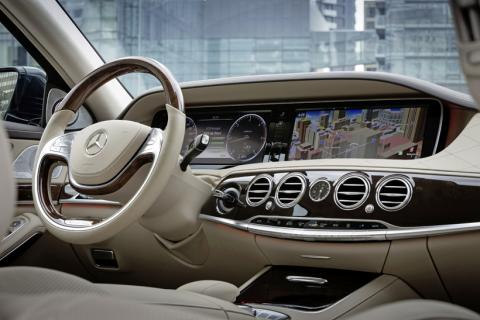
Daimler has implemented Most 150 in its latest Mercedes-Benz S Class, with plans to roll out to other vehicles.
"Most 150 has successfully accomplished series development for the next Mercedes-Benz infotainment generation, with fully-qualified series production parts available for all key components," said Peter Haeussermann, head of telematics at Daimler. "Most 150 has recently been first implemented in the brand-new generation of the S Class. After that, the technology will be rolled out onto all other Mercedes-Benz car lines, step by step."
The development of this latest Most generation has been accompanied by a cost-benefit analysis that led to several innovations on one hand and to a high level of backwards compatibility on the other.
Existing applications can be reused in the network by modifying their network interfaces. Therefore, it provides a smooth adaption with most features being continued.
Daimler will reuse and adopt many components out of its existing system architectures, as, for example, main parts of topologies, network management and application structures. As a result, the focus will be on the development of new functions.
"At Daimler, we expect that the prevalence of internet applications in the automotive environment will grow significantly,” said Haeussermann. “Consequently, future infotainment platforms have to meet these new requirements."
Most 150 contributes to this by providing the Most Ethernet protocol. With this communications channel, both high-performance IP networks and internet applications can be implemented. The Ethernet channel can transmit unmodified Ethernet frames (according to IEEE 802.3) with more than 100Mbit/s depending on the network configuration. This permits software stacks and applications from the consumer and IT domain to be seamlessly migrated into the car.
TCP/IP stacks or protocol entities using TCP/IP can communicate via Most without any modification. Thus, the new generation of Most provides the automotive-ready physical layer for Ethernet in the car.
