Lighting: Brightening the dash
Tony Armstrong from Linear Technology looks at how the latest driver ICs are helping car designers face the challenges of increased use of LEDs
Some of the key applications that drove the explosive growth of LEDs used to backlight thin film transistor (TFT) liquid-crystal displays (LCDs) included high-definition TVs, portable tablet PCs, automotive infotainment displays and the myriad of handheld communications devices. However, to maintain this impressive growth rate LEDs must not only provide enhanced reliability, reduced power consumption and more compact form factors, but must also provide improvements in contrast ratios and colour accuracy.
Furthermore, in automotive, avionic and marine displays, all these improvements must be optimised while simultaneously being subjected to a wide array of ambient lighting conditions from bright sunlight to moonless nights.
These TFT-LCD applications include infotainment systems, gauge clusters and a wide array of instrument displays. Of course, backlighting these displays with LEDs creates some unique driver IC design challenges to optimise display readability across a myriad of lighting conditions. This requires LED drivers to offer very wide dimming ratios and high efficiency conversion while also withstanding the rigours of the demanding automotive electrical and physical environment. These must have a very low profile and compact footprints while simultaneously enhancing overall cost effectiveness.
Automotive displays
To support the impressive growth in automotive lighting applications, LEDs must provide a value proposition over their incandescent bulb counterparts. These include ten times more efficient at producing light than incandescent bulbs and almost twice as efficient as fluorescent lamps, including cold cathode fluorescent lamps (CCFLs), thereby reducing the amount of electrical power required to deliver a given amount of light output, measured in lumens per watt.
As LEDs are further developed, their efficacy, or ability to produce lumens of light output from an electrical power source, will only continue to rise. Secondly, in this environmentally conscious world, LED lighting does not require the handling, exposure and disposal of the toxic mercury vapour commonly found in CCFL bulbs. Finally, incandescent bulbs are usually required to be replaced after approximately 1000 hours of operation while fluorescent bulbs can last as long as 10,000 hours. However, these figures are dwarfed in comparison to the 100,000 hour plus lifetimes afforded by LED lighting.
In most applications, this extended operating lifetime allows for LEDs to be permanently embedded into the end-application. This is especially important for the backlighting of automotive clusters, instrumentation and infotainment panels, which are often embedded into a vehicle’s dashboard, since they will not require replacement during the working life of the car. Additionally, LEDs are orders of magnitude smaller and more compact than their counterparts so the LCD panels can be made extremely thin, thereby requiring little volumetric space in a vehicle’s interior.
Also, by using a configuration of red, green and blue LEDs, an infinite number of colours can be delivered. Furthermore, LEDs also have the ability to dim and turn on and off much faster than the human eye can detect, enabling significant improvements in backlighting of LCDs while simultaneously allowing dramatic contrast ratios and a higher resolution picture.
Obstacles
Nevertheless, one of the biggest obstacles facing automotive lighting systems designers is how to optimise all the features and benefits provided by this latest generation of LEDs. Since LEDs generally require an accurate and efficient current source and a means for dimming them, an LED driver IC must be designed to address these requirements under a wide variety of operating conditions. Further, their power supply must be highly efficient, rugged and reliable while also being very compact and cost effective.
Arguably, one of the most demanding applications for driving LEDs will be found in the backlighting of automotive infotainment and instrument TFT-LCDs as they are subjected to the rigours of the automotive electrical environment where they must compensate for a wide variation of ambient lighting conditions and must fit in a very space constrained areas. And all the while, they must have an attractive cost structure.
Many emerging automotive designs use a single panel to backlight all the display gauges for driver control. Often, the LED backlighting for the instrument panel is shared with the infotainment system, creating an easy to read all-in-one control panel. Similarly, many vehicles including cars, trains and airplanes also have LCDs that entertain passengers in the rear seats with movies, video games and so forth. Historically, these displays have used CCFL backlighting; however, it is becoming more common to replace these relatively large bulb designs with very low-profile arrays of white LEDs to provide more precise and adjustable backlighting as well as an extended service life.
Design requirements
To ensure optimal performance and long operating life, LEDs require an effective drive circuit. These driver ICs must be capable of operating from the caustic automotive power bus and be both cost and space effective. To maintain their long operating life, it is imperative that the LEDs’ current and temperature limits are not exceeded.
One of the automotive industry’s challenges is overcoming the electrically caustic environment found on the car’s power bus. The problems include transient conditions known as load dump and cold crank.
Load dump is a condition where the battery cables are disconnected while the alternator is still charging the battery. This can occur when a battery cable is loose while the car is operating, or when a battery cable breaks while the car is running.
Such an abrupt disconnection of the battery cable can produce transient voltage spikes up to 40V as the alternator is attempting a full-charge of an absent battery. Surge suppressors on the alternator usually clamp the bus voltage to approximately 36V and absorb the majority of the current surge; however DC-DC converters downstream of the alternator are subjected to these 36 to 40V transient voltage spikes. These converters are expected to survive and regulate an output voltage during this transient event. There are various alternative protection circuits, usually surge suppressors, which can be implemented externally. However, they add cost and weight, and take up space.
Cold crank is a condition that occurs when a car’s engine is subjected to cold or freezing temperatures for a period of time. The engine oil becomes extremely viscous and requires the starter motor to deliver more torque, which in turn draws more current from the battery. This large current load can pull the battery or primary bus voltage below 4.0V upon ignition, after which it typically returns to a nominal 12V.
An alternative is to use an LED driver that is capable of both surviving and regulating a fixed output voltage throughout both of these conditions. These exist with input voltage ranges of 3 to 30V and transient protection to 40V, making them suitable for the automotive environment. Even when Vin is greater than Vout, which could occur during a 36V transient, they will regulate the required output voltage.
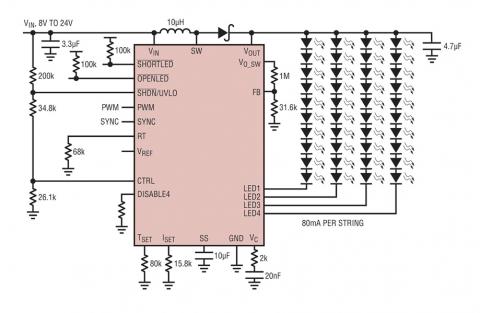
As most LCD backlighting applications require between 10 and 15W of LED power, the drivers have been designed to service this application. They can boost the automotive bus voltage (nominal 12V) to as high as 44V to drive up to four parallel strings, each containing ten 100mA LEDs in series. The diagram shows a schematic driving four parallel strings with each string comprised of ten 80mA LEDs, delivering a total of 12W.
These devices use an adaptive feedback loop design that adjusts the output voltage slightly higher than the highest voltage LED string. This reduces power lost through the ballasting circuitry to optimise the efficiency. The efficiency can be as high as high as 90 per cent.
This is important because it eliminates any requirement for heat sinking, enabling a very compact low profile footprint. Equally important for driving LED arrays is to provide accurate current matching to insure that the backlighting brightness remains uniform across the entirety of the panel.
Conclusion
There can be no doubt that the growth potential of high-brightness LEDs for use in automotive applications represent a significant increase in demand from today’s deployment rate for both the LEDs themselves and for the LED driver ICs required to drive them. High current LED driver products are available aimed specifically at automotive applications ranging from LCD backlighting to turn signals and even headlight applications.
Tony Armstrong is director of marketing for power products at Linear Technology
