Lighting: Drive safely
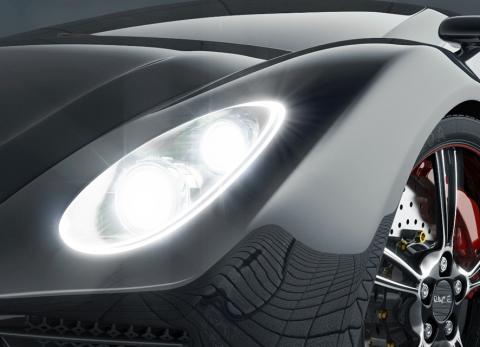
Stefan Grötsch and Thomas Christl from Osram Opto Semiconductors say that LED development is accelerating the use of intelligent light functions
The issues of light and driving safety have always been closely intertwined. Nowadays, increasingly more intelligent and autonomously operating applications with visible and invisible light are providing more safety and driving comfort. In this respect, LEDs and optoelectronics are taking on crucial importance.
In addition, further development in LED technology is also providing design options and reducing system costs. As a result, intelligent functions, such as adaptive light systems, are appealing to a wider market.
LEDs and optoelectronics are today being used in numerous applications for vehicles. These include display, interior and exterior lighting, but also infra-red light and sensors for safety and driver-assistance systems. Seeing and being seen are among the most crucial factors governing road safety.
In many countries it is a requirement to drive with lights always switched on. Since accident statistics have shown how many accidents are down to insufficient lighting, corresponding laws have been enacted in Sweden, Italy, Hungary and some other countries. Vehicle lighting for these markets often requires that lights switch on automatically, because whenever drivers have to activate light functions themselves, mistakes and lapses are never too far away.
TÜV Süd, for example, complains that many motorists very rarely use their high beam lights. TÜV experts thus see glare-free high beam as the most significant development of the past few years in automotive light technology.
A related development is adaptive headlamps that adjust their lighting direction to the curve profile of the road during cornering. With the help of these adaptive light systems, the roadway can be automatically illuminated using exceptionally bright light and precisely controlled light distribution, without dazzling other road users in the process.
The use of multichip LEDs is one of the contributing factors to the leapfrog evolution of these intelligent lighting systems, which is continuing thanks to advances in the area of multi-pixel LEDs.
Adaptive headlamps
Multichip LEDs set new standards for incorporating adaptive functions in headlamp systems (adaptive front-lighting systems – AFS) and glare-free high beam (adaptive driving beam – ADB). They automatically provide the best visibility and light conditions and are thus much better at preventing accidents. In addition, they increase driver comfort as the driver no longer has to think about manually turning on and off light systems to avoid dazzling oncoming traffic.
With LED technology, automobile manufacturers can implement these intelligent headlamp systems much more easily than was previously the case, as the mechanical systems for pivoting the headlight distribution are no longer required.
In the case of light-emitting diodes, only the individual chips have to be selectively turned on and off by an intelligent controller. This uses several sensors to achieve, for example, glare-free high beam light by flexibly turning off regions in the headlamp’s light beam according to the driving situation and by dynamically adjusting to the position of other road users. Furthermore, dynamic cornering and turning light or marker light can be produced to illuminate potential obstructions on the side of the road.
If several of the LEDs are used with individually controllable chips, then road users can be even more accurately shielded while the intermediate areas can still be fully illuminated.
LED development
The latest generations of LEDs have been scaled down even further and hence allow for more leeway in designing headlamps. Besides miniaturisation, there are also decisive advances in other areas, helping to make LEDs affordable to a wider market. The introduction of cheaper surface-mount technology means adaptive lighting is no longer exclusive to the vehicle premium class.
The higher the number of pixels, the smaller the luminous surface and the luminous flux can be under the same operating conditions. Arranged individually or as arrays, they provide the basis for AFS and ADB functions. In addition, compact dimensions allow for the optimum light guide for daytime running lights or indicators.
The combination of high efficiency and passive cooling, through improved thermal characteristics, considerably reduces system costs and makes LEDs for headlamps appealing to a wider market.
Multi-pixel light source
To date, adaptive LED headlamps have operated with individually controlled chips for each illuminated area. The developmental trend is towards LED chips with micro-structured pixels that can shine or be turned off individually.
Under the µAFS research project, a group of German companies worked for three and a half years up to September 2016 on the groundwork for a new class of energy-efficient LED headlamps for adaptive front-lighting systems. After only one and a half years, the project partners announced the first milestone of 256 controllable pixels.
This was followed by the development of a pixel-light source with 1024 individually controllable light points. These provide about three lumen at only 11mA for an individual pixel surface of 0.115 by 0.115mm from a closed emission surface of 4 by 4mm with a grid size of 0.125mm. Here, the multi-pixel LED chip was mounted directly onto the smart Si-LED driver chip. A new conversion technology also allowed high contrast ratios as well as efficient white-light generation. The individually controllable light points enable very clearly defined light images to be produced.
The key technology for this is the integration of microelectronics and optoelectronics. Experts developed an LED pixel chip that emits flexibly controllable light patterns in blue. The challenge was to define light points during chip processing and enable these to be connected directly to the control.
Three of the 1024-pixel LEDs have already been used in the headlamps of a Daimler test vehicle.
Stefan Grötsch is principal for key expert applications and Thomas Christl is marketing manager at Osram Opto Semiconductors
