Mercedes C Class tops Thatcham autonomous braking tests
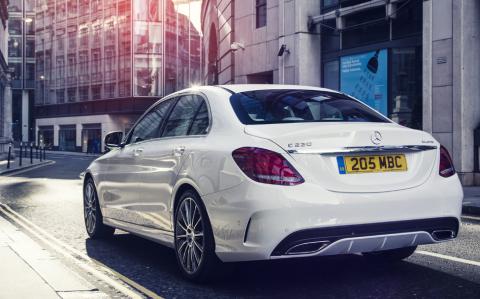
Automotive research centre Thatcham has given top marks for a self-braking car. In tests, the Mercedes braking system avoided a potentially lethal collision by sensing another vehicle in its path and bringing itself to a complete stop without input from a driver at speeds of up to 40km/hr.
The C Class is now the best performing standard-fit automatic braking system on the road following the vehicle’s release in June, thanks to sensors and under-bonnet software. To date many of the best autonomous emergency braking (AEB) systems have only been able to avoid collisions at around half the speed achieved by the Mercedes technology.
Thatcham Research carries out official crash tests as part of the Euro NCap system.
“AEB is being hailed as the new seatbelt and is already saving lives,” said Peter Shaw, chief executive of Thatcham Research. “And this system is amongst the most advanced to have been tested. AEB cuts in when it detects a potential collision and the driver has for some reason failed to apply the brakes. In the real world, AEB is already avoiding countless accidents and these latest tests show that the Mercedes system has moved the technology forward significantly for those standard fit systems.”
Thatcham says because of the extra level of safety Mercedes’ technology offers, C Class customers could see their vehicle’s insurance tumble by five groups, representing savings of up to 15% or £80 on a typical policy in the UK.
Thatcham began carrying out tests on auto-braking cars in 2007. The first on the UK market was Volvo’s XC60 SUV in 2008, with other manufacturers swiftly following. Today, 17 different vehicle manufacturers offer AEB.
So successful have the systems been, says Thatcham, that 7% of new cars now on sale have AEB as standard, while 17% are offered with AEB as an option. Examples include on Ford Fiesta and Focus models for £200 extra while Nissan offers its optional system on the Qashqai for £495, and it is standard on the Accenta Premium and Tekna models.
While only around 1.5% of cars now on the road have AEB, Thatcham believes take-up of the life-saving technology will soar – especially if the government backs insurance industry calls for a state-funded incentive for new vehicles bought with AEB.
Without incentives, experts believe there will be a 100% take-up of AEB on new cars by 2035. With incentives, this target could be reached ten years earlier, potentially saving 1220 lives and nearly 136,000 casualties by 2025.
The C Class, which went on sale in June with a starting price of £26,855 for the SE Saloon, is the first Mercedes model to use this technology as standard fit.
“AEB systems are developing rapidly,” said Shaw. “New versions can detect and identify not just pedestrians but cyclists and even large animals. As these latest Mercedes results highlight, our track tests show these systems are becoming more and more sophisticated and effective, with the potential to save even more lives. One day, we will look back and wonder how we managed without such vital systems in our cars.”
He said AEB was particularly important in addressing the 400 pedestrian deaths on UK roads annually. “The potential AEB has for improving safety levels is enormous,” he said.
The effectiveness of individual AEB systems depends on the type and complexity of sensors used to detect obstacles. Three quarters of all collisions happen at speeds of under 32km/hr in city driving scenarios. This is where AEB systems using lidar sensors perform best, avoiding crashes of up to 24km/hr and reducing the severity of those up to 40km/hr. This includes collisions at junctions, roundabouts and in stop-start traffic where one car runs into the back of another. More complex, more costly radar sensors also protect at higher speeds, teaming radar and camera sensors to spot pedestrians and other vulnerable road users.
Radar and lidar sensors function regardless of lighting conditions. Camera-based systems do need adequate lighting, however most systems work in exceptionally low-light conditions by boosting the strength of the signal.
The ability of AEB to recognise pedestrians in the dark is challenging, but the vast majority of pedestrian collisions occur in urban areas where street lighting provides sufficient illumination for camera systems to remain effective.
In Thatcham’s laboratories, scientists have found that AEB systems operate in wet conditions. Heavy snow and poor surfaces can affect performance but such conditions are rare.
The AEB assessment procedure used by NCap was devised by Thatcham Research, making it a key influencer for vehicle manufacturers. Thatcham is working to have its test procedures adopted across Europe, as well as in China, Japan and Australia.
Thatcham’s AEB tests use an impactable target that replicates an average-sized vehicle. Driving robots are used for accurate and repeatable testing, setting the path, speed and braking force.
Each test typically involves a team of five test engineers to operate vehicles, manoeuvre targets and capture high-speed film of the event. Testing is always carried out on a closed test track.
