Microcontroller allows control of lighting inside cars
A Lin connection on the Microchip Pic 12(L)F157x 8bit microcontroller family announced this week at Embedded World in Nuremberg allows the device to be used for automotive interior lighting applications.
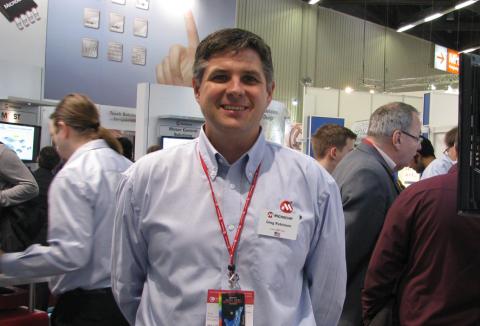
“This lets you change the colour within the car,” said Greg Robinson, Microchip’s 8bit MCU marketing director. “You can set the interior lighting to suit your mood.”
The device allows control of a string of LEDs using a touch slider to alter the brightness and colours or it could be controlled through signals coming in over the Lin bus.
“Lin still resides in the small satellite functions such as doors, seat adjustments and so on,” said Robinson. “This is totally the 8bit world.”
The device has three 16bit PWMs with independent timers and an assortment of analogue peripherals and serial communications in an eight-pin package. This suits applications where high resolution is needed, such as LED lighting, stepper motors and battery charging. In addition to standard and centre-aligned PWM output modes, the peripheral also has four compare modes and can serve as an additional 16bit timer.
A complementary waveform generator (CWG), in combination with the PWMs, can be used to create half-bridge and full-bridge drive control. The CWG can generate complementary waveforms with fine control of key parameters such as polarity, dead band and emergency shutdown states. It is said to save board space and component cost when driving FETs in motor-control and power-conversion applications. The CWG and 16-bit PWMs, coupled with the 10bit ADCs, comparator and 5bit DAC analogue peripherals, enable closed-loop feedback and control.
Other applications include indoor and outdoor LED lighting, RGB LED colour mixing, electric razors and radio-control toys.
The addition of the Eusart enables general-purpose serial communications and Lin for automotive and industrial control. The integrated 10bit ADCs enable human-interface and touch applications using Microchip’s capacitive MTouch sensing system. Additionally, it provides non-volatile data storage via high endurance flash (HEF) memory.
The LF versions have low-power technology, for active currents of less than 35µA/MHz and sleep currents down to 20nA for battery-powered applications.
The company’s full suite of development tools supports the MCUs. The PIC12LF1571, PIC12LF1572, PIC12F1571 and PIC12F1572 are all available today for sampling and volume production, in eight-pin PDIP, soic, msop and 3 by 3mm DFN packages.
