Microcontrollers: Staying secure
For automotive security, says Bryce Johnstone of Imagination Technologies, begin at the microcontroller level
Cars are rapidly evolving. It’s likely that more advances in car design and electronics will be made in the next five years than in the last fifty combined. Cars are becoming increasingly autonomous and more and more connected via a range of wireless technologies.
As a direct result, there is an increase in demand for improving and evolving the security of the car.
Evolution
When car electronics were first introduced some sixty years ago, the functions implemented were simple. There were a few electronic control units (ECU) and they were unconnected to the outside world. The ECU that controlled the electric windows did not speak with the speedometer in the dashboard.
The introduction of connectivity, which connects vehicles with the world around them, is opening the connected car up to a multitude of security problems and concerns. The combination of increased electronic integration with other fixed and portable components such as keyless entry, audio systems and wireless communications has provided routes into the control systems that are deeply embedded in the vehicle.
In the world of the connected vehicle, there are more than eleven different wireless interfaces. These include wifi, NFC, Bluetooth, 3G and LTE in such systems as wireless speakers, connection to phones and headsets, and telematics systems feeding back telemetry data. In the near future these will be augmented by vehicle-to-vehicle (V2V) and vehicle-to-infrastructure (V2I) communications. By their very nature, these wireless signals can be intercepted and potentially hacked making the car open to having user data stolen or, worse, remote controlling of the car causing accidents.
One famous example is Wired Magazine remotely driving a Jeep Cherokee off the road. The hack team – Charlie Miller and Chris Valasek – initially showed how to take control physically through the ODB port. They then extended the experiment by remotely engaging the air conditioning system, the radio, the wipers, the transmission and steering and quietly driving the journalists into a ditch. All this happened through attacking the unprotected infotainment system in the Jeep.
It’s also important to highlight that user systems potentially contain personal and private information, such as location, credit card details, insurance details, ownership documentation, while the embedded systems are inextricably tied into the fundamental physical behaviour of the vehicle. These two aspects mean that if any of the vehicle control and information systems are compromised, theft or damage is possible.
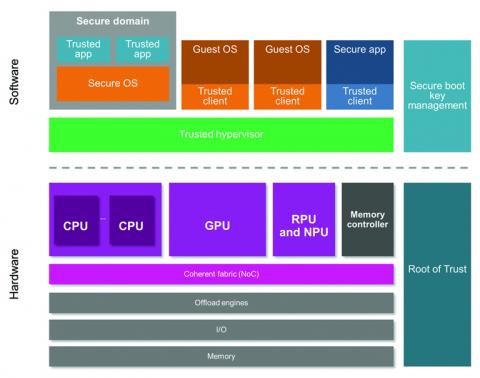
A robust alternative for the automotive market is to use hardware virtualisation at the system level to isolate applications in separate and secure environments – a concept known as security by separation.
Considerations
When deciding upon a microcontroller that will enable a superior level of security, one should look at the hardware support for the likes of virtualisation; this is built in to some microprocessors. Virtualisation can be simply seen as splitting up the resource of a single MCU into virtual sub MCUs, each one running potentially a different OS and application.
Using a hypervisor and an underlying two-layer memory management unit structure one can develop a number of separated containers that act independently and do not affect each other. The memory can be entirely separated and if one process crashes, the other(s) are unaffected. So if someone downloads a piece of malware into the infotainment system and it crashes, the car’s adas, cluster and navigation systems would be unaffected.
To complete the picture one can also build in elements such as secure boot.
Future
Security has come a long way since the initial introduction of simple features such as car alarms and keyless entry. However, the introduction of technologies such as blockchain will improve, and new standards of security will be necessary. By leveraging hardware virtualised microcontrollers in automotive applications, users can harden their platforms against attack.
The car industry has identified security as a fundamental issue and is now beginning to deploy hardware and software technologies to mitigate the security flaws and reduce the attack surfaces thus ensuring a raft of new services and features can be deployed with high levels of OEM and, ultimately, consumer confidence.
Bryce Johnstone is automotive segment marketing director for Imagination Technologies
