Middle East: Shaping the strategies
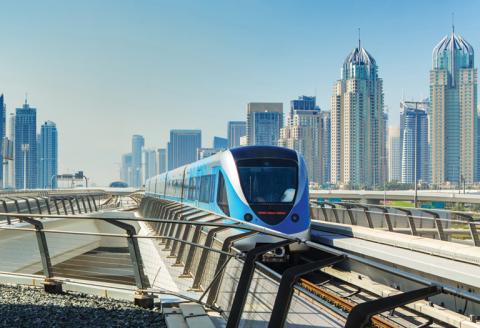
Ralf Baron, Thomas Kuruvilla, Morsi Berguiga, Michael Zintel, Joseph Salem and Mario Kerbage from Arthur D Little discuss the Middle East and urban mobility
The Middle East has been late to urbanisation, but this has given it potential to shape its strategies in the development of a core need – urban mobility. Some of its vibrantly growing urban centres, such as Dubai, are now building on best practice from around the world.
This experience provides lessons, good and bad, for other cities across the world as they struggle to meet their own urban mobility challenges.
Rethinking
Government and public authorities in the Middle East have generally followed one of two models when looking for ways to address these major transportation challenges.
The initial approach decision-makers followed was to invest heavily in roads and public transport infrastructure, raising the transportation network’s capacity to absorb the greater demand.
This transition model is inspired by the evolution of transportation networks in the Western world, where it took more than a century to build, develop and maintain advanced public transport networks. Cities in the Middle East have tried to follow these models and strengthen transport-mode offers in short time frames, often focusing on roads and rail networks.
Governance methods are reinforced in parallel through the launch of transport supervision authorities, which have mixed roles covering planning, investments and regulation.
A few advanced cities have taken different paths, trying new approaches to reinvent their transportation networks to respond to challenges. The key principles of these new approaches are to:
- • Develop a holistic view of the mobility model ex ante;
- • Integrate all available mobility modes seamlessly and holistically;
- • Consider both supply and demand levers to reshape urban transportation; and
- • Effectively leverage innovative, new mobility modes.
Middle Eastern cities provide a favourable environment for this new mode for multiple reasons. They do not have heavy legacy transport infrastructure to manage. Infrastructure rollouts are faster and easier given the short decision-making process.
Most of these cities are undergoing ambitious transformation plans with the aim of increasing their attractiveness: an innovative urban transportation experience is seen as a strong lever for differentiation.
At this moment, the ecosystem approach – usually implemented in a broader smart-city context – is a true game changer leading to progressive urban development opportunities.
The model opens the door to create true impact in a city.
For example, public transport modes using integrated offerings can reduce congestion and carbon emissions. They can provide a seamless customer experience – search, book, pay – integrating mobility and other sectors. They promote complementarity between transport modes, rather than competition. And they prepare the city to accommodate the future mobility modes.
Lessons
- • Set solid foundations on the supply side: This includes infrastructure investments as well as investments in new mobility modes. On the infrastructure side, Dubai is a role model in rapid decision making, planning and deployment of big infrastructure initiatives.
- The recently opened Dubai Water Canal, which runs through the heart of the city, took only three years to move from the start of the planning process to opening. Other examples are the metro, the tram and the ongoing renewal and modernisation of streets, bus stops and stations.
- The other aspect is investment in new mobility modes. Dubai is always striving to strengthen its position as an innovative, smart, forward-thinking pioneer.
- • Set awareness for the necessary shift in mobility demand: Public transport’s share of journeys is only 14.4% in Dubai. This is very low compared with other major cities in Asia, Europe and the USA, where it reaches 35 to 55%. One explanation for this might be climate related, but the major reason is the mindset of users.
- Historically, individual transport was the only possibility users had. Now Dubai is aiming to jump directly from an individual-centred mobility system to an integrated one. This is accompanied by financial benefits for users, as well as heavy investments in marketing and value-added smart services. The awareness of ecological issues will also be increased. The clear target of all initiatives is a shift towards greater use of public transport.
- • Think of mobility as an integrated ecosystem: The set-up and optimisation of single mobility modes and infrastructure components is important. But Dubai understood at an early stage that the entire system could only be successful if single modes were networked and integrated in a system that solved a mobility problem for the user: to go from A to B.
- A trip on the metro from station to station is worthless if the user does not know how to proceed from there, especially with a hot climate and still underdeveloped walking and cycling options.
- The answer is to integrate on the supply side as well as on the demand side – infrastructure and mobility modes have to be interlinked like a well-oiled machine to provide a seamless mobility experience. At the same time the offering has to be transparent to both tourists and locals. They all need a platform on which they can find information and book and pay for a trip from A to B, based on every available mobility offering.
- • Be at the forefront of new mobility technologies: Dubai is continually searching for the latest new technologies. Innovation labs, international experts, panel discussions, fairs and visiting trips are all used to identify technologies that might move the mobility system forward.
When potentially successful pearls are identified, decision-making and pilot programmes are rapid. In this process, Dubai essentially works like a start-up company: if an opportunity is spotted, it is tested. Dubai is renowned as a leader in innovation, particularly around mobility.
As an example, Dubai has set a target of 25% of vehicles being autonomous by 2030. Accordingly, the city’s Road & Transport Authority (RTA), with the support of private players, is working to establish a hub that focuses on R&D in the autonomous-vehicles space, as well as signing an agreement with Tesla.
Moreover, Dubai will be the first city to test innovative mobility modes – hyperloop, taxi drones and so on – to assess their viability for future deployment. A key aspect of this development is that all new and existing mobility modes work together, for streamlined integration. Dubai is aiming to develop the most innovative urban mobility system in the world.
It is worthwhile for every urban developer, technology provider and traveller to study how the new ecosystem approach is being applied. When it comes to mobility, learning may become truly bidirectional. Middle Eastern centres have followed the traditional European and American development path for quite some time. Now they are setting their own priorities. Cities in other parts of the world should observe and learn from their experiences.
The authors all work for Arthur D Little. Ralf Baron is global head of travel and transportation, Thomas Kuruvilla is a managing partner, Morsi Berguiga is an associate director, Michael Zintel is a principal, Joseph Salem is a manager, and Mario Kerbage is a consultant
