Motor Control: Emission possible
Rick Fennelly from Allegro Microsystems discusses the growth of electrical motor systems and the challenges for system developers
Governments around the world, including the European Union and USA, have placed mandatory fuel economy standards on combustion engines to reduce emissions. These initiatives will require innovative advances in technologies, driving the demand for increased efficiencies, placing additional burden on design teams, and potentially impacting development cycle times.
An area of focus will be to develop strategies for reducing load on the vehicle engine. Roughly fifteen per cent of the energy from fuel is used to move a vehicle down a road – the balance is consumed by engine and driveline inefficiencies. Therefore, reducing load will allow the engine to work more efficiently and thereby contribute to a reduction in fuel consumption.
The challenge is in providing equal or enhanced performance while maintaining or improving the overall driving experience. To achieve this goal, there is a growing demand for the electrification of cars where electrical motors are being used in place of traditional belt-driven systems. To that end, the world market for electric motors in automotive applications is growing, according to IHS Technology, at a compound annual growth rate (CAGR) of 4.7%. Specifically, the market for brushless DC motors (BLDCs) in automotive applications is predicted to outpace by twice the market growth for other motor types with a unit CAGR of 6.3% from 2014 to 2019.
Improving these systems with electrical systems has created new challenges for tier-one manufacturers, where these innovations require an increase in staff and development time. Designers are looking for methods to reduce the development cycle while maintaining high performance goals. As a result, BLDC motor control is increasing in market share.
For example, a vehicle water pump that is traditionally belt driven has transitioned to an electrical motor. This is needed for start-stop systems that improve efficiency and reduce emissions. To keep engine coolant circulating, an electrical motor replaces the belt driven pump. Other systems affected by engine start-stop systems requiring conversion to BLDC motors include hydraulic and oil pumps.
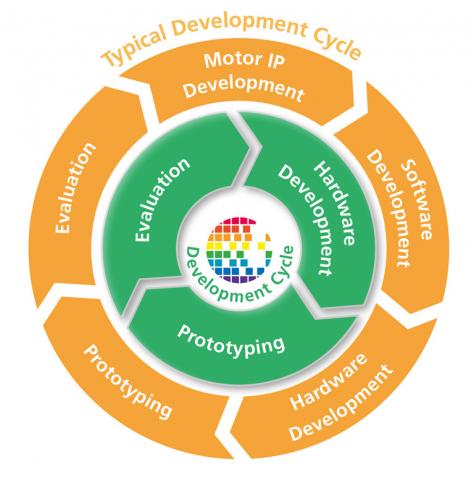
A new generation of motor driver IC can up-integrate complex commutation algorithms, simplifying the engineering design of a BLDC motor control system. Proven algorithms have been developed for trapezoidal and sinusoidal control for both sensor and sensorless BLDC motors so engineers are not challenged with writing and validating software, helping them to meet aggressive timelines, as can be seen in the diagram.
In many of the advanced motor drivers, the commutation algorithm is integrated into the IC. An easy-to-use software gui passes parameters via USB to the on-chip eeprom, where they are used by the on-chip algorithm. This enables an engineer with no software programming experience to design and validate a motor system, breaking the time-consuming cycle of software development and validation. Innovations such as these lower the workload on the microcontroller, allowing the developer to specify a less powerful – hence less expensive – device. For some applications, it’s even possible to eliminate the microcontroller altogether, providing additional cost savings.
Devices are available that incorporate on-chip sensorless trapezoidal commutation, as well as high-power gate drive to enhance the external inverter bridge. Up-integration of functions usually programmed in a microprocessor make such devices capable of standalone operation by integrating closed-loop speed or torque control.
Comprehensive diagnostics can feed back to the ECU, providing detail about synchronisation, overvoltage, undervoltage or shorted mosfet conditions. Single wire operation can be achieved by sending fault diagnostics over the PWM input.
The algorithms can provide a wide range of programming parameters, enabling engineering to reuse hardware for different products by simply modifying parameters within on-chip eeprom. This makes such programmable motor drivers easy to use and reuse for a wide variety of motors, loads and applications.
Up-integrated ICs, along with programming tools, can simplify workflow and shorten design cycles, promoting innovation. These let manufacturers achieve demanding fuel economy standards through electrification while providing improved performance to the end user.
Looking forward, vehicle autonomy will drive the continued trend for the electrification of vehicles. IHS Automotive is projecting sales of close to 600,000 autonomous vehicles by 2025. Further, IHS expects a 43% CAGR between 2025 and 2035 to nearly 21 million autonomous vehicles. This growth will spur an increasing demand for electrical motor control where system integration will continue to drive designers to look for innovative designs.
Additionally, autonomous vehicles will need to incorporate redundant systems as a matter of safety to consumers where the automobile will be making an increasing number of decisions for the driver or, with some functions, may remove the driver from the decision-making process entirely.
Companies are manufacturing and will continue to develop products meeting the ISO 26262 safety standard. The Asils defined by ISO 26262 contain requirements for both the development process and for the design of safety-related electronic systems in road vehicles. These requirements reach IC component suppliers by calling for more content integrated into existing products and the capability of running diagnostics and communicating their status. These products help engineers simplify their designs and design cycles by providing supervisory and verification functions up-integrated within the IC.
Conclusion
As the automotive market continues to innovate to meet the demand for better performance and improved fuel economy, and with the expectant growth of the autonomous vehicle market, electrical motor systems will continue to play a growing role in providing more efficient alternatives to mechanical systems.
As such, design engineers will be looking for cutting-edge products that streamline their design process while providing value-added features that help them develop cost-effective competitive products. Chip companies are recognising this need and remain at the forefront for providing products that will meet the demanding requirements for the automotive future.
Rick Fennelly is marketing manager for Allegro Microsystems
