Multi-GNSS platform supports concurrent positioning
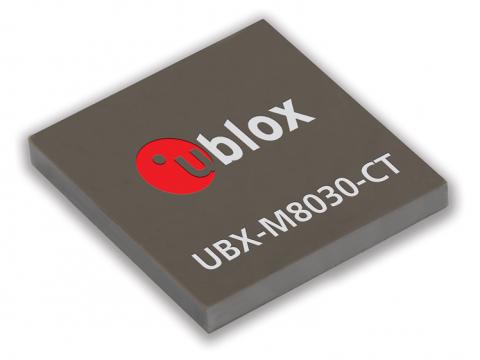
The M8 chip forms the basis of U-Blox’s upcoming line of positioning modules, which can acquire and track different satellite systems concurrently to achieve higher accuracy and reliability.
Supporting all deployed as well as upcoming Global Navigation Satellite Systems (GNSS), the platform is based on the UBX-M8030 concurrent multi-GNSS receiver IC, which is able to track American GPS, European Galileo, Japanese QZSS, Russian Glonass and Chinese Beidou satellites.
Concurrent tracking of GPS (QZSS) and Glonass or Beidou, or concurrent tracking of Glonass and Beidou satellites increases performance for applications requiring increased availability and accuracy. The chip is prepared for the European Galileo system through a future firmware upgrade once the constellation is fully available.
The platform will support functions such as automotive dead reckoning and precision timing to support vehicle, industrial and consumer applications.
To improve acquisition performance, the company’s globally available Assistnow GNSS service for accelerated positioning has been extended for the M8 products; the service supports GPS and Glonass, and the validity of downloaded assistance data is able to support offline operation for up to 35 days.
The chip is at the heart of the company’s next generation of positioning modules based on its Max, Neo and Lea module form factors.
Power consumption is reduced in concurrent reception mode thanks to a single-die architecture combined with software algorithms. The extended supply voltage range and 1.8 or 3.0V IO compliance supports various system architectures.
Radio architecture and interference suppression using active jamming detection improves performance even in GNSS hostile environments.
UBX-M8030 chips are available in miniature WL-CSP (2.99 by 3.21 by 0.36mm) and QFN (5.00 by 5.00 by 0.59mm) packages. The chip is also available in automotive quality grade according to AEC-Q100.
The platform is backwards compatibility with U-Blox 7 modules and QFP chip products.
