Nissan pushes technology limits with Pulsar
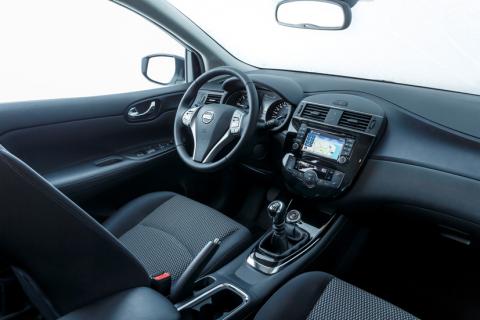
Nissan says its has introduced sector-first technology with the launch of the Pulsar, an all new family hatchback challenger for the small and medium car sector. These include moving object detection, around view monitor, active trace control and forward emergency braking, as well as the latest-generation Nissan Connect infotainment system.
At the heart of the technology package is the around view monitor. Combining image feeds from tiny cameras mounted on the front grille, tailgate and both door mirrors, the system projects an overhead 360˚ bird’s-eye view of the area around the car onto the 14.7cm satellite navigation and infotainment screen.
Image processing software generates the overhead image, and gives the impression that the camera is positioned directly above the car.
The overhead view gives the driver a clear indication of obstacles around the car, helping the driver to confirm the position in relation to the surrounding area and making manoeuvres easier and safer.
The monitor switches on automatically when the vehicle is placed in reverse gear. It can also be activated at speeds of up to 10km/h by pressing a button on the dashboard.
The system can also display the video feed from a specific camera, and can operate as a simple reversing camera that incorporates dynamic guidance on the screen to steer the driver to the correct path and into the chosen parking spot.
Moving object detection builds on the capabilities of the around view monitor, and gives the driver a digital co-pilot to help see what might be approaching the path when reversing. Although most conventional parking aids warn the driver of an object in their way, moving object detection gives an audible and visual alert if someone or something is moving behind the car – for example if a child is walking towards the reversing vehicle.
Mounted on the tailgate and with a convex lens, the rear wide view around view monitor camera has a sweep of vision in excess of 180˚. Combining this with data from the side and front camera allows the system to build a complete 360˚ picture capable of detecting hidden moving objects on sides or in front of the vehicle.
The dashboard switch has an all-on or all-off function. However if, for example, the driver wants to switch off only the lane departure warning, this too can be done via a touch screen menu. Any settings customised by the driver are remembered for future journeys.
Blind spot warning uses the rear wide-view camera to detect vehicles in the hidden blind spot area on both sides. If a vehicle is detected in either blind spot, a discreet warning light illuminates in the glass of the door mirror. If the driver indicates to change lanes and the system detects a vehicle in the danger area, the light flashes and an audible warning is given.
Lane departure warning detects if the car is starting to drift out of lane. Again, this uses only the rear wide view camera. Even faint road markings can be detected allowing the car to determine if it is drifting out of position without indicating. If it does, a warning is given to the driver to correct their road position. The system automatically adjusts its sensitivity when on rural roads to allow for the different required driving style.
To keep the lens clean, a wash-and-blow-dry system uses image processing software that can process more than 15 million pixels per second. This detects when the lens is obscured and sends a jet of water to wash away the dirt followed by a shot of compressed air to dry the lens. The system automatically determines the best cleaning method, for example only using a jet of air to remove a speck of dust or a drip of water to clear rain drops.
Forward emergency braking automatically applies the brakes if it detects that an impact is inevitable. By scanning the road ahead using radar integrated into the lower element of the front bumper, it delivers three levels of assistance. First is an audible warning, alerting the driver if the gap to the car in front is closing. Secondly, if the driver does not react, the brakes are automatically partially applied. Finally, if the gap is still closing, the brakes will be applied harder if necessary.
With applications such as Google, Facebook, Trip Advisor and Eurosports, the car can navigate the city like a local and stay tuned to the latest sports news and social networks. The system includes Bluetooth audio streaming and mobile phone integration as well as aux-in and USB slots along with dab radio.
LED lights use full LED power on the low dipped beam setting, with halogen bulbs kicking in for maximum brightness on full beam.
Active trace control monitors the behaviour and trajectory of the car, and applies subtle braking to individual wheels to replicate the action of a limited slip differential. The result is smooth cornering and better traction when accelerating out of bends.
The 1.2-litre Dig-T petrol unit hash an output of 115PS, while the 1.5-litre dCi generates 110PS and 260Nm of torque. An even more powerful 190PS 1.6-litre turbocharged petrol engine will join the range early in 2015. Both launch engines are fitted with idle stop-start as standard, helping to reduce CO2 emissions and boost fuel efficiency.
