Power surge
Ahad Ahmed Buksh from IHS shows how electrification is spurring market growth for automotive powertrain semiconductors
The automotive powertrain semiconductor market grew 8.3 per cent in 2014. Increasing volumes of new vehicles and the need for fuel-efficient technologies were the main drivers contributing to this growth.
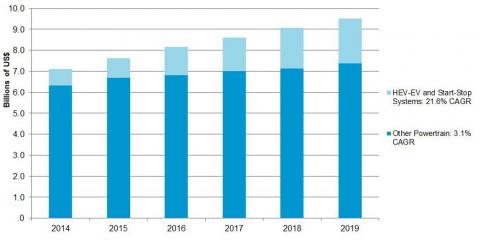
Revenues related to powertrain semiconductors look set to increase with a compound annual growth rate (CAGR) of nearly six per cent in the next five years from US$7.2bn in 2014 to $9.5bn in 2019.
Electrification is propelling the powertrain semiconductor market on a global scale. As an example, start-stop systems are forecast to grow at a CAGR of 21 per cent, while plug-in hybrid vehicles are expected to have a strong annual growth of 37 per cent for the next five years. In addition, for internal combustion engines, there is an increasing trend away from traditional incumbent multi-port fuel injection systems towards petrol direct injection systems. Direct injection systems are more efficient and require higher semiconductor content than their multi-port counterparts.
Without electrification, the powertrain semiconductor market would have only grown 3.1 per cent annually for the next five years, whereas electrification is now accelerating the market at six per cent growth rate annually.
Electric and hybrid vehicles
Propulsion systems for electric and hybrid vehicles demand, on average, ten times more semiconductor content than a conventional engine. Some key components include the motor inverter, DC-DC converter, battery management system and plug-in charger, all of which require power management by analogue integrated circuits (ICs) and discrete components. Growth rates are expected to be high, as the market is currently relatively small.
These applications saw growth of 24 per cent in 2014 and another 22 per cent increase is forecast in 2015, the highest of any automotive semiconductor application. From a revenue perspective, semiconductor content in electric and hybrid vehicles is expected to generate more than $1bn in total revenue growth from 2014 to 2019, by which time $1.6bn will be generated in this segment.
Powertrain systems
Emissions legislation efforts in most regions around the world are the main drivers for semiconductor sales in powertrain applications, while current concepts in engines and exhaust after-treatment systems for internal combustion engines, together with a requirement for on-board diagnostics, require sensors for their operation. As a result, the market for semiconductors in internal combustion engines was $5.3bn in 2014, growing to $6.2bn in 2019.
The engine control unit (ECU) consumes most of the semiconductor content in these applications, in addition to a growing trend towards electrification of various components – including fans, water pumps and oil pumps – that will further contribute to powertrain semiconductor revenues in the future.
Leading the path for growth, however, is the start-stop system, which uses semiconductor components to sense when a vehicle is stopped, and turns off the engine, thereby saving fuel and reducing CO2 output.
Transmission management
Transmissions are well-established systems for semiconductors, but recent new concepts with higher electronics content – such as dual-clutch transmissions (DCTs) and continuously variable transmissions (CVTs) – have entered the market. As a result, this portion of the semiconductor market is expected to grow from $1.4bn in 2014 to $1.5bn by 2019. Most new growth stems from the demands on microcontrollers, particularly as a result of increased sensor content featured in new transmissions. China, Japan and eventually Europe will drive the market for DCTs, while China, south Asia and eventually North America will drive the market for CVTs.
Trends
Under the challenging emission circumstances, the tier ones and OEMs have devised exhaust-cleaning strategies while maintaining car performance and improving fuel consumption. These strategies comply with on-board diagnostics and functional safety level standards such as ISO26262 where applicable. The sensors per se are also more intelligent due to an inherent ability to perform self-tests.
The evolution in legislation has lead to a significant increase in the number of inputs into the engine control unit. The other, less well developed markets such as south Asia, Russia, China and Brazil have also increased their use of sensors that have been previously deployed as a result of advanced US, Japanese and European standards, which also drive the market for pressure, speed and position sensors, among others.
Microcontrollers
The evolution of sensors for powertrains has brought a development in microcontrollers. These MCUs represent the brain of the system, and with an increase in the number of inputs, the MCU needs a higher processing power in addition to more memory and higher frequency of operation.
Apart from the impact of emission standards on MCUs, new injection systems, engine principles and increases in the number of forward speeds in the transmission demand different specifications. An MCU specified for the engine control unit of a diesel engine might operate at a frequency three times higher than an equivalent MCU in the engine control unit of a petrol engine with a multi-port fuel injection system.
Powertrain MCUs are undergoing evolutionary changes. In the past, a 32bit MCU would have sufficed for all processing, but now due to increasing DMips and asil compliancy requirements, there can be two MCUs, one a 32bit device and the other a 16bit MCU in the engine and transmission control units. This architecture could soon be replaced by one multi-core MCUs (two or more cores) in the control unit. Multi-core MCUs are already available in the market. The big MCU suppliers — Renesas, Freescale and Infineon — launched multi-core products as early as 2011.
Batteries
Today, there are mainly two types of battery technologies used in hybrid and electric vehicles – nickel metal hydride (NiMH) and lithium ion (Li-ion). These batteries made up of small cells are continuously monitored using a battery management system or BMS. The state of health (SoH), state of charge (SoC) and depth of discharge (DoD) are key parameters that need to be monitored.
These two battery types have been in fierce competition in the past, but now Li-ion batteries are winning today. OEMs such as Daimler, Nissan, Honda, BMW, Tesla, Opel, Peugeot and Ford are already using Li-ion batteries for hybrid and electric models. The Toyota Prius is the most successful hybrid model by volume and has been the main driving factor for NiMH battery development.
Today, 50 per cent of the batteries in hybrid and electric vehicles are NiMH but this share is expected to fall drastically to 11 per cent by the end of 2020. On the other hand, Li-ion technology – which had a 42 per cent share of the batteries in 2014 – is forecast to increase to 82 per cent penetration by 2020. This rapid shift will dramatically affect the semiconductor market for BMS. Li-ion batteries require more intelligent control technology as the battery has to be monitored at a cell level, as compared with modular level in NiMH.
Ahad Ahmed Buksh is an automotive software analyst at IHS
