Power Technologies: In balance
Jeff Gruetter from Linear Technology discusses how a power IC can increase safety and performance while reducing emissions
Globally, legislation is driving the development of next generation vehicle technology, offering further enhancements to emissions control and safety. Industry competition and consumer expectations are leading to higher levels of vehicle connectivity to the cloud and personal portable devices.
According to Strategy Analytics, demand for enabling semiconductor devices is expected to grow at a CAAGR of five per cent to a market worth over $41bn by 2021. The analysis also identifies that demand for microcontroller and power semiconductors will drive over 40 per cent of revenues.
Strategy Analytics provides a very quantitative description of forecasting the growth of electronics content in automobiles and commercial vehicles but, more importantly, the prevalent role that power ICs play in this growth. The latest power IC designs must offer:
- • The highest efficiency possible to reduce thermal problems and optimise battery run-time.
- • Operation from a wide range of battery input voltages; both single-cell (automotive) and dual-cell (commercial vehicle) lead acid applications that can accommodate wide transient voltage swings.
- • Ultralow quiescent current to enable always-on systems such as security, environmental control and infotainment to stay engaged without draining the vehicle’s battery when its engine (alternator) is not running.
- • Switching frequencies of 2MHz or greater to keep the switching noise out of the AM radio band and to keep footprints very small.
- • Lowest EMI and EMC emission possible to reduce noise interference concerns within electronics.
The goal of the increased performance levels of power ICs is to design increasingly complex and numerous electronic systems found in automobiles to increase comfort, safety and performance while simultaneously reducing harmful emissions. Specific applications fuelling the growth for electronic content in cars are found in every aspect of the vehicle.
For example, new safety applications, including lane monitoring, adaptive safety control and automatic turning, dimming headlights and infotainment including telematics continue to evolve and pack in more functionality, and must support an ever growing number of cloud applications. Advanced engine management implements stop-start and electronics-laden transmissions and engine control. Drive train and chassis management is aimed at simultaneously improving performance, safety and comfort. A few years ago these were only found in high-end luxury cars, but now they are commonly found in automobiles from every manufacturer, accelerating automotive power IC growth at even a faster rate.
One of the key drivers for the growth of electronics is the adoption of complex electronics to improve the performance, comfort and safety of vehicles. But many of these are also designed to be used in a myriad of commercial vehicles, including lorries, buses and forklifts. These applications generally use double batteries. But designers of many automotive systems would like the same design to service both single-cell automotive applications and dual-cell commercial vehicles, requiring a single power IC that can accommodate both configurations.
By using two lead acid batteries in series, the nominal battery voltage increases to 24V and requires transient protection to 60V during load dump compared with a nominal voltage of 12V for a car and its load dump requirement of 36V. Conversely, single-cell automobile applications require power ICs so operate with inputs as low as 3.5V to accommodate low starting voltages found in cold-crank and stop-start scenarios.
In dual cell applications, this low input requirement is greatly relaxed and only a minimum of 7V battery voltage is required. There is a wide temporary voltage swing during cold-crank, stop-start and load dump for single-cell lead-acid batteries. Dual cell applications look similar, but the maximum voltage during load dump is generally 60V and the minimum during cold-crank and stop-start is 7V.
High efficiency
High efficiency operation of power management ICs in automotive applications is of primary importance for two main reasons. First, the more efficient the power conversion, the less energy is wasted in the form of heat. As heat is the enemy of the long-term reliability of any electronic system, it must be managed effectively which generally requires heat sinks for cooling adding complexity, size and cost.
Secondly, any wasted electrical energy in hybrids or EVs will directly reduce their range. Until recently, high-voltage monolithic power management ICs and high-efficiency synchronous rectification designs were mutually exclusive as the required IC processes could not support both goals.
Historically, the highest efficiency came from high voltage controllers, which used external mosfets for their synchronous rectification. However, these configurations are relatively complex and bulky for applications under 15W when compared with a monolithic alternative. Fortunately, new power management ICs that can offer both high voltage (to 65V) and high efficiency and internal synchronous rectification can be found in the marketplace.
Supply current
Many electronic subsystems are required to operate in standby or keep-alive mode, drawing low quiescent current at a regulated voltage while in this state. These circuits can be found in most navigation, safety, security and engine management electronic power systems.
Each subsystem can use several microprocessors and microcontrollers. Most luxury cars have over 150 of these DSPs onboard and approximately a fifth of these require always-on operation. Here, the power conversion ICs must operate in two different modes. First, when the car is running, the power conversion circuits that power these DSPs will generally operate at full current fed by the battery and charging system. However, when the car ignition is turned off, the microprocessors must be kept alive, requiring their power ICs to provide a constant voltage while drawing low current from the battery. Since there can be upwards of 30 of these always-on processors operating at once, there is a significant power demand on the battery even when the ignition is turned off.
Collectively, hundreds of milliamps of supply current can be required to power these always-on processors, which could completely drain a battery in a matter of days. For example, if a car’s high voltage step-down converters require 2mA of supply current each, combining 30 of these from security systems, GPS and remote keyless entry with other mandatory always-on systems such as ABS brakes and leakage current from electronically actuated windows could drain a battery after an extended three week business trip, rendering it unable to turn over the engine. Therefore, the quiescent current of these power supplies needs to be drastically reduced to preserve battery life without increasing the size or complexity of the electronics.
Until recently, the requirement of high input voltage capability and low quiescent currents were mutually exclusive parameters for a DC-DC converter. To manage these requirements better, a decade ago several automotive manufacturers created a low quiescent current target of less than 100µA for each always-on DC-DC converter, but today anything lower than 10µA is preferred. Luckily, a new generation of power ICs has been introduced, which offers quiescent currents of less than 3µA.
Alternatives
The voltage range of single-battery automobiles and dual-battery commercial vehicle power buses can vary from under 3.5V to over 60V as they are exposed to different transient scenarios and configurations. The need for well regulated voltage rails in spite of this wide range of input voltages requires wide input voltage, high performance power conversion ICs.
As the growth of electronic content in automobiles continues to accelerate with electronic control modules (ECMs) used for security, safety, navigation, chassis control, and engine and transmission management so will the need for high voltage power management ICs that can offer high efficiency, low quiescent current, high frequency switching with very robust protection features and reliability. Fortunately, IC designs are already meeting these demanding requirements.
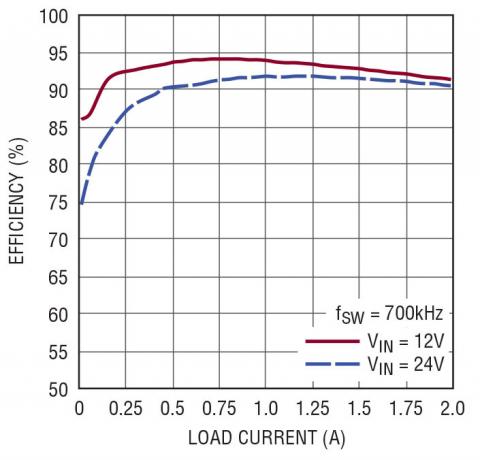
Their synchronous rectification design includes internal top and bottom mosfets to deliver efficiencies as high as 94 per cent. The graph shows they can deliver over 94 per cent efficiency when powering a 5V load from a nominal 12V input, even with a relatively high 700kHz switching frequency. Similarly, they can deliver up to 92 per cent efficiency when delivering 5V from a nominal 24V input. This high efficiency operation reduces wasted power and eliminates the need for heat sinks even in the most space constrained applications. In electric vehicles and hybrids, this can directly translate into increased driving range between battery recharges.
Additionally, burst-mode operation can reduce no load quiescent current to a 2.5µA making them suitable for always-on applications that must maintain constant voltage regulation even at no loads while increasing battery life. This is of particular importance due to the growing number of always-on systems including security, environmental control, data recording, safety and location.
Low dropout performance is also very beneficial, particularly in applications that must regulate outputs during stop-start or cold-crank conditions. Even when the input voltage drops below the programmed output voltage, 5V in this case, the output is always 500mV (at 2A) below the input voltage, once the input exceeds 2.9V. This is important because many ECMs require one or multiple microprocessors or microcontrollers. Although these are designed to operate from a nominal 5V, they continue to operate with supply voltages as low as 3V. So in a cold crank scenario, the input can drop as low as 3.4V and the microprocessor can continue to operate, enabling the ECU to operate seamlessly through cold crank.
Conclusion
The rapid growth of very complex electronics in automobiles and commercial vehicles has created even higher demands on power management ICs. One of the most notable is a single power IC which must accommodate both single and dual cell lead acid battery configurations and their required transient behaviour with a single power IC including stop-start, cold-crank and load-dump conditions. Furthermore, it must be capable of accurately regulating an output voltage throughout these conditions. Additionally, some of these systems will operate in an always-on standby mode, requiring low supply current.
As more electronics are added in ever shrinking spaces, reducing the footprint while increasing efficiency is also critical. Fortunately the latest power ICs that meet these demands are available paving the way for even higher electronic content in future vehicles.
Jeff Gruetter is product marketing engineer for Linear Technology, now part of Analog Devices
