Power Technologies: Four better than one
Multi-rail DC-DC converters are essential for adas, believes Tony Armstrong from Linear Technology
Advanced driver assistance systems, commonly known as adas, facilitate safe driving and warn the driver if the system detects risks from surrounding objects, whatever they might be. These systems are one of the major trends in automobiles for the second half of this decade.
They typically provide dynamic features such as adaptive cruise control, blind spot detection, lane departure warning, drowsiness monitoring, night vision and more. As a result, it is the increasing focus of consumers on safety, demands for comfort while driving and the continued increase of government safety regulations that are fuelling the growth of adas in automobiles.
At the heart of most adas is some kind of microprocessor to process all the input from the various sensors within the vehicle and to then process it so that it can be presented to the driver in a way that it can be easily seen and understood. Moreover, these systems are usually powered directly from the vehicles main battery that is a nominal 9 to 18V, but could be as high as 42V due to voltage transients within the system, and as low as 3.5V during a cold-crank condition.
Thus, it is clear that any DC-DC converter to be used must be able to handle a broad input voltage range of 3.5 to 42V.
Many adas will need a 5 and 3.3V rail to power its various analogue and digital IC content; however, it will be the processor IO and core voltages that will be in the sub-2V realm.
Furthermore, there are space and thermal considerations that must be taken into account.
While it is common to use a high voltage DC-DC converter for a 5 and 3.3V rail, using this kind of converter for sub-2V rails is not always practical due to the size of using multiple single output converters and the potential thermal constraints. More suitable would be to use a single DC-DC converter with multiple outputs.
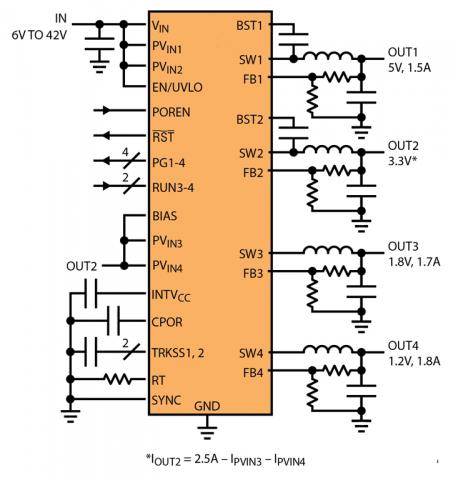
Such a device is shown in the diagram. This is a four-output monolithic synchronous buck converter. Its 3 to 42V input voltage range makes it suitable for automotive applications, including adas, which must regulate through cold-crank and stop-start scenarios with minimum input voltages as low as 3V and load dump transients in excess of 40V.
As can be seen in the diagram, its quad channel design combines two high voltage 2.5 and 1.5A channels with two lower voltage 1.8A channels to deliver four independent outputs, delivering voltages as low as 0.8V, enabling it to drive the lowest voltage microprocessor cores available.
Its synchronous rectification topology delivers up to 94 per cent efficiency while burst-mode operation keeps quiescent current under 30µA with all channels on in no-load standby conditions, making it suitable for always-on systems.
The switching frequency can be programmed from 250kHz to 2MHz and synchronised throughout this range. Its 60ns minimum on-time enables 16Vin to 2.0Vout step-down conversions on the high voltage channels with a 2MHz switching frequency.
Tony Armstrong is director of marketing for power products at Linear Technology, now part of Analog Devices
