Power Technologies: Heavy going
Bruce Haug from Linear Technology looks at an alternative to anti-surge devices in lorries and heavy-equipment environments
Lorry, automotive and heavy equipment environments are very demanding for any type of power conversion devices. Wide operating voltage ranges, coupled with large transients and wide temperature excursions, combine to make reliable and robust electronic system design challenging.
Further, some applications require installation of power conversion devices under the bonnet, so +150˚C operating capability is needed. At the same time, the number of electronic components is increasing, space requirements are shrinking, making high efficiency and high input surge voltage ride-through even more critical.
Whether it’s a load dump, cold crank or high temperature under the bonnet, automotive on-board power supplies need to be designed to operate reliably under all these conditions.
Under normal steady-state conditions, a 12V battery system only varies from about 9 to 18V and a 24V system about 21 to 36V. However, during a load dump transient, voltages in excess of 120V can be generated for hundreds of milliseconds.
A load-dump occurs when the alternator is charging the vehicle’s battery and an electrical open-circuit causes a momentary disconnection of the battery from the alternator – a very common phenomena. Until the voltage regulator can respond, the full alternator charging current is applied directly to the automotive power bus, raising its voltage to potentially dangerous levels. Such a transient could be caused through a physical disconnection and could also result from a faulty connection in the battery cable or corrosion at the battery terminals.
Other physical factors in vehicular design are also a concern. In particular there are long power supply lines that feed from the power distribution box in the engine compartment to the distant corners of the vehicle. The average automobile has approximately 1.6km of copper wire, compared with just 45m in 1948. Because of the inductive characteristics of long leads, there are even higher transient levels than those that occur during a load dump. The governing specification for tail light electronics is that they must be able to withstand transients of +100V. This can be a challenge for IC-based electronics such as LED tail light regulators.
Moreover, there are several electronic systems that require continuous power even when the vehicle’s motor is not running, such as remote keyless entry, GPS and security systems. It is essential for these types of always-on systems to have a DC-DC converter with low quiescent current to increase the battery run time when in sleep mode.
Under such circumstances, the regulator runs in normal continuous switching mode until the output current drops below a predetermined threshold of around 30 to 50mA. Below this level, the switching regulator must go into lower quiescent current operation to reduce the current draw, thereby reducing the power drawn from the battery, which in turn extends its run time.
Critical systems must survive, and must also function seamlessly through such transients without interruption. Until now, most vehicles have used a passive protection network consisting of a low-pass LC filter and a transient voltage suppression array to clamp the peak voltage excursions of the power bus. However, a high input voltage DC-DC step-down controller can operate through these high voltage surges and protect downstream components without the need of additional surge suppression devices.
Such a device is a non-isolated synchronous step-down switching regulator controller that drives all n-channel mosfet power stages. Its 4 to 140V (150V absolute maximum) input voltage range is designed to operate from a high input voltage source or from an input that has high voltage surges, eliminating the need for external surge suppression devices. It continues to operate at up to 100 per cent duty cycle during input voltage dips down to 4V, making it well suited to automotive, lorry and heavy equipment applications.
It can produce a 12V output from a 7 to 140V input voltage range. When the input voltage is below 12V, the output voltage will follow the input voltage since it would be running at 100 per cent duty cycle with the top mosfet on continuously. This feature is possible due to an on-board charge pump.
Burst mode
A device such as this can be enabled to enter high efficiency burst mode operation, constant frequency pulse skipping, or forced continuous conduction mode at low load currents. When configured for burst mode operation and during a light load condition, the converter will burst out a few pulses to maintain the charge voltage on the output capacitor. It then turns off the converter and goes into sleep mode with most of its internal circuits shut down.
The output capacitor supplies the load current and, when the voltage across the output capacitor drops to a programmed level, the converter starts back up, delivering more current to replenish the charge voltage. The action of shutting down and turning off most of its internal circuits significantly reduces quiescent current, thereby helping to extend the battery run-time in always-on systems when in standby mode.
Efficiency
The 8.5V output produces very high efficiency at up to 98 per cent. The 3.3V is also over 90 per cent efficient. In addition, this design is still over 75 per cent efficient for each output with a 1mA load, due to its burst mode operation.
Fast transient response
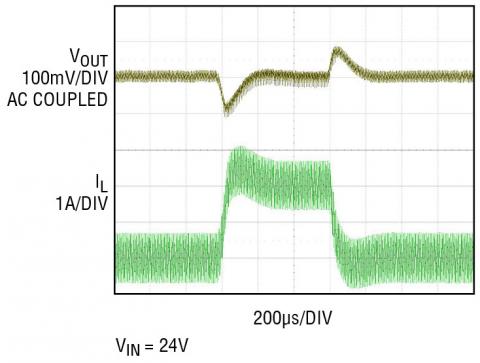
The device uses a fast 25MHz bandwidth op amp for output voltage feedback. The high bandwidth of the amplifier, along with high switching frequencies and low value inductor, allow for a very high gain crossover frequency. This enables optimisation of the compensation network for a very fast load transient response.
The diagram illustrates the transient response of a 2A step load on a 12V output with a less than 100mV deviation from nominal and a 200µs recovery time.
Conclusion
A new level of performance for safe and efficient operation can be brought to demanding high-voltage transient environments such as those commonly found in automotive DC-DC converters. This choice suits lorry, heavy equipment, rail and automotive applications, where high voltage transients are commonplace.
Bruce Haug is senior product marketing engineer with Linear Technology, now part of Analog Devices
