Powertrain evolution
Ian Riches from Strategy Analytics takes a look into the powertrain market
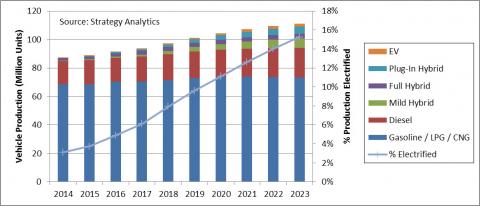
Despite the high profile of electric and hybrid vehicles, conventional petrol and diesel-powered models will remain the majority of the market for many years to come. Around 85 per cent of global light vehicle output is expected to be conventionally powered in 2023, as can be seen in the table.
However, that does not mean the powertrain control requirements for these vehicles are not changing. Vehicle manufacturers and their suppliers are facing ever-tightening controls on both fuel economy and exhaust emissions. This was the case before the recent emissions scandal involving diesel engines, but is arguably even more pressured now.
The result is that there are increasing requirements for more complex after-treatments, and the fitting of after-treatments to vehicles that had previously not used them. Ensuring that these after-treatments operate correctly clearly requires more complex control of the powertrain. Indeed, Mercedes already fits particulate filters to some of its petrol engine-models, starting in 2014 on the W222 S500. The company has said use will expand as it updates its engines.
As well as after-treatment changes, control strategies are also becoming more complex, with an increasing use of model-based control rather than simpler map-based techniques. Moving to model-based control typically means greater processing requirements. In some cases specific accelerator IP can be used, but it is more common to support model-based control directly on the processor core. This needs floating point support and, for efficient execution, the inclusion of some specific maths operations also helps.
Although electrified vehicles still make up a relatively small part of total global light vehicle production, this proportion will undoubtedly grow significantly as emissions targets tighten and vehicle manufacturers continue to release more affordable and desirable products.
Some research done by Strategy Analytics shows that demand for all types of electrified vehicles is predicted to grow from five per cent of total production in 2016 to 15% by 2023.
Total HEV and EV production is forecast to grow from around 3.3 million units in 2015 to 11.6 million by 2020, a unit CAAGR of over 28%. This is way above the expected 1.6% annual growth rate for conventionally-powered vehicles and 3.3% annual growth rate of production overall. Demand for electrified vehicles is forecast to grow further to more than 17.0 million units by 2023.
Vehicle types
There are many different types of electrified vehicles, which can be broadly categorised in order of their degree of electrification.
Mild hybrids are where the electric motor is typically less than 15kW and has only torque assist rather than any pure electric drive function. Vehicles of this type will see the second fastest growth of the various hybrid types, at a CAAGR of 45% over the 2015 to 2020 period. This is highly dependent upon the successful introduction of 48V technologies. This type of 48V mild hybrid is particularly expected to emerge in strength in Europe, as OEMs seek to develop cost-effective petrol-powered alternatives to diesel engines.
Full hybrids are where the electric motor is typically more than 30kW and can drive the car without any assistance from the internal combustion engine. The battery fitted to these vehicles is typically small, and the electric-only range is thus normally limited to just a few kilometres. These types of vehicles will see the slowest growth, with a CAAGR of 8% from 2015 to 2020, still well above the 3.3% overall market growth. This segment is currently by far the most popular and mature – for example the Toyota Prius – and thus growth is harder to achieve. In addition, demand is moving away to plug-in variants in some cases.
Plug-in hybrids are similar to the full hybrids, with a powerful electric motor, but typically with a much larger battery that can be recharged from an external source, and thus a much larger electric only range. They thus can offer the best of all worlds, with an electric-only range suitable for every day commuting, but a petrol-supported range and high-speed petrol refuelling to allow much longer trips. These types of vehicle will see the fastest growth, with unit CAAGR of 54% over 2015 to 2020. Plug-in hybrid production is thus expected to overtake the full hybrid market in 2020.
Pure electric vehicles have no petrol or diesel engine. They will see the third-fastest growth, with a unit CAAGR of over 34% over the 2015 to 2020 period, albeit from a very low current base. New models from volume car makers will be required for these forecasts to be met. The cost and range of these vehicles will likely continue to limit their adoption for some time to come.
Processors
This change in the powertrain mix – together with the pressure on emissions and fuel economy in conventional, vehicles – is leading to increased demands on powertrain controllers and their embedded processors. Hybrid vehicles, which feature both an internal combustion engine and electric motor drive, need to have both of these systems controlled, as well as sophisticated algorithms to decide the combination of output from the two propulsion sources in response to the driver’s dynamic torque demand. Battery management systems are also required to monitor and control the charging, discharging and thermal management of the typically lithium ion battery packs. Plug-in hybrids and pure EVs additionally require an on-board charger controller and hence, in total, could be running with half-a-dozen 32bit microcontrollers for the powertrain alone.
Even on the conceptually simpler pure electric vehicles, the control strategies can be complex.
The electric motor is typically handling both acceleration and deceleration torque requests, as the vehicles make use of regenerative braking.
Some vehicles are using multiple electric motors for higher-performance. Elements of dynamic control in terms of torque vectoring and front-rear torque split need to be managed and controlled.
Overlaying all these performance requirements is the increasing need for functional safety. The driver is getting ever further removed from direct control of the torque output, so ensuring a predictable and safe motor response in all circumstances is required.
In addition, recent years have seen an ever-increasing focus on functional safety across all automotive applications, with the publication in 2011 of ISO 26262. An example of one area in which this impacts powertrains is in battery management systems for electric and hybrid vehicles. The large 90kWh lithium ion battery pack in a Tesla contains the equivalent amount of energy as 77kg of TNT explosive. Although this remains less energy than stored in a typical vehicle’s petrol tank, the correct thermal and charge management of these batteries – overseen by electronic control units – is vital to ensure safe operation.
Semiconductor vendors have thus been required to help support, both in terms of the specific design features of their products such as dual core lock step, ECC protected memory and buses, and the design processes, for example the provision of a safety manual and support for IEC 61508 SIL 3 and ISO 262626 Asil D.
The final emerging challenge for powertrain control is the trend towards centralisation. A current high-end vehicle can have more than 100 separate electronic control units. Within powertrain systems it is not uncommon to have separate controllers for basic internal combustion engine control, valve-train control (for example BMW Valvetronic), transmission control, as well as control of any traction motors, inverters and batteries in a hybrid vehicle.
Many OEMs, especially those at the luxury end of the market, are now seeking to consolidate control functions into a smaller number of more powerful ECUs. These controllers are likely to be multiple processor devices, with each processor itself likely featuring multiple cores and running multiple applications. The ability to run multiple operating systems and virtualise tasks under hypervisors will become increasingly important for all automotive application areas, not just in the infotainment domain.
It was clear from presentations and discussions at the June 2016 Ludwigsburg Automobil Elektronik Kongress that BMW, Mercedes and Audi are all pursuing a centralisation strategy for their future vehicle architectures. It was also clear that the task is non-trivial, and that a jump from highly decentralised straight to highly centralised is very unlikely. From this it’s logical to expect a growing use of so-called domain controller type architectures, which see the integration of functions within a single vehicle domain such as the powertrain into a single controller.
One vision of where this trend may lead was given recently by BMW in a recent announcement of its upcoming autonomous vehicle platform. BMW made it clear than it foresaw such a vehicle essentially having two large controllers – one to control the vehicle, and one to control the infotainment platform. This is a long-term trend, and unlikely to have any impact on the volume market this side of 2020. However, semiconductor investment cycles are long, and action is required now to meet these emerging requirements.
The upshot of these changing and challenging requirements is that demand for processors used in engine control applications is expected to exceed $1bn in 2023. This represents around 9% of the total demand for processors in OE-fit light vehicle applications.
Within these engine control applications, processor demand from electrified powertrains is growing far faster than that for conventional petrol and diesel-powered vehicles. By 2023 over 37% of all engine control processor demand will come from electrified vehicles. This is much higher than the 15% of production that these vehicles will represent, as many of these electrified vehicles will be hybrids, and thus require control of the petrol or diesel engine as well as the motor, inverter and battery.
In 2020, a typical petrol-only powered vehicle will have around $7 of processor content in engine control applications. For a plug-in hybrid vehicle, that processor content in engine control will be much higher in 2020, at over $34.
Implications
With powertrain processors today, most are using proprietary architectures, however there are a number of indications that this could change for future iterations. All automotive-focused semiconductor vendors face the significant challenge of investing large sums in these proprietary architectures to continue to update them for next-gen powertrains. The requirements are not static, and decisions will need to be made on when or if to update product line-ups. An off-the-shelf product that already has the required safety features and processes with documentation for safety-critical applications could accelerate time to market for new designs.
In the longer-term, as automotive control becomes more centralised, some OEMs such as BMW have the vision of centralising all significant vehicle dynamic control into a single module. This is being done as part of the move towards more automated vehicles. In the context of a seismic shift from multiple, distributed control boxes to a smaller number of more powerful devices, the move from a proprietary architecture to a standardised one looks more appetising.
Ian Riches is director of Strategy Analytics’s global automotive practice
