Powertrains: The road to a clean future
Peter Harrop from IDTechEx looks at the main powertrain options for land vehicles over the next twenty years
In the coming decades the improvement and choice of land vehicle powertrain will mainly be dictated by emissions conformance at best cost versus performance compromise and not independently performance, cost and fuel economy as in the past. Cost embraces upfront cost, cost of ownership and resale price issues. This will result in popularity moving from conventional to pure electric as laws tighten and technology improves.
Pure electric is already the norm for most small land e-vehicles such as electric bicycles, mobility for the disabled, scooters, e-tuktuks, e-rickshaws and other micro EVs, such as quadricycle homologation in Europe. Other examples are indoor forklifts and electric airport ground support equipment (GSE). Some are already large markets not to be confused with cars homologated as such.
For example, Terra Motors of Japan makes the three-wheeled micro EVs and Bangladesh alone is importing 500,000 yearly from China and, in India, the ICE three wheeler replacement potential is over five million. The Philippines, with 3.2 million taxi tuk-tuks to replace due to extreme pollution has just announced that it will put one million EVs on its roads very soon. Over 70 per cent of golf cars are already pure electric, the rest being internal combustion not hybrid. Continuing this progress, many microcars are jumping directly from ICE to pure electric.
New end game
Compared with previous understanding of the subject, significant new powertrain arrivals are 48V mild hybrids (MH) – set to replace much conventional ICE and non-plug-in strong hybrid – and energy independent vehicles (EIV), the new end game. The Immortus car currently fundraising for manufacture in Australia is an example of an EIV as is the NFH-H tourist microbus already on sale in China.
Both rely on unusually efficient, large areas of photovoltaics for power and nothing else. Indeed, the tourist bus is available without battery in ultra-light lizard mode, waking with the daylight. Yes, the end game is even more radical than thought.
EIVs may be heading to a multibillion dollar business in 10 to 15 years, mimicking the EIV airships and planes that stay aloft for five to ten years, already the subject of billions of dollars investment by Nasa, Facebook, Google and so on today.
EIV powertrain impact will be huge from enabling the developing world and remote communities to military applications. EIV land vehicles could be a $250bn business in 20 to 30 years. They will not be significant long before that in spawning new technologies useful in many types of vehicle, rather like Formula One today. Indeed, the world record breaking Nuon Solar Team from the Netherlands, with their solar racers crossing Australia fastest, has already spawned five start-ups and other solar racers have set records for photovoltaics and motor efficiency on land vehicles. Meanwhile, there is a move from range anxiety to range excess with PEVs as the world awaits unlimited range of EIVs. Will the Nanoflowcell pure electric hypercar really have over 1600km range as claimed this year? If not, one certainly will one day.
Newly low cost route
At the other extreme of making existing ICE powertrains have three electric modes – silent take-off, creeping in traffic and maintained-speed active coasting – there is the 48V mild hybrid. It is the lowest cost route to an electric vehicle at the larger C and D sizes of car and larger vehicles such as vans, trucks and buses.
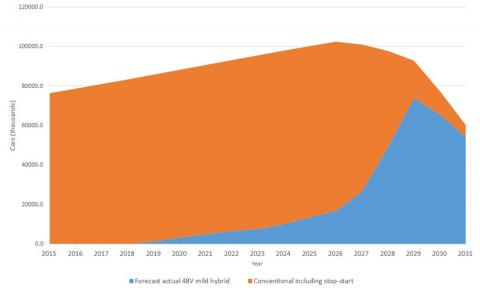
Following first series production in 2017, and even then not yet in EV form, it is possible that 48V mild hybrids will peak at over $250bn in yearly sales before pure electric takes over because they look to be the only low cost way that manufacturers can meet the tough 2030 emissions legislation with minimal hassle, not because they are a poor man's EV, though that will help to sell them as will the fuel economy.
Common enablers
Certain enabling technologies are common to most or all of the powertrain configurations identified as commercially important over the coming twenty years beyond the ubiquitous internal combustion engine usually with stop-start. These include new reversing electric machines, power electronics and lithium-ion batteries.
However, it is misleading to say, as some have done in 2016, that this removes risk from powertrain choice. For example, a downsized, down-speeded ICE for a 48V MH is managing huge load variations as primary traction whereas one used as a range extender, simply charging a battery when needed, may be at almost constant, gentle torque and revolutions – a completely different, far simpler design. The same is true of a reversing electric machine – the modern equivalent of a traction motor, alternator and starter – for a 48V mild hybrid versus one for a pure electric vehicle with much tougher traction requirements and no starter function.
The one in a pure electric vehicle will increasingly get much of its charge from multiple energy harvesting and regeneration not the motor going backwards as with regenerative braking. Nevertheless, a trend to more than one reversing electric machine per vehicle is seen from 48V MH right through strong hybrids to pure electric powertrains.
Facilitating change and disruption
Facilitating these priorities in design of the land vehicles of the future are certain approaches to powertrains such as light-weighting, size reduction, cost reduction, improvement in reliability, safety, life and so on.
Much of this will be tackled disruptively, for example by structural electronics and new components such as GaAs photovoltaics or GaN power semiconductors sometimes removing the need for water cooling. The Li-ion battery will be completely reinvented with new anodes, cathodes and non-flammable electrolytes possibly removing the need for some safety sensors and electronics and possibly making them suitable for moulding into load-bearing structures, saving weight, space and reducing the cooling requirement.
Supercapacitors, being electrostatic and not moving at all, are first candidates for this however. New systems will be added such as regenerative active suspension, high power charging, inductive charging interfaces and vehicle-to-grid (V2G) electronics on-board becoming part of the powertrain. One worry is that that long term testing becomes useless if the original component in any of these has been withdrawn or redesigned radically on the production line while testing is carried out.
Forecasting
Forecasting now becomes very difficult indeed because one is estimating such things as unpredictable politicians and their subsidies and inventions yet to be made. Add to that deciding whether cars will be mainly rental, throttling market growth or not or mainly autonomous, making the powertrain a commodity in the view recently expressed by Porsche Engineering. However, someone has to try.
A possible scenario of the number of cars sold globally that are conventional ICE versus mild hybrid, with several pure electric modes in later years is shown in the graph. There will be an eventual collapse in sales of both as mainstream pure electric vehicles take over when they are the most attractive and affordable option in the view of most mainstream buyers.
Peter Harrop is chairman of IDTechEx
