Programmable Logic: Load up
Steve Rogerson looks at the automotive plans of Altera and Xilinx
There is no doubt that the automotive programmable logic market heated up last month as both major players – Altera and Xilinx – hit the news. Altera was the big story, as Intel announced it was acquiring the company, almost overshadowing the announcement of its Stratix 10 family, which could have major implications in the autonomous vehicles market. But Xilinx was determined not to be outdone as it revealed its revised automotive roadmap.
But first Altera. Intel announced it was buying the California company for US$16.7bn as it sought to take control of its FPGA products for use in IoT infrastructure applications. The acquisition will couple Intel’s products and manufacturing process with Altera’s FPGA technology. The combination is expected to enable new classes of products that meet customer needs in the data centre and IoT market segments.
“I think this is a very cool move,” said Chris Balough, senior director for Altera. “It will be good for us. Intel is looking at merging their processors with our FPGAs. Imagine a new class of products that merge our technology with their technology. About thirty per cent of data centres could benefit from this.”
Intel plans to offer Altera’s FPGA products with Intel Xeon processors as customised, integrated products. The companies also expect to enhance Altera’s products through design and manufacturing improvements resulting from Intel’s integrated device manufacturing model.
“This is a dramatic piece of news,” said Balough. “It is Intel’s largest acquisition price in its history. There is clearly a lot of value they place on our technology.”
With $2bn in 2014 revenues, Altera is the second-largest – behind Xilinx – supplier of programmable logic devices and SoC FPGAs.
There are many applications and markets where a high-performance MPU and configurable logic are designed to work side by side – industrial applications for military and aerospace, manufacturing and process control, automotive applications, security and surveillance, and broadcast, and more. Even in high-performance computing, FPGAs will perform co-processing functions.
Stratix 10
However, could Altera’s Stratix 10 be the jewel that Intel wanted with thise takeover? Even though details of the FPGAs and SoCs were only made public after the takeover announcement, Intel has known about them for some time – they use Intel technology and Intel is the exclusive foundry for Altera and thus has access to its roadmap.
The Stratix 10 is a major step up from previous Altera products and it is targeted right at data centres and IoT infrastructure applications, the area that Intel is desperate to dominate as its core PC business slides. But interestingly, trials of autonomous vehicles are being seen as a key area for the FPGAs and SoCs, according to Craig Davis, the company’s product marketing manager.
They use Altera’s HyperFlex FPGA fabric architecture built on the Intel 14nm tri-gate process to provide double the core performance over previous generation FPGAs. The devices are based on quad-core Arm Cortex-A53 processors and have 10Tflops on a single piece of silicon. They can have up to 5.5 million logic elements.
Combining what is claimed to be the industry’s highest performance, highest density FPGA with advanced embedded processing capabilities, GPU-class floating point computation performance and heterogeneous 3D SiP integration, enables users to address design challenges in the next generation of communications, data centre, IoT infrastructure, military and high-performance computing systems.
However, Davis said the device was also attracting interest from car manufacturers carrying out trials of autonomous vehicles.
“These are for the prototypes where they are willing to spend the money,” he said. “We have had interest from some of the car makers doing this.”
He said the devices were not really suitable for current adas functions, as there were other devices in Altera’s range that were a better fit.
“But for the autonomous testing, that is happening,” he said. “They are a good fit.”
Xilinx
Not surprisingly, Xilinx has not been quiet while all this has been going on. The company was quick to put out a statement reasserting its commitment to its existing roadmaps, markets and industry drivers, in particular its continued expansion of its FPGAs, 3D ICs and Arm-based SoCs.
“Xilinx is totally committed to our existing roadmap and highly valued customers across all existing markets, including, but not limited to aerospace and defence, test and measurement, ISM, automotive, broadcast, wired communications, wireless communications and data centres,” said Moshe Gavrielov, CEO of Xilinx.
The statement even speculated that the Intel-Altera partnership could lead to a more x86-centric approach, neglecting growing Arm-based applications.
“Our strategic goal is to expand our user base fivefold in five years, enabling FPGA, software and system engineers to directly programme Xilinx all programmable devices,” said Gavrielov. “We also intend to play a central role in the key industry drivers of 5G, software-defined networking, network function virtualisation, cloud computing, industrial IoT and video and vision applications, including adas and the roadmap to autonomous vehicles.”
To back this up, the company did a series of briefings to reassure people of its continued commitment to automotive, a market that it has been in since 2002 and in which it won its first major success in 2004 with Mercedes-Benz for radar assisted adaptive cruise control. On the Ford F-150, the highest selling petrol vehicle in North America, it has several design wins as well as in Japan with Honda, Acura and Isuzu and in Europe with Audi and Volkswagen. It now has a 60 per cent share in automotive PLDs.
“We are in the top ten of global automotive processor and logic suppliers and expect to be number seven or eight within the next 12 months,” said Stephan Janouch, senior manager for automotive at Xilinx. “This is due to our presence in the adas market.”
The company’s focus is on the adas, infotainment and driver information markets rather than in the powertrain area where there is a demand for up to 150˚C ambient temperatures.
“The highest we specify is 125˚C, and in reality this is not sufficient for powertrain applications,” said Janouch. “We have been looking at some powertrain applications where we would have a value proposition, but it doesn’t make sense for us to compete in a market where customers are using $1 microcontrollers. There is not enough meat for us.”
The company has six technologies that meet AEC-Q100 and are in volume production at OEMs. There are four in the FPGA sector – S2E 0.15µm, S3 90nm, S6 45nm and Zynq and Artix 28nm – and two in CPLDs – CRII 0.18µm and 9500XL 0.35µm. The company also has its home-made quality system that it claims is double some of the requirements of AEC-Q100.
Out of its target automotive markets, infotainment is where it getting the most revenue but adas is where the company has the most design wins.
“In the not so distant future, we will generate more revenue with driver assistance,” said Janouch. “The growth rate for adas is a lot higher than infotainment.”
He said a lot of this was due to infotainment functions now being handled by standard chipsets, whereas with adas the flexibility of programmable logic was a major requirement. As car makers continue on their goal towards autonomous driving, this will grow further.
“The path to autonomous driving is marked pretty clearly,” he said. “We know the steps on the way and we know where we are going. We want a flexible and scalable architecture that can work on low-end as well as high-end vehicles.”
One of the big steps for semi-autonomous driving will be the Zynq Ultrascale+, which is scheduled for volume production for automotive by mid-2017. Development and discussions with customers have already started and first silicon is expected by the end of this year.
“Selected customers have a lot of the documentation already along with tools for up-front development,” said Janouch. “There is already a software emulator and a hardware emulation board. In the future, Ultrascale+ will replace several Zynq devices and the host controller.”
Features will include a four times better performance per watt ratio than current Zynq devices. It will consume more power but is hoped will deliver a lot more performance.
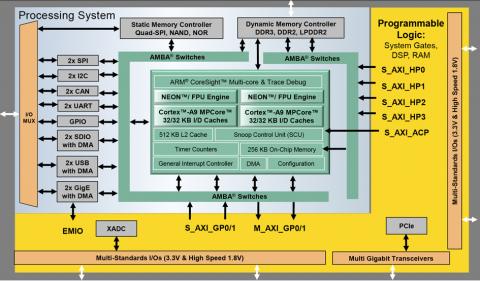
For now, a lot of the focus is still on the Zynq 28nm all-programmable SoC, which is already in production at several OEMs.
“We believe by 2020 this will be responsible for more than half of our automotive revenue,” he said. “However, it is almost impossible to win a design just with your own device, so we have built an ecosystem around our offerings.”
This roadmap and ecosystem is why Janouch is not worried about Altera having the future backing of Intel.
“I don’t see the Intel takeover of Altera as a threat to us,” he said. “We are not afraid of this combination.”
