Rattling the Cobra
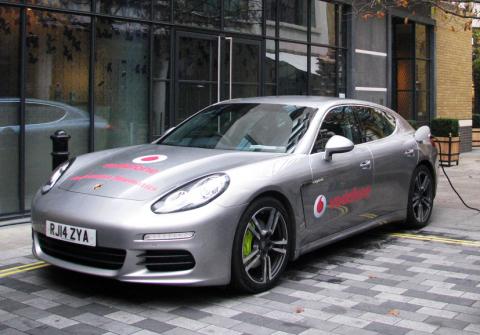
Steve Rogerson speaks with Vodafone about its plans in automotive following this year’s takeover of Cobra
Those who have had the good fortune to drive the latest Porsche Panamera S or Cayenne S hybrids will have found that they contain a neat piece of connectivity – also available as options on other models – that links the car to a smartphone. This technology comes from Italian company Cobra and could soon be made more widely available following the firm’s takeover by Vodafone earlier this year.
For Porsche, the technology is at the heart of its e-mobility push.
“It works through a phone app,” said Porsche spokesperson Rob Punshon. “You click on it and all the functionality is there on the home page in front of you.”
The my-car feature lets the user see immediately on the phone the amount of fuel and the range – it even has a map to show how far it can go either on fuel or on electric charge from its bank of Li-ion batteries, the state of charge of which is also displayed.
“As it charges, the range goes up on the map,” said Punshon. “And it gives you all you need to know about your plug-in status. You can even set times to start charging and pre-heat the cabin or turn the aircon on.”
A find-my-car function lets drivers locate the car if they’ve forgotten where they parked it.
Cobra, the company behind this technology, is not a new firm, in fact it has been around since the end of the 1970s.
“Today, we are the only company is this field that came from the automotive sector rather than from IT or services sectors,” said Ludovico Fassati, who was until the Vodafone takeover chief executive officer, but is now head of business development and strategy. Vodafone’s M2M director Eric Brenneis has taken over as CEO.
Among Cobra’s achievements over the years have been the invention of remote keyless entry systems and technology that sends the owner a text message if the car window is broken.
“We have always been a bit ahead of the big ones such as Continental and Bosch,” said Fassati.
The data from its black boxes are managed and analysed from its own service centres in Italy and the UK and from centres in 39 other countries that license the software.
“Most of the luxury car makers are our customers,” said Fassati. “We are the market leader in the UK on these types of systems. Porsche is our main customer in the automotive sector.”
The company also works a lot with the insurance companies for driver behaviour monitors and one of its biggest customers is insurance giant Generali.
“We initially founded our own insurance company in the UK because we were so convinced about our system,” said Fassati. “That led us to the contact with Genreali.”
The takeover by Vodafone was finally completed in August and it raised a few eyebrows as to why a mobile phone company would want to be so intimately involved in this business; after all, Cobra was already one of its customers and so profits from this business were helping the Vodafone bank balance anyway.
“The automotive market is one of the biggest growth markets in M2M,” explained Brenneis. “Less than ten per cent of vehicles have built-in connectivity today. Even most of the new cars don’t have built-in connectivity. As such, we see this as a huge growth area.”
He said companies such as BMW had paved the way for this growth with technologies such as e-call.
“We at Vodafone are one of the leaders in providing connectivity in devices for cars,” he said. “So we want to look at offering more M2M services and not just connectivity. We scanned the market and we found Cobra.”
For a couple of years, Cobra had been using Vodafone sim cards for its stolen-vehicle recovery service. And the phone company had its cards in the car-connect black boxes fitted into the Porsche cars.
“Cobra has also developed the software that reads the data from the black boxes, manages that data and analyses the data,” said Brenneis. “They also developed the app for the smartphone. They impressed us so much we thought if we take over this company we immediately become a major player in connected cars. We can now offer services such as stolen-vehicle tracking. That is the main reason we bought Cobra.”
The second reason, he said, was that it let Vodafone offer the complete value chain for automotive – the hardware, the network, application services and service centres that manage the data.
“These are the four parts of the value chain,” he said. “We are now with Cobra the only company that fully controls every single part of the value chain.”
For the future, he said there were plans to grow in several directions, taking advantage of Vodafone’s global sales force to increase the potential market for Cobra products.
“With Vodafone, we can address many more customers and we have a strong brand in countries that Cobra doesn’t, such as South Africa, India and Australia,” he said. “We are also going to continue to strengthen the technical team that builds the underlying hardware and platforms.”
This is important because it cannot just sell the same black box used by Porsche to other car makers as every car is different.
“In the Porsche, it connects directly to the car’s diagnostic system,” he said. “Also, different insurance companies have different algorithms to give them what they want. We have already started to put the Cobra teams to work on the hardware and software sides to develop for adjacent markets to automotive.”
He said it was too early in the development cycle to announce what these markets would be in detail but said there were working on developing a fully managed asset tracking service for yet-to-be-announced vertical segments.
To help Vodafone take Cobra into more companies, Mark Rose, Vodafone’s head of automotive, has been transferred to the Cobra team.
“What we have now with Cobra is a very sophisticated usage-based insurance service and a large customer with Generali,” said Rose. “We used to have a basic usage-based insurance service with Vodafone and that gives us contacts within the insurance companies. Now, with the Cobra capability, we can use the Vodafone sales teams to take that capability to them.”
Brenneis said this had brought surprising success in a short period of time.
“We have found another large insurance company that has taken that and we have found another car manufacturer that will take something similar to the Porsche one,” he said. “But we cannot announce either of them.”
Will Cameron, Vodafone’s senior communications manager, added: “The Vodafone name opens hell of a lot more doors than the Cobra name. We can now start thinking of more capabilities such as infotainment and Wifi.”
The long-term plan, said Brenneis, was that all these services would be offered in the Vodafone name, but because of Cobra’s reputation in some areas, especially security and insurance, it was likely to continue as a brand. Some of the products will also be offered through aftermarket channels, and these will include the fully managed tracking services.
“Cobra is stronger than Vodafone in the garages,” said Brenneis, “and we have never serviced them as an indirect channel but Cobra has and we will use that.”
Rose pointed out that there were a billion cars on the road and 90% of them had no connectivity: “These indirect channels can be used to push these products there. I am talking about things like usage-based insurance. This is another real strength we gained from the acquisition. There is great potential for growth.”
Another area that Cobra is in is ultrasonics for parking sensors and Vodafone is working with tier ones who use these sensors as part of its new push into automotive.
“On the R&D side,” said Brenneis, “we had started work before we bought Cobra to make sure our networks can support the future needs of autonomous driving and traffic management systems. The network at the moment is not suitable as there are too many latencies. But our teams are already working with car makers and others to develop the systems. We will bring all this together.”
And he said that there was no need to wait for the arrival of 5G to start addressing these issues. This is not likely to arrive until 2020 but he said that the evolution was already starting.
“We have time to make our network ready,” he said.
