R&D: Shades of grey matter
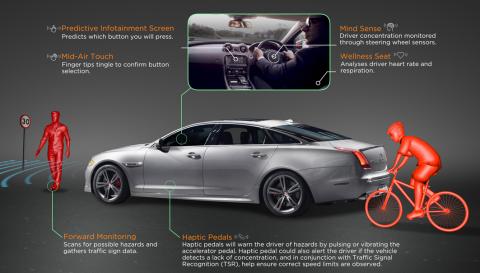
Jaguar Land Rover road safety research includes brain wave monitoring to improve driver concentration and reduce accidents
Jaguar Land Rover’s pioneering Mind Sense project is researching measuring brainwaves to monitor driver concentration in the car. Researchers are also developing a wellness seat in a Jaguar XJ that can analyses the driver’s heart rate and breathing to monitor driver health and stress.
Other products in development include touchscreens that predict which button the driver wants to press as the user’s fingers are in mid-air to reduce time spent with eyes off the road and a haptic accelerator pedal to communicate hazards to the driver.
The overall aim of these road safety technology research projects is to reduce the number of accidents caused by drivers who are stressed, distracted and not concentrating on the road ahead.
The Sixth Sense research projects use advanced technology – from sports, medicine and aerospace – to monitor the driver’s heart rate, respiration and levels of brain activity to identify driver stress, fatigue and lack of concentration. The UK-based team is also looking at innovations that would reduce the amount of time the driver’s eyes are off the road while driving, and how to communicate with the driver via pulses and vibrations through the accelerator pedal.
“We believe some of the technologies currently being used in aerospace and medicine could help improve road safety and enhance the driving experience,” said Wolfgang Epple, Jaguar Land Rover director of research and technology. “The car is becoming more intelligent and more able to utilise cutting-edge sensors. These research projects are investigating how we could exploit this for the benefit of our customers and other road users.
“One key piece of new research is to see how we could measure brainwaves to monitor if the driver is alert and concentrating on driving. Even if the eyes are on the road, a lack of concentration or a daydream will mean the driver isn’t paying attention to the driving task. They may miss a warning icon or sound, or be less aware of other road users so we are looking at how we could identify this and prevent it causing an accident.”
Mind sense
The basis of Jaguar Land Rover’s Mind Sense research is to see if a car could effectively read the brainwaves that indicate a driver is beginning to daydream, or feeling sleepy, while driving.
The human brain continually generates four or more distinct brainwaves at different frequencies. By continually monitoring which type of brainwave is dominant, an on-board computer could potentially assess whether a driver is focussed, daydreaming, sleepy or distracted.
“If brain activity indicates a daydream or poor concentration, then the steering wheel or pedals could vibrate to raise the driver’s awareness and re-engage them with driving,” said Epple. “If Mind Sense does not detect a surge in brain activity following the car displaying a warning icon or sound, then it could display it again, or communicate with the driver in a different way, to ensure the driver is made aware of a potential hazard.”
The most common method for monitoring brainwaves is close to the source using sensors attached to a headband, something that would be impractical in a vehicle. Jaguar Land Rover is investigating a method already used by Nasa to develop a pilot’s concentration skills and by the US bobsleigh team to enhance concentration and focus.
This detects brainwaves through the hands via sensors embedded in the steering wheel. Because the sensing is taking place further away from the driver’s head, software is used to amplify the signal and filter out the pure brainwave from any background noise. Jaguar Land Rover is conducting user trials to collect more information on the different brainwaves identified through the steering wheel sensors and will involve leading neuroscientists in the project to verify the results.
Wellness monitoring
The car maker is assessing how a vehicle could monitor the well-being of the driver using a medical-grade sensor embedded in the seat of a Jaguar XJ. The sensor, which was originally developed for use in hospitals, has been adapted for in-car use and detects vibrations from the driver’s heart beat and breathing.
“As we develop more autonomous driving technologies, there will be instances when the autonomous car needs to hand control back to the driver,” said Epple. “To do this safely, the car will need to know if the driver is alert and well enough to take over. So our research team is looking at the potential for a range of driver monitoring technologies to give the car enough information to support this decision. If the car detects severe health issues, or simply how alert the driver is, then the car could take steps to ensure the driver is focussed enough on the driving task to take over.”
Monitoring the physical health of the driver could not only detect the onset of sudden and serious illness that may incapacitate the driver, but also allow the car to monitor driver stress levels. This would then allow the car to help reduce stress, for example by changing mood lighting, audio settings and climate control.
Predictive screen
Technology can increase the speed and efficiency of the interaction between the driver and the infotainment screen. The aim is to reduce driver distraction by reducing the amount of time the driver’s eyes are on the screen.
“The driver will instinctively look at the infotainment screen or dashboard when pressing buttons to select navigation, music or the telephone,” said Epple. “It’s intuitive. So our research is looking at how we could take a current infotainment screen and increase the speed and efficiency of this interaction to minimise the time the driver’s eyes are away from the road and their hand is off the steering wheel.”
The predictive infotainment screen prototype uses cameras embedded in the car to track the driver’s hand movements and this enables the system to predict which button the driver intends to press. This allows successful button selection to take place in mid-air, which means users wouldn’t have to touch the screen itself. In user trials, this increases the speed of successful button selection by 22 per cent and therefore reduces the amount of time the driver is looking at the screen with their eyes off the road.
The system could also use mid-air touch to provide the driver with a sensation, otherwise known as haptic feedback, that their button selection has been successful. Mid-air touch uses ultrasonics to create a touch sensation in mid-air without the skin needing to be in contact with any surface. The sensations could include a tap on a finger or a tingling on the fingertips. As touch provides an immediate response to the brain, there will be no need for drivers to glance at the screen for visual confirmation which would help keep their gaze on the road ahead.
Haptic pedal
Haptics could also be used to communicate with the driver through the accelerator pedal to increase the speed of response and to ensure the correct action is taken.
To create these sensations in the accelerator pedal, an actuator sits at the top of the pedal arm and allows for vibrations or pulses to be passed through to the foot of the driver. The technology also uses a torque motor that can create resistance in the pedal feel.
This resistance could be used to notify the driver that they are pushing the accelerator through a speed limit. Alternatively, if you were crawling along in traffic a timely warning through the accelerator could prevent you bumping into the car in front.
“To avoid saturating the driver with more visuals and sounds, which could overload and distract them, we are exploring other ways for the car to communicate with the driver,” said Epple. “With our haptic pedals research we are investigating non-visual ways to communicate which would enable the driver to make smarter and faster decisions and reduce the potential for accidents.”
