Road temperature
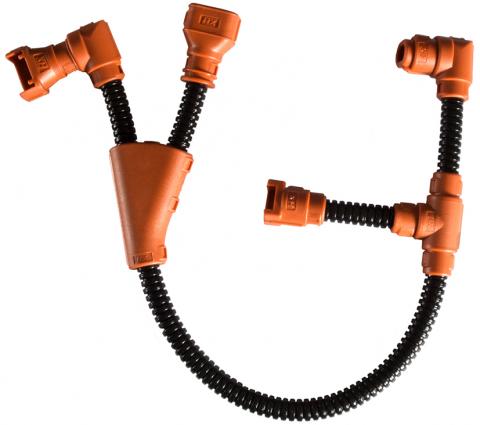
Meirion Buck from Harnessflex discusses protecting vital high temperature wiring and connectors from engine hot spots
Modern engine design has evolved, not just to achieve improved performance, but to meet changing regulations relating to safety, noise and emissions. The drive for greater efficiency and the reduction of NOx particulates has, in particular, been subject to increasingly stringent legislation.
In the past 24 years, engine and vehicle makers have invested heavily in developing technology that has seen the levels of NOx and particulate matter fall dramatically. The introduction of the Euro 6 and USA10 set some of the most stringent regulations for emissions, with permitted NOx levels of a diesel engine reduced by 75 per cent and particulate matter reduced to 0.01gm/kWh – or a further 66 per cent reduction – compared with Euro 5. Both Europe and America are expected to introduce further regulations in 2020.
Euro 6 represents a significant step change from Euro 5 and achieving compliancy alongside the goals of increasing power, tractability and efficiency has led to a growing number of engine design changes. For instance, the introduction and use of exhaust gas re-circulation (EGR), multiple and variable geometry turbocharging, and diesel particulate filtration technologies among others, have combined to create temperature hot spots within the engine bay, particularly near the EGR, injection and turbo systems.
In addition to these new technologies, improved controls, sensors and system monitoring modules are creating tightly packaged engines, making the protection of specialist high temperature cables even more pivotal.
One common answer is wrapping the wiring in heat reflective tape. While this acts as an effective heat shield, it can ultimately be expensive due to the amount of tape required and the potential need for reapplication during maintenance cycles. It also limits the flexibility of the cables, which can impact and limit the layout of the system for a manufacturer. Additionally taping doesn’t offer protection for the connector, which can leave it exposed and vulnerable to damage from vibration, impact and fluid ingress.
Conduit and fittings that cover both the cables and the connectors solve many, if not all, of the problems created by wrapping heat reflective tape. They not only provide the necessary protection from dirt, as well as pressure, steam or chemical cleaning, but relieve the strain on wiring to prevent disconnection or long-term issues.
For example, there are products designed to protect high-temperature cables from abrasion and ingress in temperatures up to +200˚C, representing a temperature rating increase of over 60 per cent against standard ranges. Such conduit and fittings are made from specialist co-polyester and polyamide, respectively, that provide long-term heat, age, tensile and impact strength to protect vital cable connections. Long-term heat age testing ensures consistent performance when the correct high temperature wiring is used.
While supporting the higher engine temperatures and cables that manufacturers and harness makers now need to work with, there is also a clear market requirement for a full system that includes both conduits and matching fittings. Specifying and installing a full system provides the user with complete high-temperature wiring and cabling protection, helping to reduce further possible wiring failures. It also means that a bespoke system can be developed in partnership with individual manufacturers to guarantee the best possible outcome for their specific engine.
It is also important to ensure that the fitting and connectors can provide a high back-stop and pull-off strength to guarantee a secure and reliable connection.
With the arrival of efficiency-led regulations and the on-going demand for higher performing vehicles that are also sensitive to noise levels, the automotive industry must now be taking the potential for high temperature issues seriously. Considering a complete conduit system, which covers both the high-temperature cables and connectors, can be ideal for compliance and improved performance.
Meirion Buck is senior design and technical manager for Harnessflex
