SiC DC-DC converter passes EV test
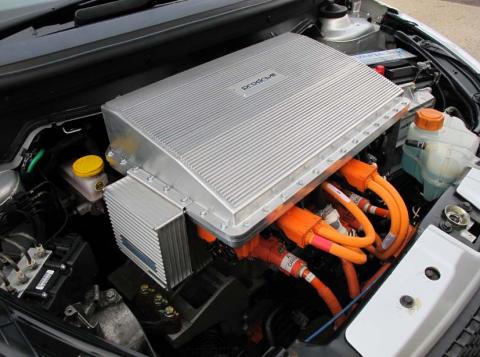
A consortium led by Prodrive has run a silicon carbide-based multiport DC-DC converter in an electric car. The converter controls power flow between multiple energy sources and has been able to achieve an efficiency of 98.7%, while increasing power density and reducing the size and weight of the converter when compared with silicon-based systems.
The DC-DC converter acts as a hub that transfers energy between components in the vehicle’s high voltage electrical system. It has four ports: two connect to the traction motor and high voltage battery; a third connects to a secondary energy source, which in this test car is a super capacitor bank; and the fourth powers the vehicle’s 12V systems. The converter can match the voltages of these components and transfer energy between them in response to Can commands from an external supervisory controller.
The test vehicle is a Tata Vista EV demonstrator, developed by the Tata Motors’ European technical centre in Warwick, UK. The vehicle has a 220V battery, 37kW traction motor and two 200kJ super capacitor banks, which operate at 75 to 150V.
In normal driving, the converter boosts the battery voltage to around 400V to optimise motor performance and can supplement the battery supply with additional energy from the super-cap banks when the driving situation demands. During regeneration, the converter transfers energy from the motor to the battery or super-capacitor banks as requested by the supervisory controller. Energy can also be transferred directly between the battery and super capacitor ports.
“The system can be configured to support other energy sources, such as fuel cells, or could supply multiple traction motors,” said Mark Willows, Prodrive electrical systems and control specialist.
A key aspect of the converter is the use of silicon carbide devices. These operate at a much higher frequency than equivalent silicon components – at 75kHz in the test vehicles – with a reduction in switching losses. This has resulted in a reduction in the size of the magnetic components and has enabled the converter to achieve an efficiency of 98.7%, a gravimetric power density of 10.5kW/kg and a volumetric power density of 20kW/litre.
The use of silicon carbide power modules could also allow much higher temperature operation than conventional silicon modules. This provides the potential to integrate the power electronics and IC engine cooling systems in hybrid applications.
The consortium is now working on a follow-up project to increase the converter operating voltage to 750V, further increase power density and demonstrate operation at increased coolant temperatures.
“For this project we have developed a rolling test bed based on a light commercial vehicle chassis, which has a 75kW traction motor,” said Willows. “The energy storage consists of a 320V Li-ion battery and two super capacitor banks, all of which were built by Prodrive specifically for this project.”
The consortium of British companies is backed by the Technology Strategy Board and led by Prodrive, working with the University of Manchester, Tata Motors, IST Power Products, Raytheon Systems and Scisys.
