Symtavision celebrates a decade of automotive timing analysis
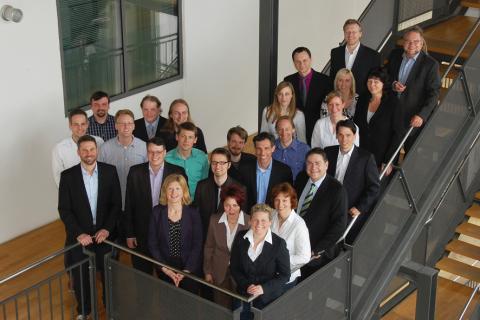
This month, Symtavision is celebrating its tenth anniversary in timing analysis for embedded real-time systems. The company was founded in 2005 by Marek Jersak (CEO) and Kai Richter (CTO) to commercialise timing analysis for automotive software and electronics using tools they had developed during their doctoral research at Braunschweig University of Technology in Germany.
Today, Symtavision provides tools – Symta/S and TraceAnalyzer – and professional services for planning, optimising and verifying the timing and performance of ECUs, networks, and electrical and electronic architectures, facilitating the integration of advanced system and software.
“Ten years ago timing analysis was in its infancy,” said Richter. “But with the trend towards networked software functions in automotive electronics and with the industry’s commitment through Autosar to the standards needed to drive a connected future forward, we knew it would have an increasingly crucial role to play. What we were not exactly sure of was when the topic of timing would reach economic scale.”
Today, Symtavision’s tools and services are deployed globally at leading premium and volume car manufacturers and tier-one suppliers including Audi, BMW, Bosch, Daimler, Denso, Fiat-Chrysler, General Motors, Hyundai-Kia, Toyota and VW. Symta/S is used in the traditional domains such as powertrain, chassis control and body electronics, in the network and electrical and electronics departments, and for the development of functions for adas and automated driving.
Momentum and take-up in this sector continues to build as companies seek to find better ways to manage how software can be integrated within the context of increasing complexity without ruining project budgets, destroying timelines or compromising quality.
Development of Symtavision’s tools – Symta/S for model-based timing analysis, optimisation and verification and TraceAnalyzer for analysis of actual traces from ECUs and networks – has been continuous over the past decade with improvements made in response to customers’ requirements, technological developments in automotive electronics and the enhancement of industry standards.
“The adoption of timing analysis in design methodologies has been an evolutionary rather than revolutionary process,” said Jersak. “In the early days, we spent a lot of time raising awareness that timing analysis is needed to manage the future and avoid getting stuck in testing the here and now. More recently, with timing becoming a key issue in practically all automotive electronics projects, companies have really begun looking at timing analysis and dynamic software architecture in a systematic way. Our customers save time and money by optimising and verifying concepts before committing to implementations. Any remaining timing and performance issues are fixed early and continuously until final verification.”
Today, the company’s products cover a broad spectrum of timing-related fields from network development (Can, CanN-FD, Ethernet, Flexray and Lin) and ECU development with rtos (Osek and Autosar-OS) including multicore. The tools are complemented by consulting in system architecture design, software integration and function development.
“A decade ago, when we founded Symtavision, timing analysis was an emerging trend,” said Richter. “Today, with the increased levels of design complexity and continuing pressures on unit costs as well as development timelines, timing analysis for embedded real-time systems is on the verge of becoming a global standard.”
