Technology Trends: What’s around
Heinz-Peter Beckemeyer, director for automotive systems at Texas Instruments, looks at the global market trends that are fuelling automotive innovation
It is probable that in our lifetime we will drive or ride in a self-driving car – and it will almost certainly be an electric vehicle (EV). How long before such vehicles are widely available is much debated, but car manufacturers and technology suppliers are committed to making self-driving cars and EVs happen.
Self-driving electric cars merge two complementary technical developments with a lot of momentum behind them: autonomous operation and an affordable EV with fast recharging and an extensive range. When you add in the trend to use advanced electronics to make travelling safer, more comfortable and more connected, the result will be a revolution in transportation in just a few design generations.
This revolution will save weight, improve operation, increase energy efficiency, and make vehicles safer, more comfortable and more convenient.
Automated driving and vehicle electrification are both multistage and multigenerational. To track developments in automated driving, SAE created the J3016 standard. This standard defines five levels of autonomous driving, ranging from none at all (level 0) to fully self-driving (level 5), with different degrees of nonhuman control in between. Many features in the lower levels have already appeared in production vehicles, including dynamic stability control (level 1) and adaptive cruise control and lane keeping (level 2), with limited self-driving for situations such as automated parking or driver incapacitation in emergencies (level 3) on the horizon. Along with advanced information and warning features, these driving aids are collectively known as advanced driver assistance systems (adas) and they promote safety and convenience.
Informational adas, such as rear- or surround-view camera systems with displays gives drivers a better field of view and allows them to see into blind spots. Machine vision-based systems process information from various sensors to identify objects and dangerous environments surrounding a vehicle, and warn the driver with visual, haptic or acoustic signals.
An adas takes it a step further and can perform simple manoeuvres for drivers, such as steering back into the centre of a lane or stopping the car if a pedestrian walks in front. For highly automated and fully automated systems in a vehicle, many sensors and subsystems will have to work together to transmit, combine and process all available information in real time, called sensor fusion.
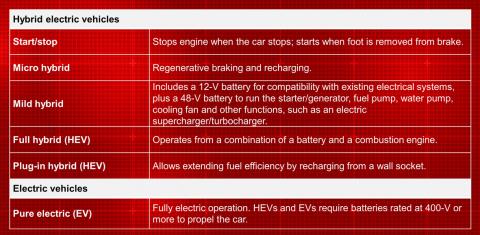
Vehicle electrification has similar levels of limited to fully electric operation, giving consumers a selection as they become accustomed to the technology. Generally, the automotive industry distinguishes the EV categories listed in the diagram. Each category includes the features in those above it, and each in turn saves an increased amount of combustible fuel.
Vehicle electrification through these stages complements the development of automated driving because both depend on advanced electronics deployed throughout the vehicle. In some cases, both electric drive and automated driving may use the same systems for acceleration and stopping; in other cases, they may share sensing, computing and communications resources for operation and diagnostics. Moreover, adas-activated automation often achieves the goal of energy efficiency, which is a central purpose of electrification. For example, adaptive cruise control helps maintain a uniform fuel usage, which is more efficient than frequent acceleration and braking.
Paving the way
Providing the pathway to vehicle automation, adas technology is based on extensive sensing and imaging from cameras, ultrasound, radar and lidar. The more adas technologies, the greater the need for high-bandwidth communications, high-performance image and other signal processing, and intelligent control. The information has to be processed immediately, so functional acceleration and low-latency communications are especially important, as is using as few wires as possible to save space and weight.
Cameras produce a vast amount of video data, requiring algorithms to filter and condition those data. These algorithms also search for and recognise objects of importance such as traffic lights, lane markings, pedestrians and other vehicles. All this takes place in real time, along with determining whether the car should swerve, slow, stop and so on, and initiating that action.
The combination of video, data from other sensors and control decision-making demands heterogeneous processing, ranging from dedicated video signal-processing hardware for the raw data input, through programmable signal processing for object scanning and recognition, to a high-performance microprocessor for decision-making that affects vehicle operation. Image processing requires the grouping of as many of these heterogeneous processing elements as possible, along with the fast communication interfaces that supply camera data to the processor.
This need for more sensors and cameras with higher resolution translates into requirements for high-bandwidth communications; currently, adas uses different networking standards and topologies. Latency must be low to ensure efficient delivery of critical data. Optimised networking that allows video and other data, control signals and even power over a single wire significantly reduces requirements for weight and connector size, thus reducing space in the modules themselves, as well as the weight of the wiring harness.
Aside from flexible communications and heterogeneous processing, adas also relies on integrated, adaptable power management. Automotive voltages vary over a wider range than for most electronic systems, and the operating environment can be extremely stressful in terms of temperature range, vibration and contamination. Power-management is important for adas, not only because it supplies reliable power for the operation of the assist systems, but because it offers important protections that help prevent damage to other critical automotive systems. Robust power management is all but invisible to users, but system developers know that it is not only essential in the evolution of adas technology, but to the powertrain as well.
Powertrain
While the powertrain isn’t highly visible to drivers and passengers, it remains the most fundamental technology in the automobile. More cities and countries are planning to ban vehicles with internal combustion engines (ICEs) between 2030 and 2050. Thus, the changeover of subsystems from ICEs to electric motors is progressing quickly.
The industry demands innovative electronics for the high-powered drive and fast charging needed for hybrid electric vehicles (HEVs) and EVs, making fuel-powered engines operate more efficiently, and reducing weight in areas such as power steering.
Power management is far more challenging under the bonnet than elsewhere in the car. Wildly differing voltage levels, ranging from 3V to more than 800V – including the growing 48V technology in HEVs – may need support, and electronic power supplies must accommodate the rise and drop in battery voltages caused by various charging and load conditions. Maximum voltages that surpass the capabilities of silicon require new compound power-transistor materials.
With power management in HEV and EV powertrain systems, high voltages bring stringent requirements for materials, processes, designs, packages, qualification – the whole gamut of IC technology.
Meeting these challenges is important not only for reliable functioning but also for safety in operating the starter-generator, power steering, traction control, battery management, bidirectional DC-DC conversion and many other areas. These systems must be protected against over voltages, over currents, power spikes, signal feedback to other systems, electromagnetic noise from outside sources, and a variety of other destructive or contaminating influences. Above all, there must be no risk whatsoever that people will be exposed to high voltages and currents.
Safety depends heavily on circuit isolation, which may be internal to a chip die, between chip dies in a single package, among IC devices that function together or some combination of these. To ensure safety, automotive specifications call for twice the isolation required for simple functioning, known as reinforced isolation.
High voltages in hybrids permit downscaling of the combustion engine, which reduces fuel consumption but also reduces the power delivered. To compensate for the smaller engine, the electric starter motor needs to deliver torque to the engine, and the conventional turbo-supercharger needs to be replaced or complemented by an electric one that adds torque during operation.
Providing overvoltage transient protection for these functions and others requires power field-effect transistors (fets) characterised for up to 100V. Propelling the car and charging it from an external source such as a wall socket or induction coil requires even higher levels of characterisation measuring as high as 1kV to support fast charging cycles.
Some applications require support for extremely high-frequency switching as well.
Providing fets capable of achieving these high voltages and frequencies is another challenge in automotive electronics. Silicon power fets are characterised for voltages high enough to handle the loads on traditional 12V and many loads on 48V batteries.
Managing the batteries of HEVs and EVs is a key area for innovative high-voltage technologies. Dual-voltage systems combining 12 and 48V batteries need bidirectional DC-DC conversion both to protect circuitry and enable functionality. Even higher voltages, associated with propulsion and external charging, will come from large numbers of cells connected in series. Battery management needs advanced control intelligence that can monitor charging, discharging and recharging with sensing for temperature, voltage and current in each cell.
Future
The systems challenges facing the automotive industry require innovative electronics technology in power management and throughout the signal chain. As car makers and tier-one suppliers travel the road to greater automated driving, electrification, safety, comfort and convenience, innovative semiconductor technology and automotive system expertise will be with them all the way.
Heinz-Peter Beckemeyer is director for automotive systems at Texas Instruments
