Test & Measurement: Checking the signals
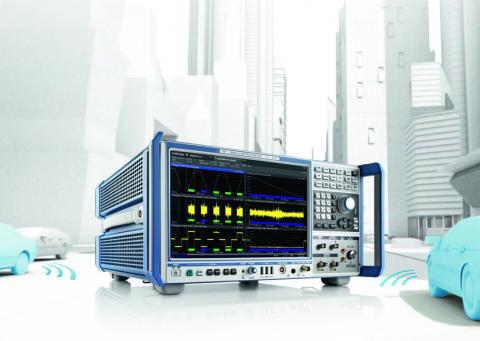
Steffen Heuel and Wolfgang Wendler from Rohde & Schwarz explain how to make simpler measurements on automotive radars
The high resolution of automotive radar sensors requires signal bandwidths up to the gigahertz range. For this reason, frequency bands around 77 and 79GHz are provided for these applications. Until recently, harmonic mixers had to be used for test and measurement because no analyser was available that covered up to over 79GHz in a single sweep. Fortunately, new signal and spectrum analysers overcome these problems.
Radar sensors measure the range, radial velocity and azimuth angle of targets in the vicinity under any weather conditions. Thanks to good performance data and low costs, they lay the foundations for more and more assistance and safety functions in vehicles, nowadays even reaching the compact class. Sensors for the automotive sector operate in the frequency bands around 24, 77 and 79GHz.
The frequency bands, emitted power level and test requirements for automotive radars are defined in various standards such as EN 301091 v1.4.0. In Europe, some wideband automotive radars are temporarily using the 24GHz band; however, this must be discontinued by 2022. In its place, the internationally available 79GHz band has been proposed by the European Commission. Use of this band is being discussed and has already been accepted in many countries owing to the significant advantages it offers.
Along with minimal limitations regarding the emitted power level and a smaller form factor for sensors, it offers wider signal bandwidth up to 4GHz and a higher range resolution. For example, while a modulated signal bandwidth of 150MHz allows a range resolution of one metre to be achieved, ten times this resolution can be achieved at 1.5GHz. Wider bandwidth also allows the integration of technical measures such as frequency hopping into the sensors to reduce interference between several radars.
Higher frequencies are not only helpful for the development of smaller sensors, they also help improve radial velocity resolution. Radial velocity resolution depends on the wavelength and the coherent processing interval of the radar waveform. If the coherent processing interval is kept equal, the radial velocity resolution improves by about a factor of three when the signal is emitted at 79GHz instead of 24GHz.
Chirp sequences are often used in automotive radars. This requires several linearly frequency-modulated signals with a duration of about 100µs and a bandwidth of several hundred megahertz up to several gigahertz.
Twin challenge
To detect and resolve two adjacent objects, the range resolution of the sensor must be higher than the separation of the objects from each other. However, wide signal bandwidths are required for a high range resolution. This is not just a challenge for signal generation and evaluation in the sensor, but also requires high-end test and measurement equipment for development, verification and standard-compliant analyses. The measuring instruments must cover the frequency range up to 81GHz and offer analysis bandwidths up to 2GHz. Signal and spectrum analysers are typically used for this task, but older technology can only achieve bandwidths up to 500MHz, and maximum input frequency usually comes nowhere near 81GHz.
Given these limitations, the frequency ranges of analysers have to be expanded with the help of external harmonic mixers for measurements in the 79GHz band. This setup, however, has no pre-selection. When the signal is down-converted to an intermediate frequency, the user sees both the signal and its image. An additional measurement is therefore required whereby the frequency of the local oscillator is shifted by double the intermediate frequency. This enables the analyser to detect and then remove unwanted mixing products. However, this only works when the intermediate frequency is higher than half of the signal bandwidth, otherwise the image and signal overlap.
Another factor is it is cumbersome to reduce the input level in a suitable manner when measuring with harmonic mixers. Attenuators must be attached to the waveguides and then re-adjusted for each changing level.
Crossing frontiers
In recent years, test and measurement vendors have introduced features that make such unwieldy compromises unnecessary. A key development is the ability to perform measurements from 2Hz to 85GHz in one sweep, enabling complete radar applications in the 79GHz band. Integrated pre-selection allows analysers to display signals without unwanted mixing products when measuring the spectrum, even where this is significantly wider than double the intermediate frequency. In addition, the inclusion of attenuators inside the signal and spectrum analyser means signals with different levels can be easily analysed without having to adjust the input level using cumbersome external attenuators.
While an internal analysis bandwidth of up to 512MHz suits many automotive radar measurements, it is not sufficient for the 79GHz band, where signals have considerably larger bandwidth. For these applications, equipping the instrument with a wideband analysis option – fully controlled by the signal and spectrum analyser – resamples, equalises and down-converts the signal into digital baseband. In combination with a suitable oscilloscope, it can perform measurements up to a signal bandwidth of 2GHz.
Such analysers fully control the oscilloscope and transfer, process, equalise and analyse the digital data. The signal path from the analyser’s RF input to the oscilloscope’s A-D converter is characterised with respect to amplitude and phase response.
In the latest generation of test and measurement instruments, connection of the oscilloscope to the analyser is completely transparent for the user and measurement option operation is identical in all cases whether using the A-D converter in the oscilloscope or the one in the analyser.
For wideband, linearly frequency-modulated and continuous wave signals such as those used in automotive radars, customised measurement applications are available for recording signals up to 2GHz bandwidth and analysing them automatically. Important parameters such as chirp rate or deviations from ideal linear behaviour are measured and displayed graphically or in tabular form. All the important parameters can also be measured and displayed at the push of a button using a software option customised for automotive radars.
Steffen Heuel works in technology management and Wolfgang Wendler is product manager for spectrum analysis, both at Rohde & Schwarz
