Test & Measurement: Keep in touch
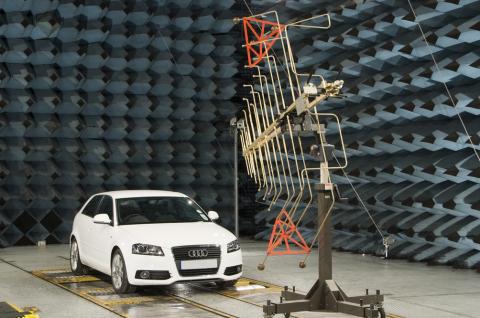
Anthony Martin from Horiba Mira discusses the impact intelligent mobility is having on EMC testing
Intelligent mobility has become an area of much debate and development among automotive engineers over the past few years, with fully autonomous vehicles on the horizon. Hailed by some as the greatest automotive revolution since the development of the production line, intelligent mobility is set to change the face of the automotive sector as we know it.
For test engineers this change is particularly influential, especially for those working in electromagnetic compatibility (EMC).
With the advancements in intelligent mobility and intelligent transport systems (ITS), there are far greater EMC implications upon the safe requirement for transport due to the high number of devices required in the control of autonomous and connected vehicles and their need to communicate with each other and the surrounding infrastructure. Driverless and connected vehicles will demand much more from EMC testing as the complexity of control systems increases along with their reliance on more and more sensor inputs.
There are a significant number of electronic systems fitted to modern day vehicles but intelligent vehicles will bring a large increase in electronic content to deliver a feature rich and safe journey for occupants. However, all electronic systems will need to be resilient against electromagnetic energy and have the ability to operate together. Needless to say, engineers have a task on their hands to ensure EMC testing is robust enough to handle these changes.
Changing requirements
In-vehicle wireless technologies, including GSM, 3G, 4G, 5G, GNSS, wifi and Bluetooth, are the backbone of the connected and autonomous car.
Many of these digital technologies rely heavily on external communications between vehicles on the road and between the vehicle and surrounding infrastructure. These so-called V2X communications are at the foundation of ITS, and their reach and reliability depend on the quality and radio frequency (RF) protection of the antennas, of which there are many in the vehicle.
The rapid increase in the level of wireless technology within vehicles allows for a multitude of new services to be realised, however manufacturers will need to form robust strategies to account for the increased levels of software upgrades required. The implications on manufacturers may mean they require additional assistance from test organisations, with expertise in rapid software validation.
At vehicle level, a great deal of innovation, through the use of moving targets and a number of other intelligent test systems, is required to test vehicle automation or vehicle assist functions in an EMC chamber. This will mean using the latest test equipment and facilities to guarantee test completion to the highest standards.
For all vehicle systems, correct functionality must be ensured in their intended EM environment. This means off-board threats such as high power phone and TV transmitters and on-board threats including mobile devices and installed transmitters. This verification is especially important for safety-related systems that have functions that control or affect the safe operation of a vehicle. For the autonomous car, the list of safety related systems will increase dramatically. For testing, this will mean a greater level of diagnostic information will be required to understand exactly which systems are in error.
For EMC engineers, a thorough understanding of the safety, security and reliability requirements of each vehicle feature is a necessity. All vehicle control units, sensors and actuators taking the place of human functions will find themselves on the safety related function list, thus requiring higher levels of engineering rigour. Understanding the source of malfunctions will require a significant increase in effort during the EMC engineering process.
Robust requirements
To deliver these services with a robust level of performance, to prevent the customer from being plagued with audio, video or data corruption and dropouts, and the vehicle’s autonomous driving functionality from being impaired, is a challenge. Issues such as fading due to differing signal paths, shadowing where signals are obstructed by a hill or a large building, Doppler effect when receiver and transmitter are moving relative to each other, and surface clutter significantly complicate the process; and poor antenna characteristics and high levels of vehicle RFI can be disastrous to reception and connectivity performance.
For example, ITS enabled vehicles broadcast positional information and listen for similar messages from other vehicles or roadside infrastructure. For transmitted messages, the vehicle antenna performance determines the area in which the vehicle will be heard. The communication range of a vehicle fitted with a poor antenna system will be significantly less than the same vehicle fitted with a good antenna system. This can be likened to trying to shout with your hand over your mouth.
Similarly, an ITS vehicle with a poor antenna system and components that produce high levels of RFI will only hear messages broadcast from other vehicles and infrastructure at a very much reduced distance than a vehicle with a good antenna and components that produce low levels of RFI. In this instance, it can be likened to trying to listen with your fingers in your ears.
When these issues are encountered in vehicle designs. OEMs quickly become plagued with problems relating to poor performance and the risk of customer dissatisfaction increases significantly. Highlighting performance issues early, accurately and in-line with customer perception to avoid over or under engineering is therefore of key importance moving forward.
Implications
Consumers have historically been used to a one-off payment when purchasing a vehicle, however with embedded data and voice connections, an additional contract with a network operator may also be required. To deliver voice and data services with a robust level of performance is very difficult and costly to realise. With consumers paying for connectivity, it will be up to the network operators and vehicle manufacturers to deliver services that are perceived by the consumer to be adequate. While broadcast and network operators maintain geographical service coverage across urban and rural locations, it will be down to vehicle manufacturers to optimise their integrated systems such to limit service degradation. In addition, vehicle manufacturers will need to ensure signal loss and interference sources inside the vehicle are kept to a minimum to ensure good connectivity for personal devices.
Future
There is no doubt that the future of the automotive industry is set to become significantly more complex with the development of intelligent mobility in autonomous vehicles. This continuous development is driving industry standards, particularly when it comes to EMC.
A key indicator of the impact intelligent mobility will have on EMC engineers is the complexity of the testing to be carried out. Training and awareness in the latest standards will constantly need updating, while access to the correct equipment and facilities used will be key to the development of the industry in the future.
The fight to become the leader in autonomy will continue among manufacturers, while new relationships will need to be established with EMC test consultancies and engineers at the forefront of their field to develop advanced test methods and robust systems for the future.
Anthony Martin is electromagnetic compatibility chief engineer at Horiba Mira
