Thermal Management: Dry eyes
Thilo Haiss from WL Gore & Associates looks at how to protect headlamps against condensation as well as dirt and water ingress
Headlamps have to cope with environmental conditions that change every day. What’s more, they have to be protected against dust, dirt, deposits and condensation if they are to work effectively and guarantee drivers a clear view at all times. Various options are available to automobile manufacturers and suppliers for removing moisture from headlamps.
When selecting a venting membrane as an option, this must be able to equalise pressure within the headlamp housing, form an effective barrier against dirt and water ingress, and be able to reduce condensation.
In cars, conventional halogen headlamps are increasingly being phased out in favour of more modern technology. While standard halogen lamps are still used in the subcompact class, xenon headlamps are now standard in midsize cars. As premium vehicles already feature LED headlamp technology, car makers and headlamp manufacturers face new challenges.
The heat an LED lamp generates in operation is radiated towards the rear – not towards the glass at the front, as in a halogen or xenon lamp. So the coldest area of an LED headlamp is the lens at the front. Any condensation that forms will impact lens clarity and eventually lead to compromised and corroded electronic components, which shortens the service life.
Replacing an LED headlamp is extremely costly, since LED headlamps are way more expensive than conventional halogen lamps. Headlamp manufacturers and OEMs are understandably keen on ways to reduce the frequency of these types of warranty claims. Not to mention the damage their brand image could potentially suffer whenever owners complain about foggy or dirty headlamps.
Moisture sources
Moisture in headlamps comes from three main sources. The most common of the three is desorption, which is triggered by differences in temperature. When the light source is switched off, the temperature drops and the plastic that the headlamps are made of soaks up moisture like a sponge. When the light source is switched on again, the temperature rises, releasing this accumulated moisture from the material. At the same time, the dew point rises, which can cause condensation to form at the coldest place in the headlamp. The next time the light source is switched off, the temperature drops and the plastic absorbs moisture. This process accounts for roughly 80 per cent of the moisture in headlamps.
Permeation is the second source of moisture: a process by which water vapour from the outside continuously diffuses through the plastic into the housing interior over a longer period. The third cause of moisture is the vent itself, through which moisture can get in and out of the headlamp.
Measuring moisture
Although moisture levels in headlamps are frequently expressed in terms of relative humidity, specifying the dew point is actually much more useful and to the point, as it does not depend on prevailing temperatures. This will become clear in the following example, which demonstrates the correlation between dew point and temperature.
In the example, moisture is measured under laboratory conditions. At +22˚C and 50 per cent relative humidity, the dew point is +11˚C. If the temperature falls to +15˚C, relative humidity climbs to 77 per cent. The dew point remains constant. At +11˚C, relative humidity reaches 100 per cent, meaning that the air is saturated and cannot absorb any more moisture. If the temperature drops below the dew point, condensation occurs.
Convection or diffusion
Essentially, there are two methods of removing moisture and ventilating headlamps – convection and diffusion.
In this context, convection involves open, transverse ventilation and works using at least two venting tubes, which conduct moisture outside by circulating air. This process is triggered by pressure differentials, produced when temperatures increase (for example, when the headlamp is switched on) or as a result of movement while the vehicle is in motion.
These pressure differentials create an air current that carries moist air outside. Ambient air is drawn in through the lower opening and flows out again through the upper opening. The disadvantage of open venting such as this, however, is that dust, particles of dirt, insects and so on get into the headlamp along with the suctioned air. Also, convection works only when the vehicle is in motion or the headlamp is switched on. On top of this, there is often the problem that air cannot circulate to the required extent around headlamps due to the large number of components crammed together in the engine compartment.
A more effective means of removing moisture from headlamps is diffusion. This physical process causes water vapour to move from regions of high concentration to regions of low concentration.
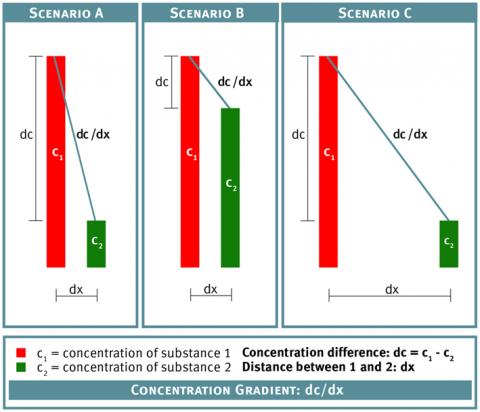
The following law of diffusion describes this movement: vD = -D * A * dc/dx, where vD is the diffusion rate and D is the diffusion constant. Accordingly, to increase the diffusion rate, increase either the exchange surface A and/or the concentration gradient dc/dx. Here, dc represents the concentration difference (dc = c1-c2), and dx is the distance between the concentrations. The influence of exchange surface A on the diffusion rate is shown in the diagram.
In addition, the diffusion rate increases when the concentration gradient dc/dx is as high as possible (Fig. 6). This happens when the following conditions between the inside and the outside of the headlamp are met:
- • the concentration difference dc is as big as possible; and
- • the distance dx is as small as possible.
Cap versus membrane
There are two practical options for facilitating diffusion: cap vents and venting membranes. A venting membrane that is simply stuck onto the headlamp housing (adhesive vent) enables better condensation reduction. The exchange surface A of an adhesive vent is typically larger than that of a cap vent, which has a positive effect on the diffusion rate.
In addition, adhesive vents have an average thickness of only around 0.3mm, whereas cap vents are often about 20mm in length. As a consequence, the distance (dx) that the moist air has to overcome is significantly higher with cap vents and leads to poorer condensation reduction. Furthermore, dust, dirt and deposits can clog up the venting path in cap vents, further obstructing ventilation.
Ventilation surface
The easiest way to demonstrate the performance of venting components in relation to moisture transfer is to carry out a moisture vapour transmission rate (MVTR) test. This involves filling a vessel with 100ml of water, sealing it airtight, and fitting it with a venting product. The container is weighed daily for two weeks under laboratory conditions (+22˚C, 50 per cent humidity) to measure the volume of water that has diffused every day.
Measurements show that about 550mg of liquid can diffuse through the automotive vents in one day. Meanwhile, automotive vents with a different exchange surface but made from the same material transport only about 125mg of liquid a day. This demonstrates the influence of exchange surface A. The correlation between exchange surface (285mm2/65mm2) and moisture transported per day is linear. However, even the smaller moisture vapour transmission rate is double that of tube vents or cap vents. This makes this type of vent particularly well suited for use in smaller housings such as tail and fog lamps.
Automotive vents stand out from other systems through both their diffusion and their protection performance. Tube vents use convection, which enables efficient condensation reduction while the vehicle is in motion, but does not protect headlamps against dust, dirt, deposits or water. In contrast, cap vents offer effective protection against dirt and so on, but they provide only limited diffusion, which leads to poor condensation reduction. An automotive vent should provide an optimal balance between protection against particle and liquid ingress and reliable, tried-and-tested condensation reduction.
These adhesive vents are manufactured from expanded polytetrafluoroethylene (ePTFE). This material is characterised by its extremely close-meshed pores, which are some 20,000 times smaller than a drop of water and keep out even the tiniest droplets and dirt particles, down to a size of 1.0µm. In addition, ePTFE is extremely temperature and chemical resistant.
Due to its low surface energy, ePTFE possesses outstanding hydrophobic and oleophobic (water- and oil-repelling) properties. These are very important, because under the bonnet the membrane comes into contact with oils, lubricants, detergents and other typical automotive fluids. However, these oleophobic properties are achieved only by further refining the membranes. These properties make venting components with ePTFE membranes ideal for protecting headlamps against dirt and maintaining optimal venting performance over the lifetime of the vehicle.
Thilo Haiss is product line manager for automotive lighting at WL Gore & Associates
