Thermal Management: Engine off…venting off?
Thilo Haiss from WL Gore explains how vents can protect car electronics from serious temperature fluctuations
In electric cars, hybrid cars or cars with conventional combustion engines, the electronics are exposed to constant pressure fluctuations. Yet driving is not the only activity that poses major challenges for electronics housings. Shutting off the engine in particular causes huge pressure spikes, putting considerable stress on the seals that are supposed to protect sensitive electronics from dirt and liquids.
When the vehicle is in operation, the wind cools the electronics that heat up in the engine compartment. However, if the car is sitting in traffic or at a traffic light, then this natural coolant disappears. As a result, the temperature under the bonnet quickly shoots up. This increase is even more serious when the car remains stationary for several hours.
The heat from the engine rapidly drives up the temperature, which in turn produces pressure spikes in the electronics housings. Because these spikes equalise only very slowly without vents, enormous strain is put on the seals. This happens at least twice a day in commuter cars; the recurring stress can weaken the seals over time, eventually allowing ingress of dirt particles and liquids into the housing’s interior. Ultimately, this can damage the sensitive electronics.
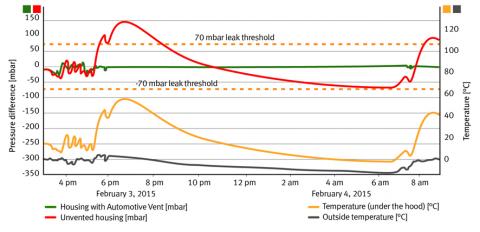
Vent specialists tested the temperature and pressure changes in two identical electronics housings installed under the bonnet. One electronics housing remained in its original condition (in other words, non-vented), while an automotive vent was integrated into the other. The test observed both electronics housings during a typical commuter day – starting at 4pm with the drive home and concluding with the drive back to work the next morning (see diagram).
Non-vented housings
While the driver was running afternoon errands, the wind caused by the car’s motion was able to cool off the engine sufficiently. Yet around 5:30pm, when the car was sitting in rush hour traffic, the temperature under the bonnet rose from roughly +15˚C to about +45˚C (yellow line). It didn’t drop until traffic started moving and the generated breeze began cooling the electronics again – and even then it fell only slightly. As soon as the car was back at home, with the engine turned off and no wind to dissipate the heat, the temperature climbed up to a new high of nearly +60˚C. There it remained until hours later, when the cool night air brought it back down.
In the non-vented housing, this temperature increase created a positive pressure of 150mbar (red line). Positive pressure of just 70mbar over an extended period of time can already be dangerous, as it allows the seal to become porous. It wasn’t until the engine cooled off several hours later that the pressure gradually fell to its original value of 0mbar.
In winter, if the car is exposed to outside temperatures of just above freezing for an entire night, negative pressure forms in the non-vented housing, putting critical strain on the seals. As a result, water and dirt particles can penetrate the housing.
Vented housings
By contrast, the venting integrated into the comparison housing continually equalises pressure differentials, making it impossible for spikes to form. The pressure in the vented housing remains the same as the ambient pressure and therefore doesn’t harm the seals (green line).
On the following morning, the problems of the previous day’s test repeated themselves. After the car was driven to work, the temperature in the engine compartment rose to over +40˚C (yellow line), again creating a pressure spike of about 100mbar (red line) in the non-vented housing. But in the vented housing, the air pressure once again remained the same as the ambient pressure (green line).
The result is that the vent reduces strain on seals and protects the electronics.
Conclusion
Driving to and from work every day – which means turning the engine on and, more specifically, off again twice a day – leads to multiple harmful temperature and pressure spikes in non-vented housings. That doesn’t even take into account other types of driving, such as vacations, weekend getaways and day trips. All in all, the electronics housings in a typical commuter vehicle are exposed to an average of 500 critical pressure spikes each year. Their seals cannot withstand such high levels of stress over an extended period of time. In the medium to long term, they give in to the constant strain and permit ingress of dirt particles and liquids into the housing, potentially shortening the life of automotive electronics by allowing them to corrode and become damaged.
Nowadays, the average mid-size car features more than 100 sensors, 30 or more control units and 20 or more engines and actuators – sensitive electronic components that have to function throughout the car’s entire service life.
Automotive vents make it possible for pressure to be continuously equalised, so dangerous spikes don’t even happen in the first place. The seals can function reliably throughout their entire lifetime and protect the car’s sensitive electronics.
Thilo Haiss is product line manager for automotive lighting at WL Gore & Associates
