Toyota raises the bar in Detroit
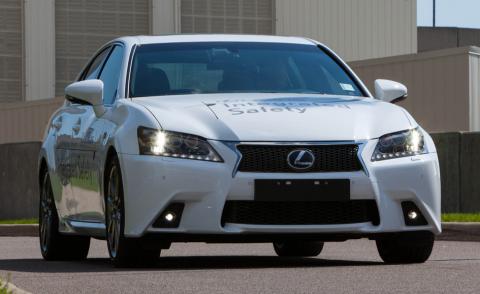
Toyota has tried to raise the bar at this week’s Intelligent Transport Systems World Congress in Detroit by using it annual Advanced Safety Seminar in Ann Arbor, Michigan, to reveal a range of advances in automated driving and safety technologies.
These include: laser detection systems that can track objects on the road, day and night; 3D information displays that transform the way traffic information is delivered to drivers; and a driving support system that will be on the road within the next few years.
The seminar provided an early insight into the company’s latest safety research and development work and the progress it is making in securing safer mobility for all in the future.
“Toyota’s vision is of a world without traffic fatalities, and these advanced connected and automated vehicle technologies have the potential to revolutionise automotive safety,” said Seigo Kuzumaki, Toyota’s chief safety technology officer. “We are committed to bringing advanced active safety systems to market as quickly as possible and making them accessible to a broad range of drivers.”
First revealed last year in Japan, Toyota’s AHDA automated highway driving assist is designed work with the driver to achieve safe car control. The latest version, unveiled at the seminar and being shown at the ITS World Congress, has been programmed according to real-world traffic conditions in the USA and can operate at speeds up to 112km/hr.
AHDA integrates three core technologies – dynamic radar cruise control, lane trace control and predictive and interactive human-machine interface. These support the driver by keeping the vehicle to its lane and a safe distance from others on the road, all while travelling at cruising speeds. The predictive and interactive HMI promotes driver engagement, warning when the system is going to disengage and monitoring the driver’s level of attention on the road ahead.
Dynamic radar cruise control allows drivers to maintain speed and make more comfortable progress while reducing accident risk by keeping a safe distance from the vehicle ahead. It uses a 77GHz millimetre-wave radar to detect and monitor vehicles in front of the car and maintain specific speeds and distances. The AHDA demonstration vehicle is fitted with a prototype radar sensor on the front grille that Toyota plans to bring to the market as part of its next generation of driving assist systems.
Lane trace control helps the driver keep the car safely within its lane, using signals relayed by a front-mounted camera and a millimetre-wave radar. The sensors detect lane markings on the road surface and vehicle ahead. The system calculates the right driving path, automatically adjusting the vehicle’s steering angle so the car keeps within its lane, within an appropriate margin from surrounding vehicles.
While the improved automation provided by the dynamic radar cruise control and lane trace control contribute to making driving safer and more comfortable, it remains essential to keep the driver focussed. For this reason, AHDA includes a predictive and interactive HMI to help them in a smooth, safe transition as the car moves from automated to manual driving.
The system gives the driver advanced warning when only limited automated system support can be expected. It makes its predictions on the basis of the lay-out and geometry of the road ahead and historical sensor performance. These predictions are intelligently generated, so they apply specifically to the traffic lane in which the AHDA vehicle is travelling. It can make lane-specific predictions by combining data from an enhanced map, an automotive-grade GPS receiver and sensors including the front camera and radar.
Monitoring technologies check the driver’s level of attention on the road ahead. An infra-red camera monitors the driver’s face and a touch sensor locates where the driver’s hands are on the steering wheel. The system warns the driver if it detects the hands are off the wheel or the eyes are not on the road ahead for a long period.
Toyota plans to market technologies based on the AHDA advanced driving support system within the next few years.
Spad lidar – or single photon avalanche diode light detection and ranging – is an environment mapping and recognition system. This was demonstrated for the first time at the safety seminar and is said to mark important progress towards making automated driving a reality. As well as performance improvements, the system is smaller than the previous bulky units, which had to be mounted on the roof, and can be installed inside the car. It has also been made less expensive.
The lidar combines the functions of a millimetre-wave radar and stereo cameras. It can detect the shape and position of obstacles ahead and its active sensors mean it can operate in daylight and at night.
The 3D head-up display projects critical information onto the windscreen, such as vehicle status, traffic conditions and road signs, rendering it in 3D with no need for the driver to wear special glasses or use other accessories.
