In-vehicle computers: Driving intelligent transportation
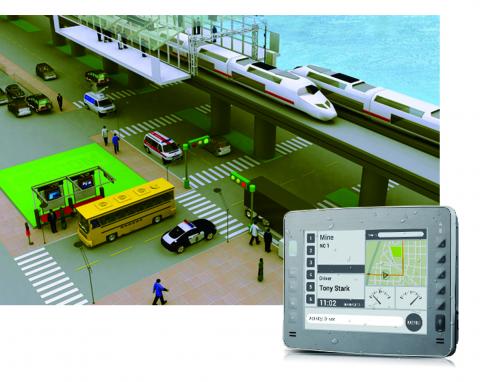
In-vehicle computers can embrace diverse integrations, according to Steven Wu
The recent rise of the internet of things (IoT) has brought several innovations to the development of intelligent transportation, which started 20 years ago. In-vehicle computers, the main building blocks of intelligent transportation, are widely used to increase transport efficiency, to improve transportation safety and to meet the demands of surveillance, entertainment and more. To fulfil the expanding requirements of intelligent transportation, integrating communications technologies and industrial designs into the in-vehicle computers are key for success.
The technology of communications devices in intelligent transportation has been evolving continuously. To keep up with the technology and establish a firm footing in intelligent transportation, new generation in-vehicle computers require the ability to collect, store and analyse data, as well as include communications, tracking and navigation mechanisms. However, unlike conventional computers, in-vehicle computers need to adapt and interoperate with different automotive electronics in various vehicles. Therefore, there are complex design issues concerning power management, communications and navigation that require careful thought.
Rugged platform
The characteristics and behaviour of the automotive battery are different than municipal electricity not only in the unstable voltages and amplitudes, but also in the power surges that occur during vehicle ignition, which can damage in-vehicle computers. In addition, automotive electrical systems vary from vehicle to vehicle. In light of this, incorporating wide range DC power input, low-voltage detection and protection, power ignition delay on-off control, idle mode, and power over Ethernet (PoE) are key design elements to provide a viable and rugged power management mechanism that allows in-vehicle computers to work with each type of automotive electrical system.
Wide range DC power input, low-voltage detection and protection, and power ignition delay on-off control enable these computers to overcome problems caused by low voltages and power surges and maintain ongoing data communications and integrity when the vehicle is turned off. In addition, instead of shutting down completely, entering idle mode allows remote wake-up of the in-vehicle computers. Lastly, with PoE in place, data and power can be shared on a single cable, simplifying cable installation for IP cameras or other peripheral devices.
In terms of communications, as data are transmitted over Wifi and 3.5G networks, additional roaming costs may incur when used in large geographic countries such as in Europe and America. To save cost and maintain optimal connection when travelling between different regions operated by different telecommunications service providers, system integrators often turn to in-vehicle computers with dual-sim support. In addition, a wake-on-SMS feature allows remote power-on over cellular networks, enabling administrators to upload work-related information or software updates in advance, thereby improving work efficiency.
For seamless integration with the vehicle’s components, apart from supporting general network communications, in-vehicle computers need to support Can bus standards such as SAE J1939 and J1708 to collect data on fuel consumption, mileage, engine temperature and travelling speed as well as control vehicle components.
Navigation wise, the computers need to consider the positioning systems in different regions and provide support for GPS (USA), Galileo (Europe), Glonass (Russia) and Beido (China). Furthermore, advanced functions such as dead reckoning are required to provide position tracking when vehicles enter tunnels or areas where satellite signals are blocked, and immediately re-establish positioning and navigation after the vehicles exit the tunnels or receive satellite signals.
Connected everywhere
In-vehicle computers are primarily used for fleet management, in-vehicle surveillance, infotainment and intelligent transport. Fleet management improves transportation efficiency by assisting road transportation, emergency service and waste management operators in dispatching vehicles, recording drivers’ behaviours and working hours, tracking vehicles and optimising routes. For example, a major US carrier uses in-vehicle computers to assess the signal strength of various regions and provide improvements. In-vehicle computers are also used by another major US carrier to enhance field engineer coordination and strengthen the efficiency and quality of customer service.
On the other hand, in-vehicle surveillance is applied in public transportation and transporting valuable goods or hazardous materials to ensure transport safety. Security administrators can monitor for suspicious activities in real time from a remote location and take proactive measures, or store the surveillance data and use them as evidence when required.
Digital signage is the most common form of in-vehicle infotainment, for example, in response to the London Olympics, local taxis were equipped with in-vehicle computers to display tourism information and process credit-card payments.
For intelligent transportation, in addition to public transit arrival information systems, vehicle and pedestrian collision avoidance systems as well as emergency traffic notifications are emerging as the norm.
The “intelligent” of intelligent transportation will span across a wide area of subjects, from pedestrians, vehicles, roads to roadside infrastructures as the IoT expands. In-vehicle computers will adopt Wave (wireless access in vehicular environments) and DSRC (dedicated short-range communications) technology to provide intelligent roadside functions. The low-latency transmission characteristic of Wave/DSRC can satisfy the communications needs of vehicle-to-vehicle (V2V), vehicle-to-infrastructure (V2I) and vehicle-to-any (V2X), and provide real-time alerts to notify drivers about the changes in the surrounding roadside environment.
By integrating Wave/DSRC, in-vehicle computers can retrieve real-time traffic status and guide drivers in locating the fastest driving route, or notify drivers about the speed change of the vehicle within a 1km radius. This gives drivers more time to react and prevent traffic collision, thus providing safety and improving the overall transport efficiency.
Steven Wu is general manager of mobile computing at Nexcom
