Vehicle Networks: Making a mesh
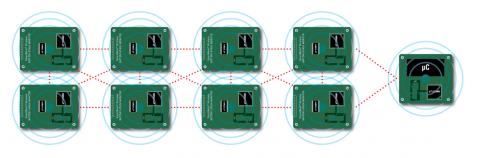
Greg Zimmer from Linear Technology discusses how a wireless mesh network can improve reliability in battery management systems
Lithium-ion batteries require considerable care if they are expected to operate reliably over a long period. They cannot be operated to the extreme end of their state of charge (SoC). The capacity of lithium-ion cells diminishes and diverges over time and usage, so every cell in a system must be managed to keep it within a constrained SoC.
To provide sufficient power for a vehicle, tens or hundreds of battery cells are required, configured in a long series generating as much as 1kV or higher. The battery electronics must operate at this very high voltage and reject common mode voltage effects, while differentially measuring and controlling each cell in these strings. The electronics must be able to communicate information from each cell in a battery stack to a central point for processing.
In addition, operating a high-voltage battery stack in a vehicle or other high-power applications imposes tough conditions, such as operation with significant electrical noise and wide operating temperatures. The battery management electronics are expected to increase operating range, lifetime, safety and reliability, while reducing cost, size and weight.
Steady advances in battery cell monitoring ICs have enabled high performance, increased life and reliability of battery packs in automobiles today. Wireless battery management systems (BMS) promise to improve safety and reliability of the full battery system.
Modular battery packs
To accommodate the large quantity of cells required for high-power automotive systems, batteries are often divided into packs, and distributed throughout available spaces in the vehicle. With ten to 24 cells in a typical module, modules can be assembled in different configurations to suit multiple vehicle platforms. A modular design simplifies maintenance and warranty issues, and can be used as the basis for very large battery stacks. It allows battery packs to be distributed over larger areas, for more effective use of space.
To support a distributed, modular topology within the high electromagnetic interference environment of an electric or hybrid-electric vehicle, a robust communications system is required. Both isolated Can bus and isolated SPI offer road-proven methods for interconnecting modules in this environment.
Given the success of Can bus in automotive applications, it provides a well-established network for interconnecting battery modules, but requires a number of additional components. For example, implementing an isolated Can bus via an SPI interface requires the addition of a Can transceiver, a microprocessor and an isolator. The primary downside of a Can bus is the added cost and board space required for these additional elements.
An alternative to a Can bus interface is a two-wire isolated SPI interface using a simple transformer and a single twisted pair, as opposed to the four wires required by Can bus. The SPI provides a high RF noise immune interface in which modules can be connected in a daisy-chain over long cable lengths and operated at data rates up to 1Mbit/s.
Wireless BMS
In a wireless BMS, each module is interconnected via a wireless connection instead of a Can bus cable or an isolated SPI twisted pair. The industry’s first wireless automotive BMS has already been demonstrated in a BMW i3 concept car. This combined a battery stack monitor with a wireless mesh network, replacing the traditional wired connections between the battery packs and the battery management system.
This demonstration of a fully wireless BMS car represents a significant breakthrough that offers the potential for improved reliability, lower cost and reduced wiring complexity for large multi-cell battery stacks for electric and hybrid-electric vehicles.
Car makers are finding it difficult to ensure the driving public that electric and hybrid-electric vehicles are both safe and reliable. Thus it is time to look beyond the safety and reliability of the battery monitoring IC to address the potential mechanical failure of connectors, cables and wiring harnesses in high-vibration automotive environments.
To date, the metal and high-EMI surroundings in vehicles were thought to be too harsh for a wireless system to be reliable. However, wireless mesh networking provides a truly redundant interconnect system through its use of both path and frequency diversity to route wireless messages around obstacles and to mitigate interference.
Field-proven in industrial IoT applications, embedded wireless networks can deliver better than 99.999% reliable data transmission in harsh environments, such as railcar monitoring, mining and industrial process plants.
By delivering the reliability of wires yet eliminating mechanical connector failures, the wireless BMS concept car shows the promise of wireless technology to improve overall system reliability and simplify the design of automotive battery management systems.
Benefits
A BMS with a wireless mesh network has the potential for functionality unavailable in a wired system. The network enables the flexible placement of battery modules, and makes possible the installation of sensors in locations previously unsuitable for a wiring harness.
Additional data germane to the accuracy of battery SoC calculations, such as current and temperature, may be collected by the BMS master by simply adding mesh enabled sensors. The network can automatically time synchronise each node to within a few microseconds, and accurately timestamps measurements at each node.
The ability to time-correlate measurements taken at different locations in a vehicle is a powerful feature for calculating more accurately the battery SoC and state of health.
A wireless mesh node with local processing at each module improves normal BMS operation, and also presents the potential for smart battery modules, where module diagnostics and communications may be available to enhance assembly and service.
Mesh networks
Wireless sensor networking products are chips and pre-certified PCB modules complete with mesh networking software, enabling sensors to communicate in tough industrial IoT environments.
Such products are field proven, with more than 50,000 user networks deployed in 120 countries. By delivering data reliability in tough RF environments, wireless sensor networks are entrusted by industrial IoT providers to deliver critical sensor and control data reliably for many years without requiring intervention.
Summary
A wireless BMS promises to eliminate maintenance-prone connectors, cables and harnesses. Wireless BMS enables expanded BMS functionality with scalability and time-stamped data acquisition capability.
Greg Zimmer is senior product marketing engineer for signal conditioning products at Linear Technology, now part of Analog Devices
