Video decoder simplifies bird’s eye view vision
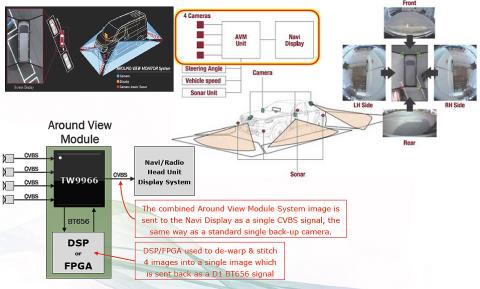
To help car makers produce bird’s eye view vision systems, Intersil introduced today (2 June 2014) the TW9966 four-channel analogue video decoder with a built-in analogue video encoder.
“This will take the input from four wide-angle video cameras around the car and create a bird’s eye view,” said Jonpaul Jandu, Intersil’s senior marketing manager.
Based on the company’s multi-channel video surveillance technology, it can replace up to five components.
“We took this technology and qualified it for automotive,” said Jandu. “Before, up to five discrete components were needed. The system makers are very excited to have a single chip to do this.”
The device still needs a separate DSP or FPGA to stitch the images together but Jandu believes that as this technology becomes more standardised across car makers then that too can be incorporated into the chip.
“The tier ones prefer to have a separate FPGA so they can have their own code as they try to beat their competitors,” he said. “It will mature to a standard approach and then we can look at hard wiring.”
The device integrates four NTSC or Pal analogue video decoders with 10bit ADCs to support four analogue camera inputs, a flexible digital output interface that sends the images to a processor that combines the four images into the unified around-view module, and one analogue video encoder that outputs the combined video as an analogue composite signal to the display. Anti-aliasing filters on each channel input further reduce component count. This integration helps simplify the system design and reduce the footprint.
A digital output interface supports up to three configurations: standard ITU-R BT.656 format output on four 8bit buses at 27MHz; time multiplexed byte interleaved output to send two channels on a single 8bit bus at 54MHz; or all four channels on a single 8bit bus at 108MHz.
A on-chip phased-lock loop can generate the 54 or 108MHz output, requiring only a lower cost 27MHz oscillator as a reference.
The device is AEC-Q100 grade two qualified and is in mass production.
