Continental to demo connected energy management at CES
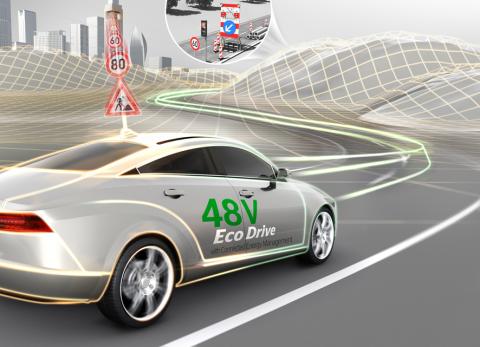
Continental is to present a 48V mild hybrid demo car with connected energy management (CEM) at next week’s Consumer Electronics Show in Las Vegas. The CEM offers fuel efficiency guidance to the driver, which can be used to save a claimed three to four per cent of fuel, CO2 emissions and cost.
Dynamic data on the latest traffic situation provide the digital input for the CEM. At CES 2016, the automotive supplier will present for the first time the CEM demo vehicle, which helps the driver save fuel.
The car is a mild hybrid equipped with the Continental 48V Eco Drive system. Compared with the 1.2-litre TSI engine powered Golf VI base model complete with 12V stop-start function, the Eco Drive hybrid can save up to 21 per cent of fuel. CEM can add another three to four per cent of fuel efficiency to this without touching the vehicle architecture.
“Our connected energy management expands a hybrid’s coasting and recuperation phases during which the combustion engine is switched off and decoupled from the drivetrain,” said Oliver Maiwald, head of technology and innovations at Continental’s powertrain division. “By analysing cloud data of the current traffic situation, CEM suggests to the driver when it makes sense to step off the pedal. If you approach a traffic light that is about to turn red, CEM will inform you. If you take your foot off the accelerator, the car will automatically activate the optimum combination of engine-off coasting and regenerative braking.
Based on cloud data, obtained through the car’s dynamic eHorizon, the CEM vehicle knows the road ahead and the actual traffic condition. This information is used to make recommendations to the driver. For instance, the CEM’s traffic light assist function knows when the next traffic light will turn red, which may not be in the driver’s line of sight.
A tangible signal at the accelerator force feedback pedal plus a visual information in the cluster instrument suggest to the driver to slow down. All the driver needs to do is take the foot off the accelerator. The CEM will ensure that the car arrives at the stop line with a minimum of wheel braking.
Hybrid cars offer the best of both worlds. The combustion engine gives them an optimum range. Electrification increases the hybrid’s fuel efficiency. At the backbone of this benefit are engine-off phases. Depending on the individual trip and road topography, the combustion engine may not be needed for propulsion during as much as 25 per cent of the total driving time. While the engine is off, the car’s kinetic energy can either be used to transform it into electric energy or to coast – or apply both strategies in a balanced combination.
CEM with dynamic cloud data can exploit the full potential of both hybrid operating strategies. For instance, CEM will tell the driver when it is most efficient to step off the pedal and just let the car use coasting and regenerative braking until it comes to a standstill in front of a red traffic light. CEM combines dynamic cloud data and map data with on-board long-range radar information to accomplish this.
“Typically, when you approach a red light, there will be a couple of cars waiting already,” said Maiwald. “When the radar picks up these cars, the CEM knows that your stop line is actually closer than the stop line of the light. Now, to harvest the most energy, the intelligent traffic light assistant will activate coasting and recuperation a little earlier so you harvest more energy and save more fuel.”
Another new CEM function that will be showcased at CES is called the intelligent deceleration assistant. It offers guidance to the driver in a multitude of situations, when the car’s instantaneous speed eventually needs to be reduced.
“When you approach a speed limit zone, CEM will tell you in time to step off the accelerator,” said Maiwald. “Your car will then automatically adapt its speed to the oncoming limit. Again, we seek to avoid using the wheel brakes because they waste energy. Of course the driver can always choose to ignore the CEM recommendation. In that case the engine-off strategy will simply not be activated.”
On the other hand, if the driver follows the CEM guidance, the resulting ride can be as smooth as the driving style that professional chauffeurs are often trained to use, plus the fuel efficiency will be better.
www.continental-corporation.com
