Etron Eys3D launches automated vehicle image controller at CES
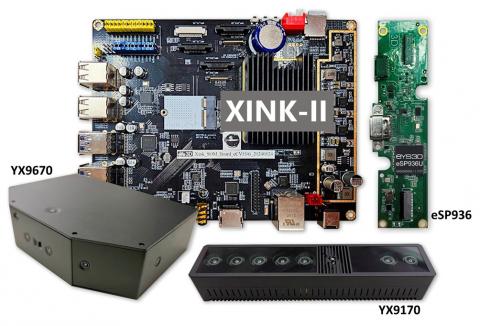
Etron Technology subsidiary Eys3D Microelectronics is launching a multi-sensor image controller IC at this week’s CES in Las Vegas for the synchronous processing of data from up to seven visual sensors, providing high image recognition accuracy for automated vehicles.
Paired with the Sense & React human-machine interaction developer interface, the eSP936 enables intelligent control through human-machine interaction, becoming a driver for implementing smart applications.
It can be integrated with multi-modal visual language models, combining multiple visual sensors with real-time AI edge computing capabilities. Smart applications include automated guided vehicles, autonomous mobile robots and drones.
The device can process multiple 2D images at high speeds and generate 3D depth maps, enhancing precise environmental recognition. Embedded AI chips enable dynamic navigation in complex environments. Additionally, industrial and service robots can achieve more precise intelligent perception in complex scenarios, combining real-time computing and automated operations for high-efficiency performance.
In immersive human-machine interaction systems, it can be integrated with AI SoC platforms to enhance the Sense & React interaction experience, widely applicable in drones, USVs (unmanned surface vehicles), video conferencing, augmented education and extended reality (XR) fields.
There is support for synchronised processing of data from up to seven visual sensors, built-in dram and wide-angle image de-warping technology, enabling high-precision environmental perception and multi-view 3D depth map generation.
Data compression capabilities reduce latency, providing developers with a flexible and efficient platform. The Mipi-plus-USB simultaneous processing technology ensures high-quality 2D image and 3D depth map output, improving image recognition accuracy.
At CES, Eys3D Microelectronics will unveil its YX9170 spatial awareness offering powered by the eSP936 multi-sensor image control chip and the Xink-ll edge spatial computing platform. This leverages multi-sensor fusion and AI-driven technologies to deliver spatial perception and recognition. It provides support for the development of intelligent systems such as industrial and service robots and autonomous vehicles, emerging as a critical driver for smart system innovation.
The core strength of the YX9170 lies in its sensor fusion capabilities. It integrates dual-depth sensors, supporting high-definition images up to 1280 x 720 resolution, and synchronises four RGB cameras for enhanced perception range and recognition accuracy. With support for multiple stereo lens baseline integrations, it overcomes the limitations of traditional stereo vision measurement techniques.
A highlight of the YX9170 is its intelligent sensing. The embedded AI algorithms enable real-time multi-object recognition from synchronised images, achieving a 30% reduction in computational load and latency. Through the YX9170 and Xink-ll's flexible and adaptable software, users can swiftly design tailored spatial awareness with integrated multi-sensor fusion.
The YX9670 navigation product is for autonomous vehicles. Equipped with the eSP936 multi-sensor image control chip and the Xink-ll edge spatial computing platform, this innovation improves environmental awareness and navigation capabilities through multi-sensor fusion and AI-driven technology.
It also integrates a dual-depth sensor supporting high-definition images up to 1280 x 720 resolution and synchronises four RGB cameras to deliver a 278˚ panoramic field of view. Additionally, a monochrome camera provides a 145˚ overhead view, with an embedded high-efficiency AHRS (attitude and heading reference system) for vessel coordination and posture recognition. The system incorporates a thermal imaging sensor.
Already deployed in autonomous vessel navigation, the YX9670 provides safe and efficient navigation support for logistics vessels, environmental monitoring ships and specialised unmanned marine applications.
The Xink-ll edge spatial computing platform-as-a-service (PaaS) development offering is equipped with the eCV5546 AI chip, featuring Arm Cortex-A and Cortex-M CPU cores, along with an NPU (neural processing unit). The platform supports the integration of AHRS, thermal imaging and mm-wave radar sensors while incorporating AI convolutional neural network (CNN) technology to enhance object recognition and detection capabilities for edge AI devices.
Notably, Arm IoT Capital has provided funding and performance enhancements for the Xink-ll platform. Arm CPUs with Neon instruction set support SIMD processing capabilities, accelerating vector and matrix operations for better computer vision and signal processing performance.
Additionally, the low-power Arm Cortex-M4 processor serves as an MCU for system control, motor operation and timeline synchronisation.
Xink-ll supports AI development and acceleration frameworks, including Onnx, TensorFlow, TensorFlow Lite and PyTorch, providing complete development kits and services to help developers more efficiently develop NPU applications.
The Sense & React human-machine interaction developer interface integrates LLMs (large language models) and CNN sensing technology. This leverages environmental sensing and uses LLMs to trigger action commands and language prompts. It enables machines to issue commands or interact naturally with users through conversational language.
Sense & React offers environmental awareness and cognition, action triggering with language prompts, and adaptability with flexibility. Through CNN sensing technology, the system perceives the surrounding environment, capturing subtle changes and dynamics for more accurate judgments and decisions. By employing LLM technology, the system generates action commands and language prompts based on sensor data, enhancing user convenience and delivering a more intelligent experience.
