Maxim driver keeps in-car displays working during cold crank
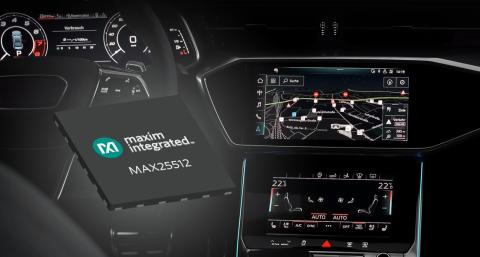
Maxim Integrated has introduced the four-channel, low-voltage Max 25512 automotive LED backlight driver with integrated boost converter.
It retains full, constant brightness of in-car displays even during extreme cold crank conditions down to 3V input voltage.
The single chip LED driver eliminates an external mosfet and current sense resistor and integrates I²C communications to reduce costs and board space by 30 per cent.
The integrated LED driver includes four 120mA channels with a claimed industry’s highest efficiency at 2.2MHz operation.
Today’s automotive start-stop systems increase fuel economy, but they can challenge the power delivery system to maintain the same level of display brightness during re-start. For example, features such as display illumination upon entry can be affected by cold crank situations, with the engine drawing down the car battery enough to cause the display to turn off and back on.
This LED backlight driver operates down to 3V after start-up without the addition of a pre-boost converter, protecting the display from these power disruptions.
The 3V input voltage and 91 per cent efficiency at 2.2MHz operation drive full, constant brightness of in-car displays during demanding cold crank and start-stop conditions. Diagnostic functions such as short to GND on each current sink alerts the microcontroller and individual channel PWM settings through the I²C interface to ensure a safer and higher quality display.
It integrates a boost converter and current sense resistor and eliminates the external mosfet typically required to drive automotive displays. Additional integration includes an I²C communication interface to display settings and diagnostics and a hybrid dimming function to reduce EMI and improve the dimming ratio.
The device comes in a 24-pin, 4 by 4 by 0.75mm QFN package.
“Over the next five years, the number of displays in automobiles is expected to grow to accommodate new and existing vehicle functions with the size and resolution of these displays increasing as well,” said Sang Oh, senior research analyst at Omdia. “Powering these displays consistently to maintain full, constant brightness while doing so as efficiently as possible, is critical to automakers today.”
Szu-Kang Hsien, director of business management for Maxim’s automotive business unit, added: “Car manufacturers are demanding LED drivers with higher integration to reduce cost and PCB area. Maxim Integrated’s Max 25512 LED driver provides the highest level of integration and efficiency at 2.2MHz switching frequency.”
