Driver assistance: Watching the traffic
Tony Armstrong from Linear Technology believes a tipping point for adas is on the short-term horizon
Either humans are not cutting it as responsible drivers on the roads anymore or there are more potential hazards on them today so advanced driver assistance systems (adas) are needed to help us cope.
Being a child of the 1960s, I can still remember being driven in cars that did not even have seat belts in them. Then, when I started to learn how to drive a car in the mid-1970s, the standard equipment usually consisted of a steering wheel, vehicle operational controls, turn signal indicators, rear view mirrors, a dashboard and a parking brake.
As for understanding what was going on around you once driving in a vehicle was concerned – it was your eyes and ears that gave you the knowledge of what was happening. Furthermore, it was your own accumulated driving experiences that enabled you to anticipate what might happen under the myriad of different situations that could occur under variable traffic conditions.
Of course, one could argue that was a much simpler time, where there were fewer vehicles and, correspondingly, fewer drivers on the back roads and highways. Fast forward to 2016, where there are over 1.2 billion vehicles on the world’s roads and you can start to understand why it might be necessary to have systems in the car that can help drivers understand what is going on around them.
By way of example, consider that 1.2 million people die due to traffic related accidents on the roads each year across the globe. What is potentially even more frightening is that this figure is expected to rise by 65 per cent in 2020. That said, what are the major causes of these accidents? But before answering that, it is important to have a little more background on this topic.
For example, did you know that the first vehicular fatality occurred in London in 1896? Since that time, over 25 million people worldwide have died in vehicle-related accidents. Perhaps the greatest irony here is that it is the vehicle drivers themselves that are the major cause of accidents. So, the six major causes of accidents, in order of greatest risk factor, are:
- Distracted drivers. These include; rubbernecking, looking at scenery, passengers or children, adjusting audio systems and reading maps, books or other documents.
- Driver fatigue. Drowsy drivers account for over 100,000 accidents in the USA on an annual basis.
- Drunk driving.
- Speeding. This is a multi-tiered threat because not only does it reduce the amount of time necessary to avoid a crash, it also increases the risk of crashing and makes the crash more severe if it does occur.
- Aggressive driving. This includes behaviour such as aggressive tailgating, flashing lights at other drives, aggressive or rude gestures, verbal abuse, physical assaults, disregarding traffic signals and changing lanes in a frequent and unsafe manner.
- Weather.
So, if adas are necessary for drivers to avoid causing, or reducing the potential for, accidents, what are these systems and what does their growth potential look like?
Adas market
The adas market is expected to reach US$60bn globally by 2020 according to Allied Market Research. This represents a CAGR of 22.8 per cent from 2014 to 2020. Not something to dismiss easily.
So what do adas do? Well, for a start, they facilitate safe driving and warn the driver if the system detects risks from surrounding objects – whatever they might be. These systems are one of the major trends in automobiles for the second half of this decade. They typically provide dynamic features such as adaptive cruise control, blind spot detection, lane departure warning, drowsiness monitoring and night vision. As a result, it is the increasing focus of consumers on safety, demands for comfort while driving and the continued increase of government safety regulations that are fuelling the growth of adas in automobiles. Nevertheless, this growth does not come without challenges for the industry, which include pricing pressure, inflation, complexity and difficulty in testing these systems.
It should come as no surprise that the European automotive industry is one of the most innovative automotive markets, and as such it has seen major market penetration and adoption of adas from its customers. Nevertheless, both the American and Japanese car makers are not far behind them. Some of the adas key players include Valeo, Bosch, Continental, Audi, Ford Motors, General Motors and Denso.
Of course, the unspoken ultimate goal with these systems is to have a fully autonomous vehicle that does not necessarily need a driver to operate it.
IC content of adas
At the heart of most adas systems is some kind of microprocessor to process all the inputs from the various sensors within the vehicle and to process them so they can be presented to the driver in a way that can be easily seen and understood. Moreover, these systems are usually powered directly from the vehicle’s main battery that is a nominal 9 to 18V, but could be as high as 42V due to voltage transients within the system, and as low as 3.5V during a cold-crank condition. Thus, it is clear that any DC-DC converter to be used must be able to handle a broad input voltage range of 3.5 to 42V.
Many adas will need a 5 and 3.3V rail to power various analogue and digital IC content; however, it will be the processor IO and core voltages that will be in the sub-2V realm. Furthermore, there are space and thermal considerations that must also be taken into account.
While it is commonplace to use a high voltage DC-DC converter for a 5 and 3.3V rail, using this kind of converter for sub-2V rails is not always practical due to the size of using multiple single output converters and the potential thermal constraints. A more a suitable method would be to use a single DC-DC converter with multiple outputs.
Because of these constraints, a four-output monolithic synchronous buck converter with a 3 to 42V input voltage range would be suitable for automotive applications, including adas, which must regulate through cold-crank and stop-start scenarios with minimum input voltages as low as The quad channel design combines two high voltage 2.5 and 1.5A channels with two lower voltage 1.8A channels to deliver four independent outputs delivering voltages as low as 0.8V, enabling it to drive the lowest voltage microprocessor cores available. Its synchronous rectification topology delivers up to 94 per cent efficiency while burst mode operation keeps quiescent current under 30µA with all channels on in no-load standby conditions, making it suitable for always-on systems.
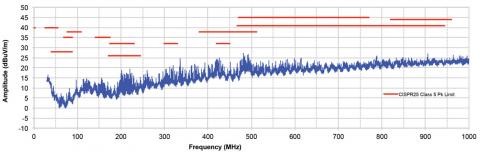
For noise sensitive applications, with a small external filter, such a device can use a pulse-skipping mode to reduce switching noise and can meet the Cispr 25, class five EMI requirements, as shown in the diagram.
The switching frequency can be programmed from 250kHz to 2MHz and can be synchronised throughout this range. The 60ns minimum on-time enables 16Vin to 2.0Vout step-down conversions on the high voltage channels with a 2MHz switching frequency. As the high voltage Vout2 channel feeds the two low voltage channels (Vout3 and Vout4), these can deliver outputs as low as 0.8V while also switching at 2MHz, offering a compact (25 by 25mm) quad output.
Conclusion
The good news for drivers is that adas will continue to increase within automobiles to enable a safer and more comfortable driving experience while also providing increased awareness of what is going on around them. Meanwhile, the engineers designing these systems are getting more compact and efficient power converters to provide both cost and space-effective devices.
Tony Armstrong is director of power product marketing at Linear Technology
