LED driver from Cypress reduces headlight size
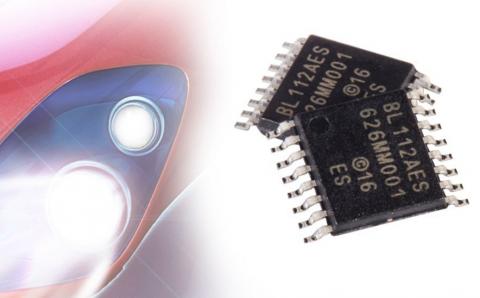
An automotive LED driver that is said to enable smaller and more cost-effective headlight systems is available from Cypress Semiconductor.
The S6BL112A automotive-grade LED driver is said to be the industry's first to use synchronous control, which helps it provide conversion efficiency enabling stable performance in a lighting system.
The device can drive LEDs at a 2.1MHz switching frequency, which enables a compact headlight that uses small, inexpensive inductors, reducing physical size and bill-of-materials. The LED drivers combine with the company's Traveo microcontrollers and power management ICs.
Input voltage range is 4.5 to 42V, encompassing extreme operating conditions such as cold-cranking – when the automobile engine starter draws an excessive amount of current due to starting the engine in cold temperatures –or load dump, a power surge that occurs when an battery is disconnected while the alternator is supplying current during engine operation.
The LED driver also facilitates the design of electrical system safeguards by including functions such as under current detection, over current and voltage protection, as well as the ability to mask undesired LED open diagnosis during cold cranking. Additionally, its synchronous operation eliminates unstable dimming that can occur when the input voltage is low.
"With the fast-growing usage of LED lighting systems in cars and other vehicles, automotive suppliers are seeking to minimise the component count and cost in these systems without compromising on reliability or performance," said Kiyoe Nagaya, vice president of the analogue business unit at Cypress. "Cypress' automotive LED drivers provide a compact, efficient headlight, supported by our complementary automotive MCUs and PMICs, with robust performance even in extreme temperatures or when faced with disruptive electrical noise."
The device is a one-channel 2A output buck LED driver that supports both analogue and PWM dimming functions, enabling precise brightness control. Its switching frequency can be set between 205kHz and 2.1MHz, with output current accuracy of ±2%. The device enables slew rate control without an external filter, limiting EMI generation that can harm peripherals.
It is sampling, with production expected in the fourth quarter of 2016, and is available in a 16-pin, thermally-enhanced tssop.
