Most showcases adas network
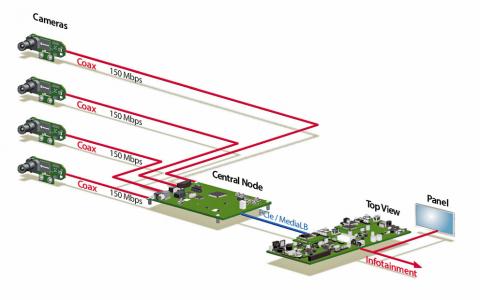
The Most Cooperation – the standardisation organisation for the automotive multimedia network Media Oriented Systems Transport (Most) – is showcasing a Most 150 based advanced driver assist system (adas) network that transmits HD video streams from up to eight cameras, using up to 1.2Gbit/s total bandwidth.
The surround view cameras are connected to a central node in a star topology over coaxial cable. The multi-channel network approach of Most, with its inherent synchronicity, is adapted for adas since it assures: hard real-time determinism and latency at 10ms; flexible topology; high bandwidth; safety aspects; and robustness and maturity.
The 360˚ automotive top view system uses small-footprint high dynamic range cameras. The cameras are based on two chips and, with the remote control feature, no microcontroller is required.
A multiport network interface controller in the central node allocates the true, full bandwidth to every branch. The different branches can then be built with any topology, including star, ring, tree or daisy-chain, and can be hot-plugged or disconnected without influencing the flow of streaming data in the rest of the system.
Sending a video stream from the camera to the renderer means that a significant amount of data is streamed for a prolonged period of time. Especially with adas, the continuously flowing stream of data cannot be interrupted or delayed.
Most provides the transport of data streams with guaranteed bandwidth and latency that the multiplex architecture inherently offers. It does not require either additional communications processors and addressing information, or the bandwidth-wasting process of breaking up the data into packets that then need to be examined every time they go through a device along the route. Complying with safety protocols, Most delivers video streams with low latency and determinism throughout the system.
Using coaxial cable, Most provides a scalable electrical physical layer for the adas automotive domain, as it allows for bidirectional communications and power supply across the same cable. Coaxial cabling is the industry standard cable for transport of high frequency signals. It has inherent shielding and provides low-cost and standard cables and connectors. Its construction enables an automated connector assembly, allowing lower assembly costs than shielded twisted pairs (STP) of copper wires.
Depending on bandwidth and cable and connector quality, it provides low reflections at up to 100m distance. The coaxial standard already works up to several gigabits per second and thus delivers an EMC-proof and low-cost electrical physical layer.
