Plessey and Segula embed heart-rate monitor in car seat at Paris Motor Show
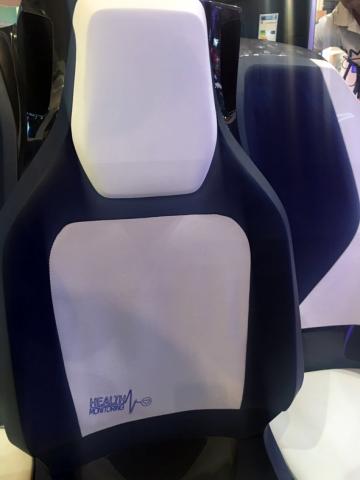
Plessey and Segula Technologies are exhibiting a heart-rate based driver alertness monitoring system at this year’s Paris Motor Show. The sensors are integrated into the seatback, and are said to provide earlier warning of drowsiness or health issues than systems based on eye or head movement.
The two companies are demonstrating the seatback wellbeing system in a full size automotive model on Segula’s stand. It is based on the patented Plessey Epic non-contact, capacitive, seatback heart rate sensing technology. This is the first public showing of the Epic seatback system.
“Plessey's award winning Epic sensor technology has been creating considerable interest with car manufacturers as it can be used to provide low-cost, reliable detection systems for several automotive applications,” said Alan Colman, commercial operations director at Plessey. “We are very excited to be bringing our innovative technology to market and showcase this for the first time to the press and public on the Segula Technologies stand.”
Epic sensing technology detects changes in electric potential. The seatback system senses the electrical impulses of the heart without direct skin contact and can return an accurate R peak signal from the users ECG, which can be used to calculate HRV, or heart rate variability. The sensor electrodes can be easily and discretely incorporated inside the seatbacks to access the necessary biometric signals. This is the first step on the road to a non-contact drowsiness detection system.
“This year at the Paris Motor Show, we are presenting Hagora Pulse, a bundle of technology in a single concept car, focusing on connected driving and health,” said Franck Vigot, CEO of Segula’s automotive department. “Among all the innovations of the next generation of e-sense, the application that lets you take control of the vehicle’s dashboard, we selected Plessey’s award winning Epic sensor technology. Integrated in the cabin of the vehicle, it monitors vital signs for a swifter emergency service response.”
Product demonstrations presented by technical and design experts, providing an opportunity to gain a deeper understanding of the technology will be held during the show.
Epic has uses in the medical, automotive and industrial arenas. Plessey’s ImPulse capacitive lead one ECG sensing system is helping with the identification of atrial fibrillation in both primary and secondary care in the UK. ImPulse is a class II CE marked medical product and has been shortlisted as a finalist at the Elektra Awards and in the healthcare technologies category of the IET Innovation Awards by the Institute of Engineering & Technology.
