Test & Measurement: Time to clean up the clutter
Matthias Karcher from K2L proposes a simple concept for better testing and validating of distributed electronic systems in vehicles
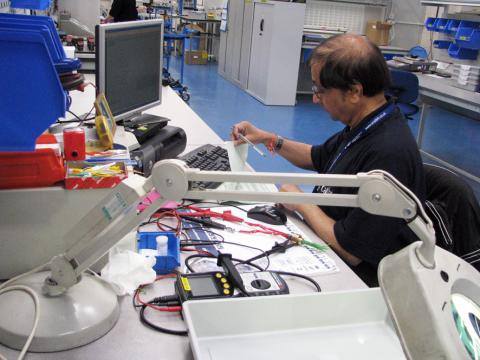
A look into the test, verification and system integration labs of all vehicle manufacturers and their suppliers leaves the same impression the world over – measuring equipment, PCs and test units everywhere. Overcrowded rooms full with test devices and electronics for automated tests put vehicle systems or subsystems through their paces around the clock.
Although often well organised, it is hard to believe that in such a mess system faults, faulty electronics and software bugs can be detected reliably to eliminate them in production vehicles.
The complexity of electrical and electronic systems in vehicles is growing steadily to include built-in electrical and electronic devices and the communications systems they are based on. In the meantime, there are cars with up to 100 different microcomputers and each with their own performance levels. These include the whole range of microprocessors and microcontrollers – from 8 to 32bit, single core to quad core, with or without rtos, and with interfaces of all kinds.
Additionally, all these devices have to communicate with each other to represent properly and reliably all the different functions in a car, from a simple window opener to a high-end multimedia system. Communications networks such as Lin, Can, Can-FD, Flexray, Most and Ethernet are indispensable in today’s architectures. In the near future, even more networks will be implemented including A2B, Automotive Ethernet, CXPI, Sent and PSI5.
It is easy to imagine that this trend combined with the desire for a more comprehensive user experience will increase the complexity of electrical and electronics systems in cars not linearly but rather exponentially.
To make things worse, in recent years development cycles for cars have become increasingly shorter to keep up with the technological advance of consumer electronics. A decade ago a complete vehicle platform was developed within six years. The engineers, designers and planners of today have a time window of only four years maximum. This is of course coupled with a much larger and more extensive range of models and model initiatives, which means more cars are developed and marketed in parallel.
The product development process or the time to market is shorter despite increased complexity – of course at even lower cost and with the same if not better quality of the final product.
This is not a simple nor a trivial task. The time to adjust to this issue and to come to terms with it was short. Often, the development process was the focus and was then optimised and shortened by different techniques such as scrum and agile development.
But what happens with the hedging, test and validation of systems and devices? Some may disagree, because today there are a lot of techniques in this field, including automation, x-in-the-loop technology and so on. However, the focus lies primarily, if not totally, on the test software.
The hardware or the measuring equipment has improved only slightly and could hardly keep pace with the systems to be tested. A frequently observed phenomenon is that existing test equipment will be enhanced with new technology, that is a new bus system although the test equipment itself is infrequently renewed.
This has led to situations in which test laboratories turn into chaos. Large amounts of test devices, interface adapters and measuring units then build a test and measurement mountain confronting the engineers. Only absolute experts will cope with this task.
Well, it is certainly understandable that this problem will increase if further bus systems and greater complexity add to this in future. The chaos and confusion will become even more over time unless a clean-up happens. After that, it holds back for a while until the next clean-up is due and perhaps some devices have to be disposed of every so often. It is an iterative and never-ending process, but it helps to have further development and increasing complexity under control.
Integration
This still relatively simple principle should be applicable to test labs. A regular clean-up and disposing helps a lot, however, higher integration on top of that helps even more. What does that mean for test devices and systems? It is quite simple. Take the basic systems and all extensions that have accumulated over the time and put them in a new expanded core system. Suddenly, the lab will be cleaned up leaving space for future extensions.
It is certainly understandable that such a clean-up has quite a positive and significant effect on other issues and parameters too. A tidy lab reduces the complexity of the test laboratories and thus the error susceptibility of tests and test equipment. Within a short period of time, quality can be realised for devices and systems.
Whether this is feasible at lower cost depends on the system and business models of the test system provider. Discussions with those affected clearly show that there are many cases in which massive cost savings can be achieved by investing in higher integrated test systems. In that way the increased cost pressure can be taken into account.
To clean up a test labs for distributed electrical and electronics communications systems in the automotive area, reduce complexity in the lab and exploit cost savings, there are certainly several starting points. One very obvious approach would be a hardware interface with a high integration of communications networks. This interface would clean up the lab because previously a single device was present for every network. Such devices unite a large amount of automotive communications networks in a single product and thus reduce the complexity of test systems as well as the chaos in test laboratories.
Suddenly, with only one step there is more space and a better overview of the test system, along with fewer connections, power supplies and wiring effort. The important synchronous time stamp for all messages, events and signals on all networks will be maintained. Looking at the costs, a lot of money can be saved with such a system – both direct and indirect. Direct costs relate to the purchase costs because instead of several test devices only one device is needed, which is usually cheaper than the sum of individual devices. Indirect costs will be less because the complexity of the test systems decreases as well as the test time.
The reason for this is the scaling of the test software to support all bus systems continuously. The configuration and test execution effort is reduced massively. All in all, a very good way to handle increasing complexity, reduce costs, achieve a faster time to market and increase quality. A clean-up is always worthwhile.
Matthias Karcher is senior manager for K2L
