Digital signage revenue accounts for half of bus company income
Columbia is leading the way as Advantech’s biggest customer for its in-vehicle bus computers, with some 10,000 out of the more than 20,000 installed worldwide; and advertising revenue from digital signage is the big attraction.
According to Advantech senior manager Van Lin at November’s Advantech 2013 World Partner Conference (WPC) in Suzhou, China, the systems have been installed in buses in 30 cities worldwide. Other major countries apart from Columbia include Australia, Brazil, India and Peru.
Though the Trek-668 computers can combine functions such as telematics, surveillance, fleet management, infotainment, GPS and in-vehicle Wifi, the biggest financial benefit for bus operators is the digital signage ability, which lets them attract added revenue from advertising.
“Many bus companies want to increase their income,” said Lin, “so in-vehicle signage is very important to them. Some bus companies have almost 50% of their revenue from signage advertisements.”
The system can also provide feedback to advertisers by analysing the eye movements of passengers to see how often they look at each advert. This can be linked with a mobile app that passengers can download to get more information on a particular advertiser or special offers from an advertiser.
The computers can be used as part of an intelligent transport system providing, for example, information in advance to bus stops so passengers know how long they will have to wait for the bus to arrive. This data can also be sent to mobile phone apps so passengers can track bus positions.
“And intelligent video analysis will help drivers check they are in the lane and the distance of the vehicle in front of them,” said Lin. “This is just based on the video information and software.”
The computers can handle voice recognition software so drivers can find deep menu items without taking their eyes off the road.
Other benefits include tyre pressure monitoring, real-time rear-view camera monitoring, real-time billing and invoicing, real-time information delivered to the driver and central office, and proactive vehicle diagnostics.
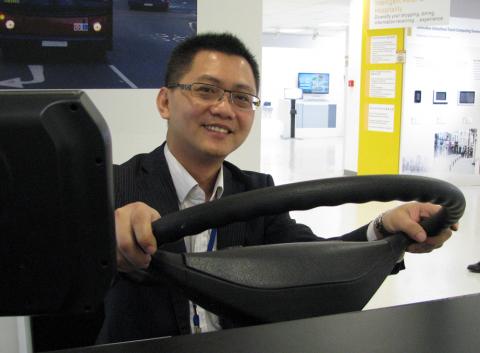
The Trek-668 in-vehicle surveillance and fleet management computer on display in a mock-up vehicle at the WPC can operate from -30 to +60˚C and its IO includes Can bus, RS232, RS485, J1708 and USB. It can take a four, eight or 12-channel analogue video input. Built-in wireless communications include GPRS, HSDPA, CDMA, wireless lan and Bluetooth.
Also on show was the Trek-306DH in-vehicle smart display with a 26.6cm 4:3 TFT LCD with five-wire analogue resistive touchscreen. There are five user-programmable function keys and two 2W waterproof speakers. And a built-in light sensor provides auto-dimming. It can operate from -30 to +70˚C.
